
| Key Takeaways Design Constraints: Designing a custom foam case insert well requires understanding compression limits and manufacturing constraints upfront, not just cutting a drawing into foam. The wrong approach can undermine fit, function, and finish even when the outline looks correct. Material Selection: Pelican-style custom foam (pick-and-pluck or CNC-cut interiors found in classic hard, gasket-sealed cases) is only one of several foam approaches. The right choice depends on production volume, budget, and how precisely the foam needs to match the equipment. Biocompatibility: This is the ability of a material to interact with biological systems without causing harmful effects. It is a critical requirement whenever a case’s foam or interior surfaces may come into direct contact with tissue, body fluids, or a medical device that itself contacts a patient. Market Growth: The global medical device packaging market was valued at $35.5 billion in 2025 and is projected to reach $72.4 billion by 2036, a compound annual growth rate (CAGR) of 6.6% according to Meticulous Research. This underscores how much regulatory and design attention this category commands. |
What actually goes into designing a custom foam case insert?
Designing a genuinely good custom foam case starts well before any cutting happens. A custom foam insert looks simple from the outside, a cavity cut to match a product’s shape, but getting it right involves real engineering tradeoffs that aren’t obvious from a drawing alone. Shell-Case’s guidance on custom case foam design makes this point directly: understanding compression limits and navigating CNC manufacturing constraints requires deep technical experience, and a good foam manufacturer doesn’t just take a drawing and cut it, they think critically about the function, fit, and finish of every insert produced. That distinction matters whether the production run is 20 units or 20,000, since aligning material choice, production method, and budget from the start is what makes a custom foam project successful rather than requiring costly rework later.
What should you know before ordering Pelican-style custom foam?
Understanding pelican case custom foam options is the natural next step. Classic hard, gasket-sealed cases (the kind people often generically call “Pelican cases,” after the brand best known for them) commonly use one of two foam approaches: pick-and-pluck foam, made of pre-scored cubes that a user manually removes to create a custom cavity, or precision CNC-cut foam, machined to an exact digital pattern. Pick-and-pluck offers flexibility and lower upfront cost, useful when the exact contents might change over time, while CNC-cut foam delivers a tighter, more repeatable fit better suited to fixed equipment configurations and higher-volume production.
| Foam approach | Best suited for |
|---|---|
| Pick-and-pluck foam | Lower volumes, flexible or changing contents, lower upfront tooling cost. |
| CNC-cut foam | Fixed equipment configurations, tighter tolerances, mid-to-high production volumes. |
| Molded PU foam | Soft, snug-fit interiors that also support sterilization in medical applications. |
| Custom foam insert (fully engineered) | Complex, multi-component kits needing precise compartmentalization and branding integration. |
What is biocompatibility, and why does it matter for a case’s interior?
Biocompatibility refers to the ability of a material to interact with biological systems without causing harmful effects, and it becomes critical whenever a product, or the case protecting it, may come into direct contact with tissue or body fluids. Shell-Case’s glossary definition is precise about the stakes: a biocompatible material must not trigger an immune response, cause toxicity, or lead to allergic reactions, and biocompatibility standards exist specifically to ensure materials are safe for either long-term or short-term interaction with the human body, minimizing risk to patients during medical procedures or treatment.
That concern extends beyond implants and devices that touch the body directly. Shell-Case’s own deeper analysis of biocompatibility in wearable medical devices explains that using non-biocompatible materials in medical device cases can create real risk and complications: when non-compliant materials come into contact with the human body, they can trigger a host response resulting in inflammation, allergies, or even systemic toxicity. Testing methods defined under ISO 10993, including cytotoxicity, sensitization, and hemocompatibility or skin irritation testing, give manufacturers a structured way to evaluate whether a given material actually meets that bar before it ships.
How does biocompatibility connect to broader medical device case compliance?
Biocompatibility is one requirement among several a medical device case has to satisfy simultaneously, and treating it in isolation misses how these standards interact in practice. Shell-Case’s overview of medical device case compliance lists the critical factors together: ISO 13485 certification to ensure the case is designed to protect medical equipment effectively, FDA-approved materials that are non-toxic, non-reactive, and sterilizable, Ingress Protection ratings appropriate to the device’s exposure risk, and biocompatibility itself where the case or its foam may contact the body. Failing to meet any one of these standards can jeopardize patient safety and create costly regulatory setbacks, which is why case design for regulated medical devices benefits from specialist experience rather than treating it as an afterthought bolted onto a finished product.
How large is the market shaped by these compliance requirements?
The scale of regulatory attention on medical device packaging reflects a large and steadily growing industry. Meticulous Research’s medical device packaging market analysis values the global market at $35.5 billion in 2025, projected to reach $72.4 billion by 2036, a compound annual growth rate of 6.6%, driven by intensifying focus on sterile integrity and the rapid expansion of home healthcare and minimally invasive surgery, both of which increase how often medical devices travel outside a controlled clinical setting and therefore how much their carrying cases actually matter.
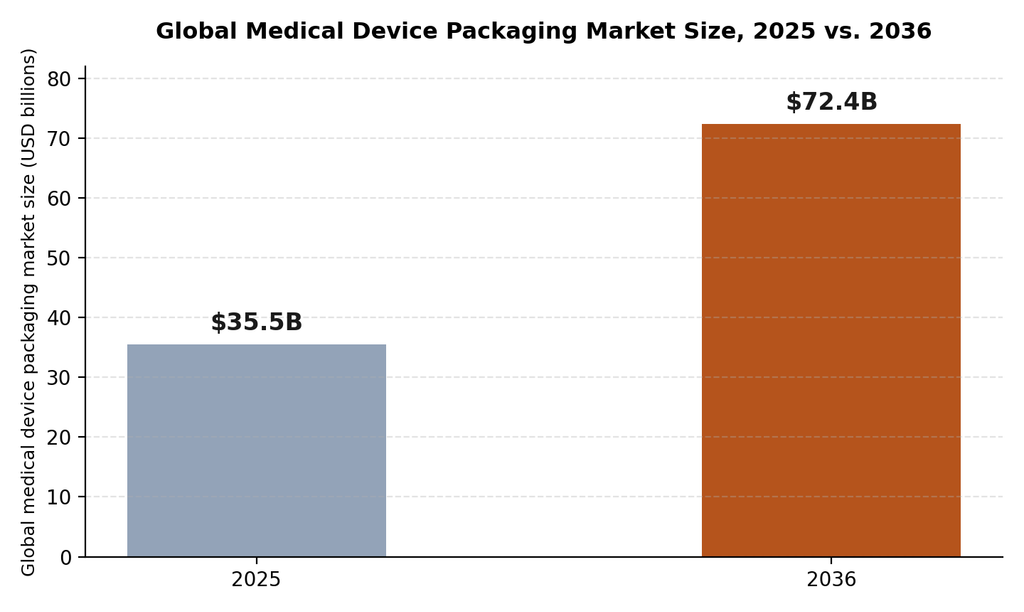
Global medical device packaging market size, 2025 versus 2036, according to Meticulous Research.
What should you ask before finalizing a custom foam and biocompatibility spec?
- Does the case’s foam contact the device directly, or only its outer packaging? This determines whether biocompatibility testing is actually required for the foam itself.
- What production volume justifies CNC tooling versus pick-and-pluck flexibility? Getting this wrong either overspends on tooling or underspends on fit precision.
- Does the case need to support sterilization between uses? This affects both foam material choice and how the case’s interior surfaces are finished.
- Which regulatory standards apply beyond biocompatibility? REACH, RoHS, and CAL65 often apply alongside biocompatibility for medical and electronic device cases.
What do REACH, RoHS, and CAL65 actually add on top of biocompatibility?
Biocompatibility answers one specific question, whether a material is safe for direct contact with the body, but it doesn’t cover every regulatory concern a medical or electronic device case has to satisfy. REACH restricts a broad list of substances of concern in products sold into the European market, regardless of whether those substances ever touch skin. RoHS restricts hazardous substances specifically in electronic and electrical equipment, relevant whenever a case’s components include wiring, connectors, or embedded electronics. CAL65, California’s Proposition 65, requires clear warning when a product contains certain chemicals known to the state to cause cancer or reproductive harm, and applies broadly across consumer and medical products sold into that market. A case manufacturer working across regulated industries needs fluency in all of these standards together, since a material that clears biocompatibility testing can still fail a REACH or RoHS review if it wasn’t evaluated against those separate lists from the start.
Why does specialist experience matter more for regulated case design than for general carrying cases?
A case protecting a consumer electronics accessory and a case protecting an implantable-adjacent medical device face very different consequences if something goes wrong. Getting a material or compliance detail wrong on a general equipment case might mean a warranty claim; getting it wrong on a medical device case can mean a failed regulatory submission, a delayed product launch, or in the worst case, a genuine patient safety issue. That asymmetry is why case manufacturers serving regulated medical and electronics industries typically maintain their own quality certifications, like ISO 13485, and build institutional experience navigating overlapping standards, rather than treating each project’s compliance requirements as a one-off research exercise handled from scratch.
Frequently Asked Questions
Is all foam used in custom cases biocompatible by default?
No. Biocompatibility is a specific material property that has to be verified through testing methods defined under standards like ISO 10993, not something to assume based on a foam’s general appearance or common use in other cases.
What’s the difference between pick-and-pluck and CNC-cut custom foam?
Pick-and-pluck foam uses pre-scored cubes a user manually removes to shape a cavity, offering flexibility at lower upfront cost. CNC-cut foam is machined to an exact digital pattern, delivering a tighter, more repeatable fit that suits fixed equipment configurations and higher production volumes.
Do all medical device cases need biocompatible materials?
Not necessarily. Biocompatibility specifically matters when the case’s materials, most often the interior foam, may come into direct contact with a patient’s tissue or body fluids, or with a device that itself contacts the patient. Cases that only enclose and transport a device without that direct contact may not require the same standard.
How does biocompatibility relate to other compliance standards like ISO 13485?
ISO 13485 certifies a company’s quality management system for medical device manufacturing broadly, while biocompatibility is a specific material property verified through its own testing standards. A case manufacturer can hold ISO 13485 certification while still needing to separately confirm biocompatibility for any material contacting the body.
