
| Key Takeaways • An importer of record (IOR) is the legal entity that takes formal responsibility for customs clearance, permits, and duties when goods cross a border, standing in as the consignee on shipping documents. • In the U.S., Canada, and Mexico under USMCA, any individual or company can act as importer of record, while CIS countries require the IOR to be a local legal entity whose registered specialty matches the imported goods. • The U.S. Export Administration Regulations (EAR) extend beyond finished exports to cover reexports, dual-use items, and certain technology disclosures to foreign nationals, which is why tech hardware shipments often carry export-control obligations alongside import-side customs duties. • The World Customs Organization’s Time Release Study, now in its fourth version, has been used for more than 25 years to measure the time between a shipment’s arrival and its physical release from customs. |
What does an importer of record actually do in a tech hardware shipment?
An importer of record (IOR) is the legal entity that takes formal responsibility for a shipment’s customs clearance, import duties, and compliance paperwork, standing in as the consignee of record with the destination country’s customs authority. For a tech hardware shipment, that role typically covers preparing the documentation package, securing import permits and arrival notices, obtaining any conformity marks or industrial certifications the equipment needs, calculating and paying duties and taxes, and coordinating the freight forwarding and warehousing that gets the goods to their final destination. a detailed breakdown of how IOR responsibility transfers during a shipment walks through each of those steps in sequence.
Why do IT and telecom shipments carry extra compliance requirements beyond standard customs?
IT, telecom, and broadcasting equipment often falls under export-control frameworks in addition to ordinary customs rules, because many of these products qualify as dual-use items with both civilian and restricted applications. Under the U.S. Export Administration Regulations (EAR), that jurisdiction is broad: it covers not just first-time exports but reexports of previously exported items, transfers involving foreign-made products that contain U.S.-origin content, and even certain technology disclosures to foreign nationals inside the United States. the EAR’s own definition of that scope, in Part 730 is worth reading before assuming a shipment is a simple import-side transaction.
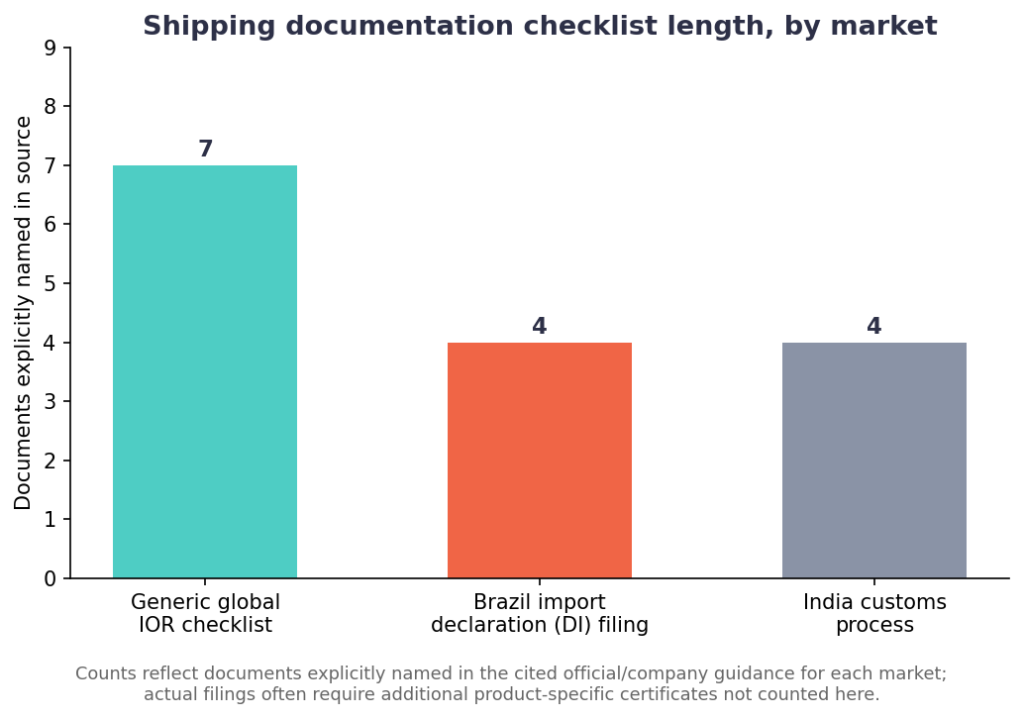
Documents explicitly named across a generic global IOR checklist and two country-specific customs processes. Counts reflect what each source names explicitly; actual filings can require additional product-specific certificates.
How does IOR responsibility differ from country to country?
The rules for who can serve as an IOR vary sharply by jurisdiction. In the United States, Canada, and Mexico under USMCA, virtually any individual or company can act as importer of record, but CIS countries generally require the IOR to be a locally registered legal entity whose declared business specialty matches the type of goods being imported, and EU requirements shift again by member state. That patchwork is exactly why cross-border logistics built specifically for IT and tech hardware tends to route each shipment through country-specific compliance checks rather than a single blanket process.
What paperwork does an IOR actually prepare?
A typical IOR documentation package includes a commercial invoice, packing list, bill of lading or airway bill, certificate of origin, the relevant import permits, any required product certifications, and a power of attorney authorizing the IOR to act on the shipper’s behalf. Different markets ask for different subsets of that list, and used or refurbished IT, telecom, and broadcasting equipment usually needs more documentation than new goods, including proof of functionality and certificates of reconditioning.
How is customs clearance speed actually measured, and why does it vary?
Customs authorities benchmark clearance speed using the time between a shipment’s arrival and its physical release, a methodology formalized by the World Customs Organization’s Time Release Study. the WCO’s own guide to that methodology notes it has been refined for more than 25 years and is now referenced directly in Article 7.6 of the WTO Trade Facilitation Agreement, which is part of why clearance speed can differ so much between countries that have adopted it fully and those still building the underlying digital infrastructure.
What happens after goods clear customs — is the IOR’s job done?
Clearance is rarely the end of the relationship for tech hardware. Equipment that fails in the field, needs recall, or requires an upgrade swap has to move back across the same borders it entered through, which is why post-clearance RMA and SLA support bundled into a global IOR program matters as much as the initial import: a provider that only handles the inbound leg leaves the reverse-logistics problem for someone else to solve later.
Frequently Asked Questions
What is an importer of record?
An importer of record (IOR) is the legal entity that takes formal responsibility for a shipment’s customs clearance, import duties, and compliance documentation, acting as the consignee of record with the destination country’s customs authority.
Can any company act as its own importer of record?
It depends on the country: in the U.S., Canada, and Mexico virtually any individual or company can serve as IOR, but many other countries, including the CIS states, require the IOR to be a locally registered legal entity with a business specialty matching the imported goods.
Is an importer of record the same as a customs broker?
No, a customs broker files paperwork on an importer’s behalf, while an importer of record holds the legal and financial responsibility for the shipment, including duties, taxes, and ongoing compliance liability.
Do IT and telecom shipments need export-control clearance in addition to import clearance?
Often yes, because many IT, telecom, and dual-use technology products fall under export-control frameworks such as the U.S. Export Administration Regulations, which can apply even to routine equipment reexports and cross-border transfers.
