
What actually separates a custom carrying case from an off-the-shelf one?
The core tradeoff is precision versus speed and cost. Shell-Case’s comparison of custom versus off-the-shelf carrying cases frames it clearly: custom carrying cases are tailored to the specific dimensions and requirements of a piece of gear, ensuring a perfect fit and maximum protection, with personalized features like custom foam inserts and precise compartmentalization. Off-the-shelf options are well suited to general use, but specialized or sensitive equipment, the kind that can’t tolerate a loose, generic fit, typically benefits from the tailored protection a custom solution provides instead.
| Factor | Custom carrying case | Off-the-shelf carrying case |
|---|---|---|
| Fit | Precisely matched to the product’s exact dimensions | Generic sizing, may leave gaps or require padding workarounds |
| Production volume | Better suited to mid-to-large production runs | Available immediately regardless of volume |
| Material flexibility | Wide range of technologies and finishes available | Limited to what the manufacturer already stocks |
| Budget profile | Higher upfront design cost, better long-term fit | Lower upfront cost, less optimized long-term |
Why does an equipment case need to be considered early in product development?
For electronics and medical devices specifically, case design isn’t a final packaging decision, it’s part of how the product actually functions in the field. Shell-Case’s work with electronic equipment manufacturers reflects this directly: modern electronics, with their advanced components and delicate sensors, demand a thoughtful, integrated approach to case design, and integrating that case process at the earliest stage of product development is vital for ensuring both functionality and optimal user experience. Waiting until a product is finalized to think about its case often means working around constraints that could have been avoided entirely with earlier input, like connector placement, ventilation needs, or how a technician will actually access the device in the field.
How big is demand for protective equipment cases becoming?
The category as a whole keeps expanding steadily rather than explosively, reflecting its role as essential infrastructure across many mature industries rather than a fast-emerging trend. Lucintel’s protective case market research values the global protective case market at approximately $3.3 billion in 2024, projected to reach $4.3 billion by 2030, a compound annual growth rate of 4.4%, with demand spanning photography and music equipment, military equipment, measuring and communication devices, medical and fire safety gear, automotive applications, and consumer electronics.
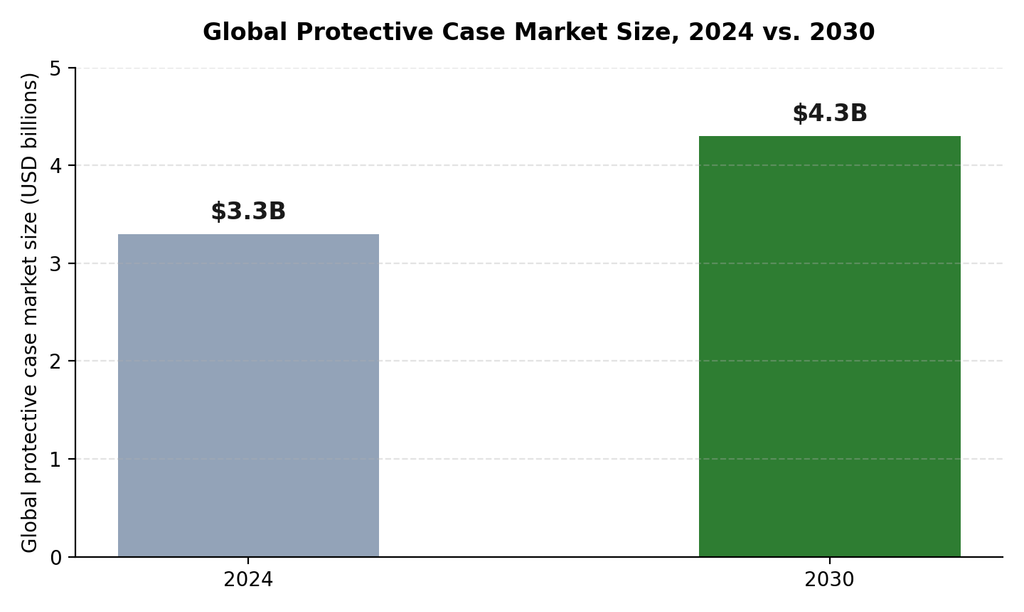
Global protective case market size, 2024 versus 2030, according to Lucintel.
When does a wheeled hard case actually earn its extra size and weight?
Wheels and a telescoping handle add cost, weight, and bulk to a case, so they’re worth including only once carrying by handle alone stops being practical. That threshold usually arrives once a case’s internal volume or loaded weight starts approaching what a person can comfortably carry across an airport terminal or a job site, particularly for repeated trips rather than a single one-off transport.
Shell-Case’s wheeled hard case line is built around exactly this use case: a lightweight, ultra-durable wheeled carrying case offering a wide range of semi-customized options, including interchangeable modular dividers, precut foam, or a fully custom foam insert. That combination, wheels for mobility plus configurable interior protection, is what makes a wheeled hard case practical for equipment that’s both heavy and sensitive, rather than forcing a choice between the two.
What should you actually weigh when choosing between case types?
- How often will it travel? Frequent transport favors durability and wheels; occasional use may not justify the added cost.
- How fragile is the contents? Delicate electronics or calibrated instruments justify more precise, custom-fitted interior protection.
- What’s the realistic production volume? Custom tooling costs amortize better across larger production runs than one-off or very small batches.
- Does it need to meet airline carry-on dimensions? Some wheeled case lines are specifically sized to comply with most airline carry-on requirements, which is worth confirming before committing to a size.
What role does branding and presentation play in an equipment case?
A carrying case is often the first physical impression a customer, technician, or end user has of a piece of equipment, and that presentation role matters more than it might initially seem. A case that looks generic or mismatched to a premium product can undercut the perceived value of what’s inside it, while a well-branded, thoughtfully finished case reinforces the quality of the product it protects. This is especially relevant for equipment that gets unboxed in front of a client or end customer, such as diagnostic devices demonstrated in a clinical setting or high-end electronics delivered to a business customer, where the case itself becomes part of the product experience rather than just its packaging.
What does a semi-customized case line actually offer over a fully bespoke one?
Between a fully custom case built from scratch and a purely off-the-shelf option sits a middle tier worth understanding: semi-customized case platforms that offer interchangeable modular dividers, precut foam options, or the ability to swap in a custom foam insert without redesigning the entire case shell. This approach lets a manufacturer standardize on a proven shell design, with its already-validated durability and dimensions, while still tailoring the interior precisely to a specific product. For many equipment manufacturers, this middle path delivers most of the fit benefits of a fully custom case at a meaningfully lower tooling cost and shorter lead time.
Frequently Asked Questions
Is a custom carrying case always more expensive than an off-the-shelf one?
Upfront design and tooling costs are typically higher for custom cases, but the total cost of ownership can actually favor custom solutions at scale, since a well-fitted case reduces damage, returns, and the need for aftermarket padding fixes over the product’s life.
How early should equipment case design start relative to product development?
As early as possible. Integrating case design during product development, rather than after the product is finalized, lets case designers influence decisions like connector placement and access points that are much harder to accommodate after the fact.
Do wheeled hard cases work for air travel?
Many wheeled hard case lines are designed with airline carry-on or checked-baggage dimensions in mind, but this varies by model and by airline policy, so it’s worth confirming specific dimensions and weight limits before relying on a case for air travel.
What’s the difference between an equipment case and a general carrying case?
The terms overlap significantly, but “equipment case” often implies a case designed around a specific piece of technical, medical, or industrial gear with precise interior protection, while “carrying case” is a broader term that can include simpler, more general-purpose designs.
