
What are Israeli VC firms actually prioritizing when evaluating a VC startup?
Team quality consistently outweighs almost every other factor Israeli VC firms consider when evaluating an early-stage opportunity. Elron Ventures’ own description of its investment approach states this directly: when evaluating early-growth companies, the firm looks for strong teams capable of building major companies and founders who dream of changing the course of their industry. That emphasis reflects a broader pattern among Israeli VC firms generally: a technically impressive product without a founding team capable of executing against a real go-to-market strategy is a common reason promising technology never becomes a fundable company.
Which sectors are actually attracting the most VC startup funding in Israel right now?
Cybersecurity, enterprise software, and AI have consistently dominated Israeli VC investment, and that concentration has only intensified in recent years. Investments in cyber, enterprise software, and fintech together accounted for more than 60% of the capital raised by Israeli high-tech companies in 2025, with enterprise software specifically increasing its share of total capital. Generative AI and “CoreAI” companies, businesses where AI sits at the core of the product rather than simply using AI tools, have also become a dominant force in fundraising, attracting billions in capital during the first half of 2026 alone.
| Sector | Why Israeli VC firms are drawn to it |
|---|---|
| Cybersecurity | Israel’s deep bench of technical talent from military intelligence and cyber units feeds a steady pipeline of founding teams. |
| Enterprise software / SaaS | Proven B2B go-to-market playbooks and strong exit history give investors confidence in the category. |
| Deep tech and AI | Israel’s research base and engineering talent support genuinely novel technical differentiation. |
| Defense tech and dual-use | Growing investor interest in technology serving both defense and civilian markets simultaneously. |
How fast has capital raised by Israeli VC startups actually grown?
The scale of funding available to Israeli VC startups has rebounded sharply after a slower 2023 and 2024. The Israel Innovation Authority’s State of High-Tech 2026 report found that venture capital investments surged by 30% compared to 2024, with total capital raised by Israeli tech companies reaching approximately $14.6 billion in 2025, the highest annual figure recorded since the peak years of 2021 to 2022. That growth came alongside a rise in the number of newly established tech companies, roughly 775 new startups in 2025, after more than a decade of decline in new company formation, signaling renewed founder confidence despite ongoing regional uncertainty.
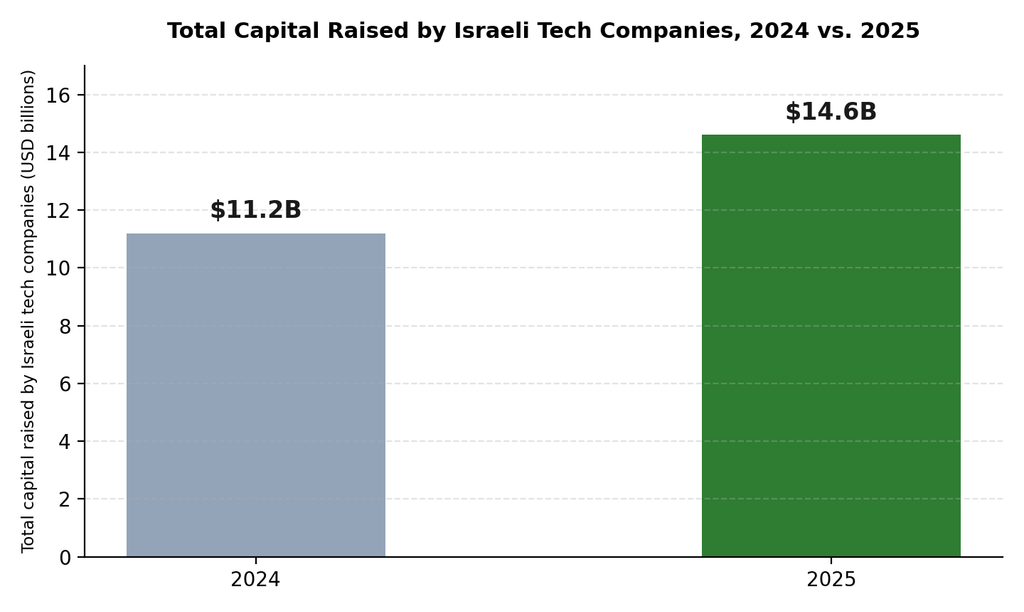
Total capital raised by Israeli tech companies, 2024 versus 2025, according to the Israel Innovation Authority.
Why is Elron’s dual-use M&A strategy relevant to VC startups specifically?
Beyond traditional early-stage equity investment, some Israeli VC firms are pursuing a distinct capital deployment strategy worth understanding. Elron Ventures’ partnership with Rafael illustrates this directly: an investment plan of up to $300 million focused on implementing an M&A strategy for early-stage dual-use technology companies serving both defense and civilian markets. For a VC startup building dual-use technology specifically, this represents a funding and exit pathway that looks meaningfully different from a traditional venture round, one where the strategic partnership itself, not just the capital, may shape how the company scales.
What should a founder actually prepare before approaching an Israeli VC firm?
- A clear articulation of team strength, not just the product, since Israeli early-growth investors weigh execution capability heavily.
- Evidence of initial traction, since early-growth investors typically expect some signal of product-market fit, not just a concept.
- A realistic view of comparable exits, understanding how similar Israeli companies in your category have been valued and acquired.
- Clarity on whether your technology has dual-use potential, given the growing interest in defense-and-civilian-market technology among some Israeli investors.
How does deal size actually shape which Israeli VC firms will engage with a startup?
Israeli VC funding has become increasingly concentrated in larger rounds even as the total number of deals has declined, a pattern that directly shapes which investors a given startup should actually target. Deals exceeding $100 million accounted for nearly half of total capital raised in recent years, a handful of very large rounds pulling in a disproportionate share of available funding, while the number of smaller rounds has continued to shrink. For an early-stage VC startup, this means the realistic path to funding increasingly runs through investors specifically focused on smaller check sizes and earlier stages, rather than assuming a fund known for writing large late-stage checks will engage meaningfully with a modest seed round.
What does unicorn activity actually signal about the broader Israeli VC startup landscape?
The pace at which Israeli companies reach unicorn status, a private valuation of $1 billion or more, offers a useful signal of investor confidence beyond the raw funding totals themselves. Seven new Israeli unicorns emerged in 2024, compared to four in 2023, and the 25 unicorns active that year collectively attracted $4.4 billion, double the amount raised by the 21 unicorns active in 2023. That acceleration reflects growing investor willingness to back Israeli companies at premium valuations, which in turn shapes founder expectations and comparable-company benchmarks across the broader Israeli VC startup ecosystem, not just at the unicorn tier itself.
Frequently Asked Questions
Do Israeli VC firms only invest in Israeli-founded startups?
Most established Israeli VC firms focus primarily on companies with Israeli founders, R&D teams, or origins, even if the company is incorporated elsewhere or has since expanded internationally, since the strategy typically leverages deep familiarity with the local talent and technology ecosystem.
What stage of company is most likely to attract Israeli VC startup funding?
Many established Israeli VC firms focus specifically on early-growth companies, those that have moved past initial concept validation and are demonstrating traction, rather than purely pre-seed or very late-stage growth equity.
Why has enterprise software attracted such a large share of Israeli VC capital?
Enterprise software benefits from proven B2B go-to-market playbooks and a strong history of successful exits from Israeli companies, which gives investors more confidence in the category’s ability to generate returns compared to less-proven sectors.
What is dual-use technology, and why are Israeli VC firms increasingly interested in it?
Dual-use technology serves both defense and civilian markets simultaneously. Israeli VC firms are increasingly drawn to it because it can access both defense procurement budgets and broader commercial markets, potentially widening a startup’s total addressable market and reducing its dependence on any single customer type.
