
Why does entering China, Malaysia, or Singapore require an IOR?
A company without a legal entity registered in China, Malaysia, or Singapore cannot import goods directly under its own name in most cases, which is exactly the gap an IOR fills. GetWay Global’s Asia region overview frames the opportunity these markets represent for IT and telecom hardware companies directly: China remains one of the most significant manufacturing, import, and export markets in the world for this equipment, while Singapore has become one of the most promising markets in Asia for both selling into the local market and using the country as a regional trading hub. In each case, an IOR provider steps in to handle customs clearance, import permits, and duty payment so that a company without local registration can still move equipment legally.
What makes IOR for IT equipment in Singapore particularly active right now?
IOR for IT equipment Singapore has become one of the busiest corners of this business. Singapore’s position as a regional hub, both for direct sales into the local market and as a distribution point for the wider Southeast Asian region, makes it one of the more active destinations for IT and telecom hardware imports in Asia. The city-state’s telecom market alone generated an estimated $3.2 billion in total revenue in a recent year, a figure that reflects sustained demand for networking equipment, telephone systems, and related hardware moving through Singaporean customs. For companies entering this market, the appeal is straightforward: focus on your equipment and software while an IOR partner assumes the logistics operations around permits, licenses, and customs clearance documentation.
What does IOR support for China actually cover beyond clearance?
IOR China support has to scale with the market itself. China’s scale as both a manufacturing base and an import destination for IT and telecom hardware means IOR support there typically needs to extend past a single clearance event. Companies moving equipment into China commonly need freight forwarding, distribution, and warehousing support alongside the core IOR function, since equipment that clears customs still has to reach its final destination, whether that’s a data center buildout, a distributor’s warehouse, or an end customer’s facility. A provider without freight and distribution capability in-market can leave a company with a cleared shipment stuck at a port with no clear next step.
| Market | What IOR support commonly includes |
|---|---|
| China | Customs clearance, import permits, freight forwarding, local distribution, and warehousing for IT and telecom hardware. |
| Malaysia | Import compliance for networking and data center equipment, supporting the country’s growing data center and digital infrastructure buildout. |
| Singapore | Customs clearance, permits and licensing support, last-mile delivery, RMA services, and reverse logistics for equipment entering or leaving the city-state. |
Why is Malaysia becoming a more active destination for IT hardware imports?
IOR Malaysia is following a similar trajectory, just a step behind. Malaysia’s growing role as a Southeast Asian data center and digital infrastructure hub has increased demand for IOR support alongside its more established manufacturing and electronics trade. As regional data center capacity expands into Malaysia, alongside Singapore and other Southeast Asian markets, the networking equipment, servers, and related hardware feeding that buildout have to clear customs and reach their destination facilities reliably. That combination, expanding digital infrastructure investment plus the compliance complexity of importing regulated IT hardware, is exactly the gap a dedicated IOR provider is built to close for companies entering the market without a local entity of their own.
How fast is the region’s underlying demand for this infrastructure actually growing?
The scale of data center investment across the region gives a sense of how much hardware is moving through customs to support it. MarketsandMarkets’ Asia Pacific data center colocation market analysis values the regional market at $29.57 billion in 2025, projected to reach $68.48 billion by 2030, a compound annual growth rate of 18.3%, outpacing the global colocation growth rate of 14.4%. China leads the region with the largest individual market, followed by Japan and India, but the buildout extends well beyond those three, with Singapore and Malaysia both playing significant roles as regional hubs for the equipment feeding this expansion.
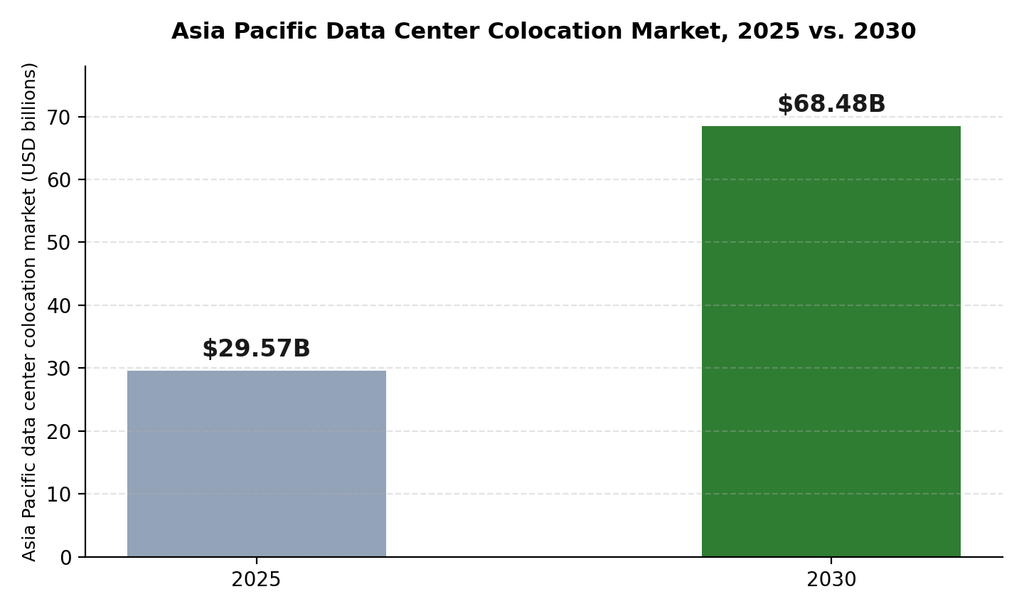
Asia Pacific data center colocation market size, 2025 versus 2030, according to MarketsandMarkets.
What should a company entering these markets check before its first shipment?
- Does the equipment need country-specific type approval or certification, which varies for networking, RF, and encryption-capable hardware across China, Malaysia, and Singapore?
- What happens after customs clearance? Confirm the provider’s actual distribution and warehousing capability, not just clearance, especially in China’s larger and more complex logistics landscape.
- Is post-sales and RMA support available locally, since equipment that needs repair or replacement will need to move through the same customs and compliance process again?
- Has the provider run a feasibility review for your specific product, rather than assuming general Asia experience covers every market’s distinct requirements equally?
How does a feasibility review actually help before entering a new Asian market?
Committing to a launch date before confirming a product’s actual import requirements is one of the more common, and more expensive, mistakes companies make expanding into Asia. A feasibility review, run by a provider’s own regional teams rather than a generic template, covers product classification, certification pathways, and duty modeling specific to the market in question, since the requirements for a given networking product in China rarely match the requirements for the same product in Malaysia or Singapore. Running that review before committing to a shipment date gives a company time to resolve certification gaps, budget accurately for duties, and confirm which entity, an IOR, an EOR, or both, the launch actually requires.
What does ongoing support look like after the first shipment clears?
A first successful shipment into China, Malaysia, or Singapore is rarely the end of the relationship with an IOR provider, since most technology companies operating in these markets need recurring import support rather than a single one-off clearance. Recurring shipments benefit from an established relationship with local customs authorities and pre-validated certification pathways, both of which shorten clearance times on subsequent imports compared to a first-time shipment. Companies scaling their presence in the region also typically need billing and collection support in local currency, ongoing RMA and reverse logistics capability, and warehousing that can flex with demand, rather than treating each shipment as an isolated transaction.
Frequently Asked Questions
Can I import IT equipment into China without a local entity?
Not directly under your own name in most cases. An IOR provider with a registered local entity in China can import on your behalf, handling customs clearance, permits, and duty payment so your company doesn’t need its own China-based legal entity to bring equipment into the market.
Why does Singapore need its own IOR strategy separate from the rest of Asia?
Singapore’s role as both a direct sales market and a regional distribution hub means IOR support there often needs to account for onward shipment to other Southeast Asian destinations, not just clearance and delivery within Singapore itself.
Is Malaysia’s IOR process similar to Singapore’s?
The two markets share some regional similarities, but each maintains its own specific import regulations, certification requirements, and customs procedures for IT and telecom hardware, so requirements should be confirmed for each market individually rather than assumed to transfer directly.
What’s the biggest mistake companies make entering Asian markets for the first time?
Assuming customs clearance is the finish line. Equipment that clears customs in China, Malaysia, or Singapore still needs to reach its final destination and, eventually, potentially move again for repair or replacement, which is why comprehensive IOR support typically includes distribution, warehousing, and RMA capability alongside the core import function.
