
What is MCP, and why does it matter for AI agents?
The Model Context Protocol (MCP) is an open standard that lets AI models and agents discover and use external tools, data sources, and workflows through a consistent interface, rather than requiring a custom integration for every single connection. Before MCP, connecting an AI agent to a new database, API, or internal tool typically meant writing bespoke integration code for that specific combination; MCP replaces that with a standardized way for an agent to discover what’s available and call it, similar in spirit to how a universal connector standardizes what used to require a different cable for every device.
How fast is MCP adoption actually moving?
Adoption has grown quickly since MCP’s release. The Model Context Protocol project’s own roadmap update reported that, across the protocol’s Tier 1 SDKs, downloads were approaching half a billion a month, with the TypeScript and Python SDKs together crossing one billion total downloads since the protocol’s release. That current monthly pace, measured against the entire cumulative total, gives a sense of how much of MCP’s overall adoption has happened recently rather than spread evenly since launch.
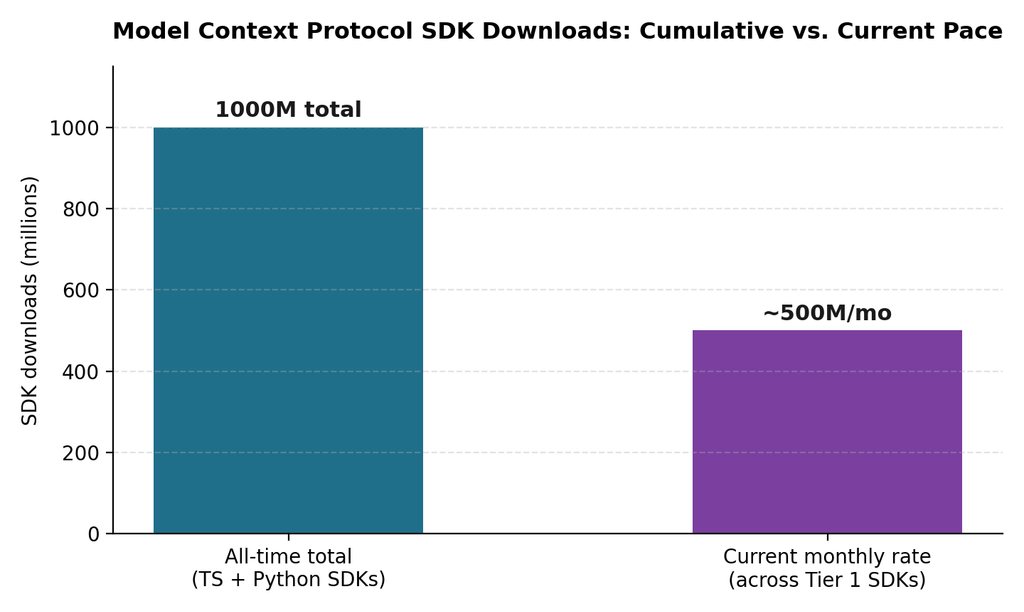
MCP TypeScript and Python SDK downloads: all-time cumulative total compared with the current monthly download rate across Tier 1 SDKs.
What does an MCP Gateway actually do?
An MCP Gateway sits in the path between an AI agent and the MCP servers it wants to use, acting as a single, governed entry point rather than letting every agent connect directly to every tool. Instead of an agent authenticating separately to each backend system it needs, the gateway centralizes that authentication and applies consistent policy across every connection that passes through it.
| Capability | What it addresses |
|---|---|
| Authentication & access control | Confirms which agent or user is making a request before any tool call is allowed to proceed. |
| Tool-level access control | Limits which specific tools an agent can see and call, rather than granting broad access to every tool a backend server exposes. |
| Audit logging | Records every tool call and its outcome, so an incident can be traced back to the exact request that caused it. |
| Policy enforcement | Applies organization-wide rules consistently across every MCP connection, instead of relying on each integration to enforce its own. |
What makes MCP security different from ordinary API security?
MCP introduces a few risks that don’t map cleanly onto traditional API security practices. An agent connecting to an MCP server is often granted broad access to every tool that server exposes by default, rather than the narrowly scoped permissions a well-designed API integration would normally enforce. Unofficial or unsanctioned MCP servers can also connect to enterprise data in ways that look, structurally, a lot like shadow AI: a tool nobody in security signed off on, quietly given access to real systems. And because an agent can chain multiple tool calls together autonomously, tracing exactly which call in that chain caused a given outcome is harder than tracing a single API request.
How does MCP security connect to agentic AI security overall?
MCP security is really a subset of a broader problem: keeping autonomous AI agents operating within their intended scope. Ovalix’s autonomous and agentic AI security platform approaches this by mapping agent decisions end to end, from the task an agent was given through every tool call and data access along the way, enforcing guardrails and compliance rules as the agent executes rather than only reviewing its actions afterward. A closely related capability for securing AI agents specifically focuses on controlling agentic behavior directly, observing every communication and decision an agent makes so that noncompliance, invalid actions, or attempts to exceed intended scope get caught quickly rather than discovered after the fact.
What should you check before trusting an MCP connection?
- Is the MCP server officially sanctioned, or did someone connect it without a security review?
- What tools does the agent actually need, versus what tools the server exposes by default?
- Is every tool call logged, with enough detail to trace an outcome back to a specific request?
- Does policy get enforced at the gateway, or does it depend on each individual integration behaving correctly on its own?
Frequently Asked Questions
Does every AI agent deployment need a dedicated MCP Gateway?
Not necessarily for a single, tightly scoped integration. But as the number of agents and MCP servers grows, a gateway becomes the practical way to apply consistent authentication, access control, and audit logging without configuring each connection separately.
Is MCP itself insecure?
MCP is a protocol, not a security product, so it doesn’t inherently include enterprise access controls or audit logging. MCP security is about the practices and infrastructure, like an MCP Gateway, layered around the protocol, not a flaw in the protocol itself.
How is an unofficial MCP server a form of shadow AI?
An unofficial MCP server connected to enterprise data without security review shares the same core problem as shadow AI generally: a system operating outside IT oversight, approval, or ongoing monitoring, just applied to a tool-connection rather than an application.
Can MCP security controls slow down how quickly agents can use new tools?
Well-designed controls add a review step, but the goal is governed speed rather than no speed. A gateway with clear policies can often onboard a new tool faster than an ad hoc, uncontrolled connection, precisely because the access rules are already defined.
