
| Key Takeaways Specialized Scrutiny: Telecom IOR (Importer of Record) services have to account for equipment that faces extra scrutiny most general cargo never sees, including type approvals, encryption clearances, and dual-use classification for hardware with both civilian and security-related applications. Strategic Warehousing: IOR services for data center equipment specifically increasingly combine customs clearance with compliance-ready warehousing. Bonded storage lets imported hardware sit until it’s actually needed without tying up capital in duty payments upfront. Brazil Import Regulations: Brazil requires companies without a local legal entity to use IOR services to import IT and telecom equipment, with compliance tied to INMETRO standards and typically high import duties and taxes that make professional handling essential. Market Growth: The Brazil data center market was valued at $3.98 billion in 2025 and is projected to reach $9.01 billion by 2034, a compound annual growth rate (CAGR) of 9.50% according to IMARC Group, reflecting sustained demand for the hardware imports feeding that growth. |
What makes telecom hardware different from general IOR shipments?
Telecom equipment routinely triggers regulatory scrutiny that ordinary commercial cargo simply doesn’t face. GetWay Global’s work across IT, telecom, data center, and broadcasting equipment reflects this directly: importing technology hardware into a new market means navigating each country’s specific requirements for electrical, radio-frequency, encryption, and other technical standards, on top of the usual customs process. Equipment with both civilian and military or surveillance applications gets extra scrutiny still, and misclassifying it is a common, costly mistake that a general-purpose IOR provider without telecom-specific experience is more likely to make.
How does IOR support connect to data center equipment specifically?
IOR services data center support has to account for timing, not just customs paperwork. Data center hardware, servers, networking equipment, and related infrastructure, often needs to move differently than a one-time commercial shipment, since it’s frequently imported ahead of actual deployment need. GetWay Global’s approach to IT equipment warehousing and distribution addresses this directly: a compliance-ready warehouse combines bonded storage, in-house IOR/EOR capability, and product certification knowledge, which a generic third-party logistics provider usually lacks in all three areas at once. Bonded storage specifically defers duty payment until goods actually move, which matters most for equipment held for on-demand deployment, reducing upfront cash outlay on inventory that hasn’t been sold, distributed, or re-exported yet.
| Capability | Why it matters for data center hardware |
|---|---|
| Bonded storage | Defers duty payment until goods actually move, avoiding capital tied up in inventory sitting on a shelf. |
| In-house IOR/EOR capability | Keeps customs compliance and warehousing under one accountable provider rather than a separate customs vendor. |
| Product certification knowledge | Ensures networking and server hardware clears the right regulatory pathway the first time. |
| Regional hub placement | Positions inventory close to where deployment actually happens, rather than shipping every unit from a single distant origin. |
Why is Brazil specifically demanding for IT equipment imports?
Brazil IT equipment import rules add a distinct layer of complexity on top of the basics. Brazil, the largest economy in South America, is also one of the more active destinations for importing tech hardware, thanks to its expanding colocation facilities and broader tech industry. GetWay Global’s guide to import and export services in Brazil is direct about the compliance burden this creates: companies importing networking devices and specialized telecom hardware into Brazil must ensure compliance with INMETRO standards and other regulatory bodies, while also being prepared to pay high import duties and taxes. IOR services ensure the shipment is handled professionally, with minimal risk of delays or penalties, an especially important consideration given how variable Brazil’s documentation requirements can be depending on the specific category of goods involved.
What role does an EOR play for equipment leaving Brazil?
Import isn’t the only direction that matters for companies operating in Brazil. Exporter of Record (EOR) services facilitate the export of goods from Brazil, ensuring all necessary documentation and legal requirements are met, handling everything from customs declarations to tax compliance. For data center equipment specifically, this matters for reverse logistics scenarios: hardware returning to headquarters for repair, being redeployed to another regional facility, or being decommissioned all require the same level of export compliance attention that the original import required, just running in the opposite direction.
How large is the market driving demand for this hardware in Brazil?
Brazil’s data center sector has grown into one of the most significant in Latin America, and the pace of that growth shapes how much IT and telecom hardware needs to move through Brazilian customs each year. IMARC Group’s Brazil data center market analysis values the market at $3.98 billion in 2025, projected to reach $9.01 billion by 2034, a compound annual growth rate of 9.50%, driven by surging cloud adoption among Brazilian enterprises, rapid fintech and e-commerce expansion, and accelerated hyperscaler investment from major cloud providers. That growth curve translates directly into sustained demand for the servers, networking devices, and telecom hardware that IOR services help bring into the country.
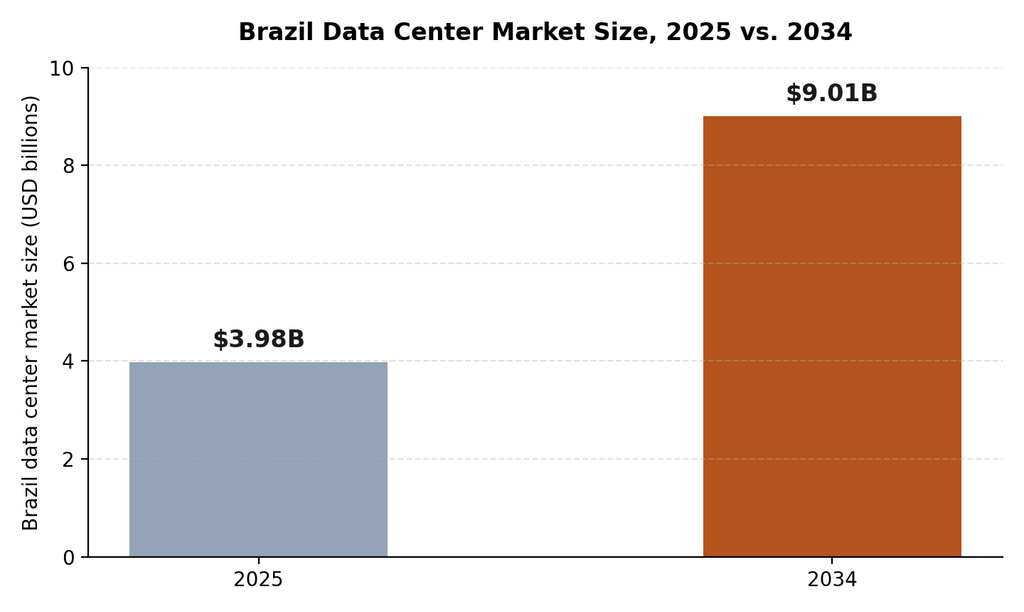
Brazil data center market size, 2025 versus 2034, according to IMARC Group.
What should a company plan for when importing telecom or data center hardware into Brazil?
- Confirm INMETRO certification requirements early, since this can affect timelines well before a shipment is ready to leave its origin country.
- Budget for high import duties and taxes, which run higher in Brazil than in many other major markets and can catch first-time importers off guard.
- Plan for reverse logistics from the start, since RMA and warranty flows will eventually require EOR support to move equipment back out of the country.
- Verify documentation requirements per goods category, since Brazilian customs documentation needs vary depending on the specific type of equipment being imported.
How do telecom IOR services and data center IOR support actually work together in practice?
For a company deploying networking equipment into a Brazilian data center, telecom-specific compliance and data center logistics aren’t separate problems handled by separate vendors, they’re two dimensions of the same shipment. The equipment itself needs INMETRO certification and telecom-specific classification, the same rigor any regulated telecom hardware requires anywhere in the world, while its final destination, a data center facility awaiting deployment, benefits from the bonded warehousing and on-demand distribution model that data center hardware generally needs. A provider handling both dimensions under one relationship avoids the coordination gap that opens up when a telecom compliance specialist and a data center logistics provider aren’t the same company, and aren’t necessarily talking to each other about a shared shipment.
What questions should a company ask before its first Brazilian shipment specifically?
- Has the provider cleared INMETRO certification for this exact category of equipment before, rather than only adjacent or general electronics categories?
- What is the realistic, current estimate for import duties and taxes, given how significantly Brazil’s rates can affect total landed cost compared to other markets?
- Does the provider offer bonded warehousing within Brazil, for equipment that needs to sit ready for deployment rather than being distributed immediately on arrival?
- Is there an established EOR process for the reverse direction, covering the RMA and redeployment traffic that will inevitably follow the initial import?
Frequently Asked Questions
What is INMETRO, and why does it matter for Brazilian IT imports?
INMETRO is Brazil’s national metrology, quality, and technology institute, responsible for certifying that networking, telecom, and other regulated equipment meets Brazilian technical standards before it can be legally sold or deployed in the country.
Are import duties in Brazil higher than in other major markets?
Generally yes. Brazil is known for relatively high import duties and taxes on technology hardware compared to many other major economies, which is part of why professional IOR handling matters for accurately estimating landed cost before committing to a shipment.
Do telecom IOR services cost more than general IOR services?
Often somewhat more, reflecting the additional certification expertise, type approval knowledge, and classification care that regulated telecom and dual-use equipment requires compared to general commercial cargo.
Why would data center equipment need bonded warehousing instead of just shipping directly to its final destination?
Data center hardware is frequently imported ahead of actual deployment need, to support on-demand rollouts. Bonded storage lets that equipment sit without triggering duty payment until it’s actually needed, avoiding capital tied up in inventory that hasn’t yet been deployed.
