
| Key Takeaways • Live sports broadcasting moves a match from venue to viewer through acquisition, transport, production control, encoding, distribution and monitoring. • Contribution, the transport of feeds from the venue to production, is the hardest stage because it must balance bandwidth, latency and reliability at once. • Remote production moves feeds to an offsite facility, and the latency a workflow can tolerate depends on whether cameras, mixing and returns are controlled remotely. • A 2026 multi-venue host broadcast used 14 portable field units across four venues, with rights holders receiving feeds over SRT and a cloud contingency layer. |
What does live sports broadcasting involve from venue to viewer?
Live sports broadcasting moves a match from the venue to the audience through a chain of stages: signal acquisition, transport to production, production control, encoding, distribution and monitoring. Each stage has its own failure points, and a weakness in one shows up on screen no matter how strong the others are.
Acquisition is the camera chain, matched to the sport and the venue. Production control is where a switcher, graphics, replay and communications systems turn raw feeds into a program. Teams planning multi-site coverage can start by mapping their own sports production workflows against these stages so that the weakest link is visible before the event rather than during it.
Why is contribution the hardest part of live sports broadcasting?
Contribution, the transport of feeds from the venue to the production site, is the hardest part because it must balance bandwidth, latency and reliability at the same time. Without enough bandwidth to carry every feed at the needed quality and delay, remote production is simply not possible.
The right transport depends on what is being controlled from afar. If nothing at the venue needs remote control, the extra delay of satellite does not rule it out. Where camera control, audio mixing or returns to the venue are required, tolerable delay drops sharply, as an SVG op-ed on remote production challenges explains. Compression choices matter too: HEVC cannot match the sub-frame latency of JPEG XS, though links tuned for low-latency contribution can be enough for remote video and audio mixing.
Crowded stadiums add another variable, because public networks slow down when many phones compete for the same capacity. A field unit designed for congested stadium networks, such as the LU900Q, answers this by bonding up to 11 internet connections across cellular, Wi-Fi and LAN and switching between them automatically.
How do broadcasters cover many venues at the same time?
Broadcasters cover many venues at once by deploying portable field units at each site, feeding a central operations center, and distributing finished content to rights holders from the cloud. The model trades fixed infrastructure for flexibility, so crews can follow the action across a city.
A 2026 multi-sport Games in Glasgow shows the scale involved. The host broadcaster deployed 14 portable units across multiple venues, covering 10 sports and six Para sports with about 3,000 athletes from 74 nations and territories, as Sports Video Group reported. The deployment used LU900Q units for ENG crews at press conferences, athlete arrivals and warmups, with multi-cam LU800 units added as a backup layer and for round-the-clock beauty shots.
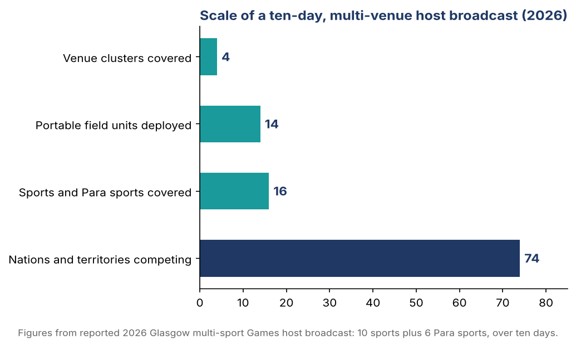
Behind those field units sat a wider operation of more than 650 staff producing about 1,400 hours of content, including a 24/7 channel and a daily 52-minute highlights program. Rights holders received live feeds through SRT, with the host routing content through a combination of LRT and SRT delivery and using a cloud layer as contingency if the operations center was disrupted.
What role do remote and cloud workflows play in live sports broadcasting?
Remote and cloud workflows let broadcasters move most production work away from the venue, so the video, audio and data feeds go to an offsite facility where the complete program is built. This reduces the crew and equipment needed on site and lets one production team serve several events.
The central question is how much of the control chain goes remote. Camera control, mixing and returning video to the venue each have different latency tolerances. If bandwidth is ample, sending uncompressed video and audio gives the highest quality and lowest latency, while compressed links suit cases where bandwidth is the limiting factor. Cloud distribution then fans finished feeds out to many rights holders without a satellite uplink for each one.
How should production teams plan for network variability across venues?
Production teams should plan for network variability by testing each venue’s connectivity separately, adding backup paths for the main feeds and choosing transport that adapts as conditions change. Network conditions can vary significantly between venues and change by the hour during an event.
In practice that means layering resilience. The main feed gets the strongest path, secondary units provide a backup layer, and distribution has a contingency route if the central facility has a problem. Building these layers into the original design is simpler than adding them after a failure.
Frequently Asked Questions
What is contribution in sports broadcasting?
Contribution is the transport of live video, audio and data feeds from a venue to a central production or broadcast facility, where the feeds are mixed into the final program.
What is remote production in live sports?
Remote production takes the video, audio and data feeds from a venue to an offsite facility, where the complete program content is produced rather than in a truck at the venue.
How do rights holders receive live sports feeds?
Rights holders commonly receive live feeds over IP using protocols such as SRT, often distributed from a cloud platform so each broadcaster can take the feed without its own satellite link.
Why do crowded stadiums cause problems for live streaming?
Crowded stadiums strain public cellular networks because many people compete for the same capacity, which is why broadcasters use bonded connections that can switch between networks as congestion changes.
