
Key Takeaways
• The PCB applications driving the most change are radar and high-frequency communications, power electronics, sensors and MEMS, automotive, and aerospace and defense.
• Radar PCBs commonly use high-frequency materials such as PTFE (Teflon), ceramic and hydrocarbon-based materials to limit signal loss at microwave frequencies.
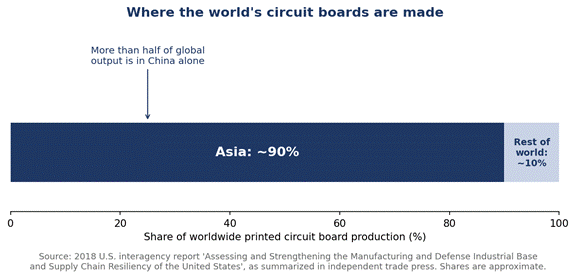
• About 90% of worldwide printed circuit board production takes place in Asia, with more than half of global output in China. • In March 2023, a U.S. presidential determination under the Defense Production Act covered printed circuit board and advanced packaging production capability.
Printed circuit boards are in almost everything with a power switch, but the list of PCB applications that actually drive the industry’s technology roadmap is much shorter. A handful of demanding uses, from radar and millimeter-wave communications to power conversion and miniature sensors, are setting the requirements that board makers and designers now have to meet. At the same time, where boards are made has become a policy question, not just a purchasing one. This analysis looks at the five trends reshaping PCB applications and what each one means for designers.
Which PCB applications are driving the most change?
The PCB applications driving the most change are radar and high-frequency communications, high-power electronics, miniaturized sensors and MEMS, automotive electronics, and defense and aerospace systems. Each of these pushes boards in a different direction: higher frequencies, more heat, smaller size or tighter reliability. A broad overview of pcb applications shows how widely the requirements vary, from sensor modules to phased array antennas. The IEEE Heterogeneous Integration Roadmap, an industry-wide technology roadmap, names a similar set of leading market drivers: high-performance computing and data centers; medical, health and wearables; autonomous automotive; mobile; aerospace and defense; and IoT.
Trend 1: How are higher frequencies changing PCB requirements?
Higher operating frequencies are forcing boards to use specialized low-loss materials and tighter signal-integrity rules, because standard materials and layouts lose too much signal at microwave and millimeter-wave frequencies. Radar is the clearest example. Radar boards commonly use high-frequency materials such as PTFE (Teflon), ceramic and hydrocarbon-based materials, and airborne, naval, land and phased-array radars all combine digital and mixed-signal circuits with very high-frequency microwave signals. Practical radar board design depends on strict signal-integrity and power-integrity rules at microwave frequencies, along with careful thermal planning.
Communications follows the same path. 5G and emerging 6G systems affect mobile products, servers, data centers, antennas, and transmitter and receiver equipment, all of which need boards that hold impedance and keep losses low at higher frequencies than earlier generations.
Trend 2: Why is thermal management becoming a board-level problem?
Thermal management has become a board-level problem because power devices and high-frequency semiconductors generate concentrated heat that the board itself must help remove. High-power devices such as battery chargers, converters, heater controls, inverters, power supplies and switches all discharge large amounts of heat during operation. Design guidance for high-power device boards focuses on choosing materials and constructions that move that heat out of the board efficiently.
Radar and RF systems add a second source of heat. As higher-frequency ICs based on GaAs and GaN are integrated into phased-array designs, advanced packaging and thermal management become key factors in reducing system size and improving long-term reliability. Next-generation arrays are moving to a flat-panel approach, with ICs mounted on the back of the antenna board, which significantly reduces antenna depth but concentrates heat in a thinner structure.
Trend 3: How is miniaturization reshaping sensor and MEMS boards?
Miniaturization is pushing sensor and MEMS boards toward finer features, denser layouts and tighter integration with the components they carry, because the devices themselves keep shrinking. Sensor boards cover a wide range of devices, including flow, image, level, light, motion, position and temperature sensors. Each one has its own design parameters: the operating environment, form factor, power requirements, signal and power integrity, cost, sensitivity, reliability and data speed.
Boards for MEMS devices such as accelerometers, gyroscopes, MEMS microphones, and motion and pressure sensor modules face the same pressure. As these parts move into wearables, vehicles and industrial equipment, the board increasingly behaves like part of the package rather than a separate carrier.
Trend 4: Why are automotive and industrial PCBs growing in importance?
Automotive and industrial PCBs are growing in importance because nearly every new function in vehicles and factories, from sensing and navigation to AI processing, runs on circuit boards that must survive harsh conditions for years. In a modern vehicle, communications, sensors, radars, optical systems, screens, engine controllers, AI processors and navigation systems are all built on printed circuit boards. Industry 4.0 applications place similar demands on boards that combine RF, advanced processors, antennas, miniaturization and optics into one integrated system.
The common thread is long-term reliability. Unlike consumer electronics with short product cycles, automotive and industrial boards are expected to operate through vibration, temperature swings and years of service, which raises the bar for materials, plating and inspection.
Trend 5: Why has PCB supply-chain geography become a strategic issue?
PCB supply-chain geography has become strategic because production is highly concentrated: about 90% of worldwide printed circuit board production takes place in Asia, and more than half of that output is in China. That figure comes from a 2018 U.S. interagency report on the manufacturing and defense industrial base, which also described the U.S. board sub-sector as aging and shrinking. Independent trade coverage of that report notes that domestic capacity concerns extend beyond military needs into the medical, automotive and telecom sectors.
Government attention has followed. The U.S. Department of Commerce’s Bureau of Industry and Security, working with the Naval Surface Warfare Center, Crane Division, has surveyed domestic bare board manufacturers to assess the health and competitiveness of the industry, and the results are summarized in its Bare Printed Circuit Board Industry Assessment. A 2022 Commerce assessment of the information and communications technology supply chain found that the production of products such as PCBs had become increasingly concentrated in China, and in March 2023 a presidential determination under Section 303 of the Defense Production Act covered printed circuit boards and advanced packaging production capability.
For designers working on defense, aerospace and other regulated programs, this trend affects supplier qualification as much as board technology. Where a board is made, and under which certifications, can now be as important as how it is made.
What do these trends mean for PCB designers and buyers?
These trends mean that PCB decisions increasingly need to be made early, alongside component and package choices, because frequency, heat, size and sourcing constraints now interact. A radar board, a power converter and a MEMS sensor module may all be called PCBs, but they require different materials, constructions and suppliers. Designers who match the application’s dominant constraint to the right board technology, and who check supply-chain requirements before committing to a fabricator, avoid the most expensive late-stage changes.
Frequently Asked Questions
What are the most common PCB applications?
Printed circuit boards are used in consumer electronics, automotive systems, medical devices, industrial equipment, telecommunications, data centers, radar, and aerospace and defense electronics.
What materials are used for radar PCBs?
Radar PCBs commonly use high-frequency materials such as PTFE (Teflon), ceramic and hydrocarbon-based materials, which keep signal losses low at microwave frequencies.
Where are most printed circuit boards manufactured?
About 90% of worldwide printed circuit board production takes place in Asia, with more than half of global output in China, according to a 2018 U.S. interagency industrial base report.
Why do power electronics need special PCB designs?
Power electronics such as converters, inverters, chargers and power supplies discharge large amounts of heat, so their boards need materials and constructions that remove heat efficiently.
