
Key Takeaways
• An industrial IoT gateway connects field devices such as sensors, PLCs and RTUs to the networks and cloud platforms that manage them.
• Most gateways combine four capabilities: industrial protocol conversion, LoRaWAN aggregation, cellular backhaul and edge computing.
• Edge computing lets a gateway store and process data locally, improving reliability, latency and security when the wide-area link is weak.
• MQTT, an OASIS standard publish/subscribe protocol, is the common cloud-side language, while gateways translate legacy SCADA protocols on the field side.
Ask five engineers what an industrial IoT gateway is and you may get five different answers: a protocol converter, a cellular modem, a LoRaWAN base station, a small edge server, or a security appliance. All five are partly right. The device has absorbed so many roles that buyers now compare products that barely overlap. This guide sorts the main approaches, explains where edge computing fits, and sets out the questions that separate a good fit from an expensive mismatch.
What does an industrial IoT gateway actually do?
An industrial IoT gateway is the connection point between devices in the field, such as sensors, meters, PLCs and RTUs, and the networks or cloud platforms that manage them. At minimum it collects data from local equipment, translates between field protocols and IT protocols, and forwards that data securely over a wide-area link such as cellular or fiber.
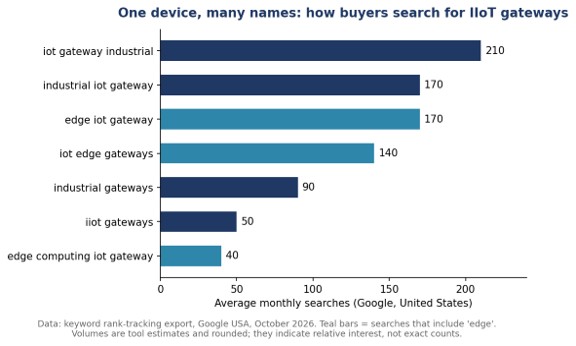
The terminology is famously loose. The same class of hardware is sold as an IIoT gateway, an IoT edge gateway, a smart IoT gateway, an IoT security gateway, a cellular IoT gateway, or simply IoT gateway hardware. A detailed buyer’s guide to IIoT gateway selection lists these synonyms side by side, which is a useful reminder to compare functions rather than labels when reading spec sheets.
What are the main types of industrial IoT gateway?
Most industrial IoT gateways fall into four overlapping types: industrial protocol gateways, LoRaWAN gateways, cellular gateways, and edge computing gateways. Many current products combine two or more of these, so the categories are best read as capabilities to check off rather than separate product classes. An overview of the main gateway categories groups them the same way: industrial, LoRaWAN, cellular and edge computing.
| Gateway type | What it is best at | Typical trade-off |
| Industrial protocol gateway | Translating SCADA and PLC protocols (Modbus, IEC 60870-5-101/104) into IP | Little local intelligence beyond translation |
| LoRaWAN gateway | Aggregating battery-powered sensors spread over wide areas | Low data rates; suits small, infrequent readings |
| Cellular IoT gateway | Backhauling site data where no wired link exists | Depends on mobile coverage and data plans |
| Edge computing gateway | Running local applications, filtering and analytics on site | Higher cost; needs software lifecycle management |
Why is edge computing becoming standard in industrial gateways?
Edge computing lets the gateway store and process data locally instead of sending everything to a central cloud, which improves reliability, lowers latency and tightens security. If the wide-area link drops, a gateway with local processing can keep buffering readings and running control logic until the connection returns. If a sensor generates thousands of readings per minute, local filtering means only the meaningful events cross the network.
The most practical form of edge computing in the field today is container hosting: the gateway runs third-party industrial software, such as a SCADA firewall, an OpenPLC instance or an anomaly-detection agent, in isolated containers alongside its networking functions. A ruggedized multiservice gateway that hosts containerized applications is a representative example, combining connectivity over fiber or cellular, a LoRaWAN radio option and an open environment for edge software in one compact unit.
The search data in the chart above points the same way. Of the gateway terms buyers type into Google, several of the higher-volume phrases include the word “edge,” which suggests the market increasingly treats local processing as part of the definition rather than an add-on.
How do MQTT and legacy SCADA protocols coexist on one gateway?
A modern industrial IoT gateway typically speaks legacy SCADA protocols on the field side and MQTT on the cloud side, acting as the translator between the two worlds. MQTT is an OASIS standard publish/subscribe messaging protocol designed to be extremely lightweight, with a small code footprint and minimal bandwidth use. It defines three quality-of-service levels (at most once, at least once, exactly once) and supports persistent sessions, which shortens reconnection time over unreliable cellular links.
Field equipment, meanwhile, often still uses Modbus RTU or TCP, IEC 60870-5-101/104 or proprietary serial protocols. Replacing every RTU to make it MQTT-native is rarely economical. A gateway with built-in SCADA protocol conversion lets operators keep existing field assets and still feed modern IoT platforms, which is often the single biggest cost saving in an IIoT project.
Which approach fits which deployment?
The right industrial IoT gateway depends on three variables: how much data each site produces, how far the sensors are spread out, and whether decisions need to be made locally. Mapping a project against those three variables usually narrows the choice quickly.
- Few devices, small data, wired or cellular backhaul: a protocol gateway or a cellular gateway is usually sufficient, and simpler hardware means fewer things to patch.
- Many low-power sensors across a wide area: a LoRaWAN gateway, often paired with cellular backhaul, aggregates readings from fields, pipelines or city districts without running cable to each sensor.
- Local control, high data volume or strict security zones: an edge computing gateway earns its higher price by filtering data, enforcing security policy and keeping logic running during outages.
Asset-heavy industries tend to land in the third group. Utilities, oil and gas, and water operators increasingly want analytics and protection at the site itself. Asset management with on-site processing is a common reference design here, where the gateway monitors equipment in real time and runs user-tailored applications next to the assets they watch.
What questions should buyers ask before choosing a gateway?
Buyers should ask which protocols, radios and applications the gateway supports today, and how it will be secured and updated over a ten-year field life. The checklist below covers the points that most often separate a successful rollout from a stalled pilot.
- Which field protocols are supported natively, and is SCADA protocol conversion built in or an extra license?
- Which uplinks are available (fiber, Ethernet, LTE, 5G), and is there automatic failover between them?
- Can third-party software run on the gateway in containers, and who maintains it?
- Is there a central VPN aggregator or management hub, and does the gateway support zero-touch provisioning for large rollouts?
- Is the hardware rated for the actual installation environment, including temperature, power options and mounting?
The gateway is rarely the most expensive line in an IIoT budget, but it is the component that decides whether every other investment produces usable data. Choosing by function, not by label, is the most reliable way to get it right the first time.
Frequently Asked Questions
Is an IoT edge gateway the same as an industrial IoT gateway?
The terms overlap heavily; an IoT edge gateway is an industrial IoT gateway that can also store, process and run applications on data locally rather than only forwarding it.
Can an industrial IoT gateway replace a PLC?
Some edge computing gateways can host PLC software in containers, which can replace simple control functions, but safety-critical control usually stays on dedicated controllers.
Do I need a LoRaWAN gateway for my IIoT project?
A LoRaWAN gateway is worth adding when many battery-powered sensors are spread across a wide area and each one sends small, infrequent readings.
What protocols should an industrial IoT gateway support?
At minimum it should support the field protocols already in use, commonly Modbus and IEC 60870-5-101/104, plus MQTT or another IoT protocol for the cloud or platform side.
