
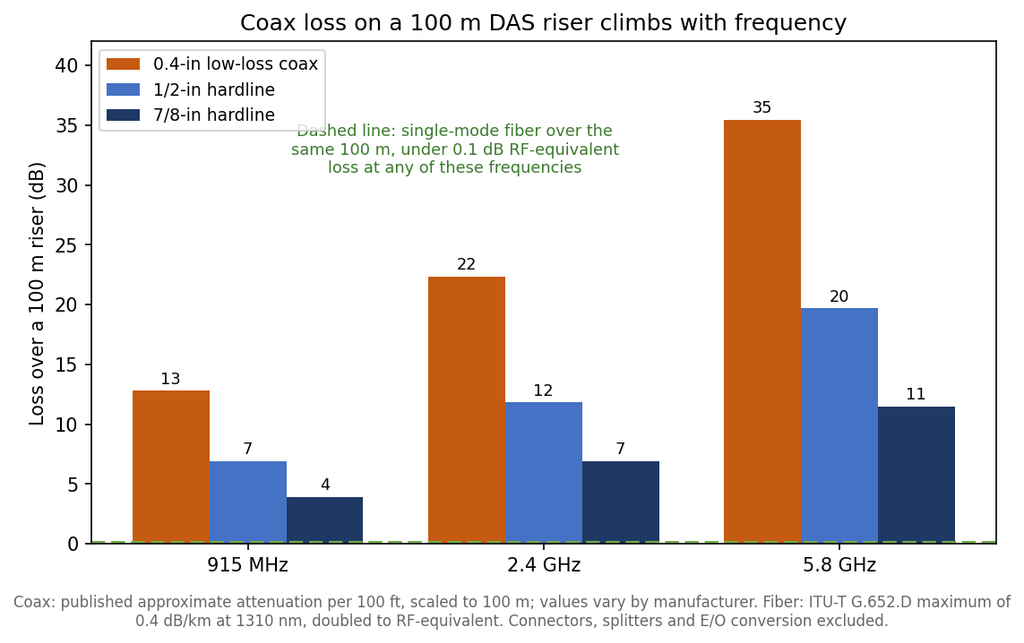
| Key Takeaways • An RF distributed antenna system (DAS) uses many spatially separated antennas fed from one signal source to extend coverage inside large buildings, stadiums, tunnels and mines. • A 100 m coax riser in 0.4-inch low-loss cable loses about 13 dB at 915 MHz but roughly 35 dB at 5.8 GHz, while the same length of single-mode fiber costs under 0.1 dB of RF-equivalent loss. • NFPA 1221 requires emergency responder radio coverage in 99 percent of the floor area of critical areas and 90 percent of general building areas. • RF-over-fiber links for DAS are typically bidirectional, with uplink noise figure and downlink linearity as the two specifications that most affect coverage. |
What is an RF DAS?
An RF distributed antenna system (DAS) is a network of spatially separated antennas that share one signal source, so wireless coverage reaches places a single antenna or the outdoor network cannot. DAS is the standard answer to weak or overloaded coverage in large buildings, stadiums, hospitals, campuses, tunnels and mines.
The signal source is usually a donor antenna on the roof, which picks up the outdoor cellular network, or a base station installed on site. A head-end unit then distributes the signal to remote antennas throughout the structure and carries the uplink from users’ devices back again. How that distribution is wired, coax or fiber, determines how far the system can reach and how many frequency bands it can carry. Fiber-fed DAS architectures show the typical rooftop-to-indoor arrangement in more detail.
Why does coaxial cable struggle in modern DAS deployments?
Coaxial cable struggles because its loss grows with both distance and frequency, so a riser that worked for sub-gigahertz service can lose most of its margin once mid-band 5G and higher bands are added. Published attenuation tables make the scale clear: a 100 m vertical riser in 0.4-inch low-loss coax costs about 13 dB at 915 MHz but roughly 35 dB at 5.8 GHz.
Heavier hardline helps, but it does not change the trend. Seven-eighths-inch hardline, which is thick, heavy and difficult to route through existing pathways, still loses about 11 dB over the same 100 m at 5.8 GHz. A passive DAS also splits that already-reduced signal between many antennas, so every split stacks on top of the cable loss.
How does fiber change the design of a DAS?
Fiber changes DAS design by carrying the RF signal as light from the head-end to each remote unit, which makes distribution loss almost negligible and keeps the remote electronics transparent to the radio signal. Standard single-mode fiber is specified at no more than 0.4 dB per kilometer at 1310 nm, so even after accounting for the rule that each 1 dB of optical loss costs 2 dB of RF signal, a 100 m riser costs less than 0.1 dB.
Because fiber loss does not depend on the RF frequency being carried, adding a new band does not shrink the distribution budget. Fiber is also immune to electromagnetic interference and far lighter than hardline, which matters in crowded risers and long horizontal runs. In practice, RF-over-fiber links for DAS are bidirectional: a downlink path carries signals from the donor or base station to the antennas, and an uplink path brings handset signals back. RF-over-fiber DAS units are usually packaged as a rooftop or head-end enclosure plus indoor units connected by fiber, with remote monitoring of RF levels and link health.
What coverage rules apply to public-safety DAS?
In the United States, NFPA 1221 requires emergency responder radio coverage in 99 percent of the floor area of critical areas and 90 percent of the floor area of general building areas. Critical areas include fire command centers, fire pump rooms, exit stairs, exit passageways, elevator lobbies, standpipe cabinets and sprinkler sectional valve locations, along with any other area the authority having jurisdiction designates.
A county fire marshal’s summary of the NFPA coverage requirements sets out these thresholds alongside the related NFPA 72 provisions, and local jurisdictions commonly also require compliance with the FCC’s signal booster rules in 47 CFR Part 90.219. Public-safety radio frequencies differ from commercial cellular bands, so a single fiber backbone that carries both is attractive to building owners. The same logic applies underground, where radio coverage for mines and emergency services depends on carrying two-way radio signals over distances that coax cannot span without repeated amplification.
What is the difference between analog and digital fiber DAS?
Analog fiber DAS carries the RF waveform itself over the fiber, while digital DAS samples and digitizes the signal before transport and reconstructs it at the remote unit. The ITU-T’s radio-over-fibre reference material uses the same split, distinguishing analog radio-over-fibre from digitized radio transport.
Analog links are frequency-agnostic within their rated range, add no conversion latency and tend to be simpler at each remote unit, which suits mixed public-safety and cellular systems and sites that expect to add bands later. Digital systems integrate more easily with network management and routing, but their bandwidth is bounded by the converters and the digital transport rate. Many real deployments combine both: digital distribution across a campus and analog RF-over-fiber for specific long or high-frequency runs, such as a rooftop donor antenna feeding an indoor head-end.
How should you specify an RF-over-fiber link for a DAS project?
Specify an RF-over-fiber link for DAS by starting from the bands it must carry today and later, then checking uplink noise figure, downlink linearity, gain control and the full optical loss budget. A short checklist covers most projects:
- Frequency coverage: include planned future bands, not only today’s carriers, since replacing remote units is far costlier than over-specifying them.
- Uplink noise figure: the weakest handset signals set the coverage edge, so the uplink path needs a low noise figure.
- Downlink linearity: multiple carriers share one link, so input compression point and intermodulation performance determine how much power can be delivered cleanly.
- Gain control range: adjustable link gain lets installers balance remote units without re-cabling.
- Optical budget: count fiber, connectors and especially splitters, remembering that a 1×2 split costs at least 3 dB optically and 6 dB in RF terms.
- Monitoring and enclosures: remote management over standard network protocols and outdoor-rated rooftop housings reduce site visits.
Cellular test and lab environments use the same building blocks; cellular and 5G RF-over-fiber applications show how the technology moves from deployment into 5G testing, where clean, repeatable signal transport between instruments matters as much as coverage does in a building.
Frequently Asked Questions
Does a fiber DAS support 5G?
Yes. Analog RF-over-fiber links carry the RF waveform regardless of air interface, so a fiber DAS rated for the relevant frequency bands carries 5G signals as readily as 4G or public-safety radio.
Can one fiber link feed several DAS antennas?
Yes. Optical splitters let one transmitter feed several receivers, but each 1×2 split costs at least 3 dB of optical power, which equals at least 6 dB of RF signal at each output.
How much radio coverage does NFPA 1221 require inside a building?
NFPA 1221 requires emergency responder radio coverage in 99 percent of the floor area of critical areas and 90 percent of the floor area of general building areas.
What is the difference between a passive DAS and an active DAS?
A passive DAS distributes signals over coaxial cable and splitters without active electronics at the antennas, while an active DAS uses fiber and powered remote units, which lets it cover larger buildings and more frequency bands.
