
| Key Takeaways • A custom hard case is either fully custom, with a shell built for one device, or semi-custom, with a standard shell and a custom interior. • Fully custom shells are made with technologies such as EVA thermoforming, vacuum forming, blow molding, injection molding, sewing and bonding. • IEC 60529 ingress protection ratings use two digits: the first rates protection against solids and the second rates protection against liquids. • MIL-STD-810 Method 516 includes a transit drop procedure in which the item is dropped onto a hard surface, inside its case or unpackaged. |
What counts as a custom hard case?
A custom hard case is a protective case designed around a specific device, either by building the whole shell for that device or by fitting a custom interior into a standard shell. The first route is fully custom; the second is usually called semi-custom.
Fully custom shells are produced with a range of manufacturing technologies, including EVA thermoforming, vacuum forming, blow molding, injection molding, sewing and soft textile construction, and advanced bonding. The semi-custom route keeps a ready-made shell and changes what goes inside it. One example of a semi-custom foam case series offers the same semi-rigid shell with three interior options: a divider set, precut cubic foam, or a custom foam insert cut to the device. For many buyers searching for custom hard cases, the real decision is which of these two routes fits the product, the budget and the timeline.
When is a fully custom shell worth the investment?
A fully custom shell is worth the investment when the device has an unusual shape, when production volume is high enough to spread tooling cost, or when the case is part of the product experience and has to match the brand. In those cases a standard shell either does not fit well or undersells the device.
Molded technologies show why volume matters. Injection molding is ideal for high-precision cases in relatively large volumes and offers some of the lowest unit prices among case technologies, while blow molding offers a lower unit cost and a shorter development time for simpler shapes. Both rely on molds that must be paid for up front. For lower volumes, a semi-custom platform such as a wheeled hard case option with modular dividers, which can be configured with interchangeable dividers, precut foam or a custom foam insert, can deliver much of the protection without new tooling.
When does a semi-custom or padded case make more sense?
A semi-custom or custom padded case makes more sense when volumes are low to moderate, when the device fits a standard footprint, and when lead time matters more than a unique exterior. The custom work moves into the interior, where it has the biggest effect on protection.
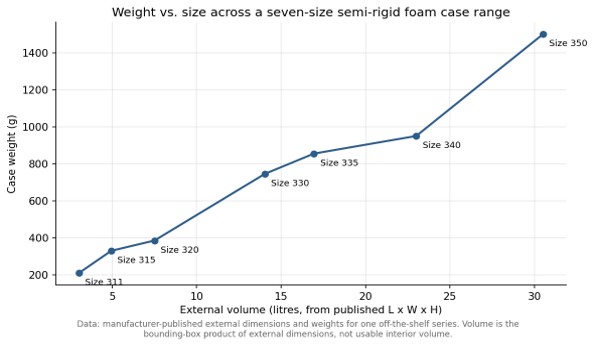
Semi-rigid designs illustrate the trade-off. Shell-Case’s Hybrid 300 line, for example, uses three layers: a heavy-duty textile with a water-repellent coating, a shock-absorbing foam padding structure, and a polyamide fabric layer that supports a modular interior. The series comes in seven published sizes, from a 220 x 145 x 95 mm model weighing 210 g to a 465 x 375 x 175 mm model weighing 1,500 g. Weight across such a range rises roughly with external volume, which is useful when estimating what a field technician or clinician will actually carry.
Customization in this category also extends to branding, with options such as logo plates, branded zipper pulls and business card holders, so a semi-custom case can still present as a company’s own product.
How do the main custom hard case approaches compare?
The main approaches differ mainly in where the customization happens and how much up-front investment they need. The comparison below summarizes the general trade-offs buyers weigh.
| Approach | Where it is customized | Up-front investment | Best suited to |
| Fully custom molded shell | Shell, interior and branding | Highest (molds and tooling) | High volumes, unusual device shapes, brand-led products |
| Semi-custom shell with custom insert | Interior foam or dividers, branding | Low to moderate | Low to mid volumes, standard footprints, faster timelines |
| Standard case with precut foam | User-arranged interior | Lowest | Prototypes, demos, small batches |
Which protection ratings should a custom hard case specification include?
A custom hard case specification should state the ingress protection rating it must meet and the drop or shock test it must pass. Ratings turn vague words such as waterproof or rugged into requirements a supplier can be held to.
Ingress protection, or IP, ratings come from the international standard IEC 60529. The code uses two digits: the first rates protection against solid objects and dust, and the second rates protection against liquids. On the solids scale, 5 means dust protected and 6 means dust tight. On the liquids scale, 7 means harmful amounts of water should not enter when the enclosure is immersed up to 1 m under defined conditions of pressure and time. This guide to IP enclosure ratings from Control.com also explains how IP ratings relate to NEMA ratings used in North America, a useful reference when a case will be sold in several markets.
For shock, MIL-STD-810 Method 516 is the reference most often cited. It contains eight test procedures, and Procedure IV, the transit drop, physically drops the test item onto a hard surface. As this overview of MIL-STD-810 shock testing notes, the item can be tested inside its transit case or unpackaged, which matters when the case and device are evaluated together. A specification should name the procedure and conditions, not just the standard number.
What should go into a custom padded case interior?
A custom padded case interior should hold the device so it cannot shift, keep accessories separated, and leave room for the way the device is actually used in the field. The interior often does more for protection than the shell itself.
Custom-cut foam inserts give the tightest fit for a single device. Dividers trade some fit for flexibility when the contents change. Precut cubic foam lets users shape the cavity themselves, which suits early prototypes and demo kits. Buyers should also consider charging access, cable routing and whether users need to operate the device without fully removing it.
How should you brief a manufacturer on a custom hard case?
A strong brief describes the device, the environment and the volume in enough detail that a manufacturer can recommend the right technology rather than default to one. Useful items to include are:
- Device dimensions, weight and any fragile or exposed parts.
- How the case will travel: hand carry, shoulder strap, wheels or shipping.
- Required IP rating and drop or shock test, with procedure details.
- Expected annual volume and how long the design must stay in production.
- Cleaning requirements and any regulatory or clinical constraints.
- Branding elements such as logos, colors and labeling.
Frequently Asked Questions
What is the difference between a hard case and a semi-rigid case?
A hard case uses a rigid molded shell, while a semi-rigid case combines a textile exterior with structured foam padding to give shape and shock absorption at a lower weight.
Does a custom foam insert make a standard case a custom case?
A custom foam insert in a standard shell is usually described as a semi-custom case, because the protection is tailored to the device while the shell itself is not.
What does an IP67 rating mean for a carrying case?
Under IEC 60529, IP67 means the enclosure is dust tight and protected against harmful water ingress during immersion up to 1 m under defined conditions of pressure and time.
Which drop test is used for transit cases?
MIL-STD-810 Method 516, Procedure IV, the transit drop, is a widely cited test in which the item is dropped onto a hard surface either inside its transit case or unpackaged.
