
| Key Takeaways • Live video distribution is the delivery of live feeds from one broadcast facility to many others, such as a network sending content to its affiliate stations. • The FCC’s 2020 C-band order moved U.S. satellite services from the full 500 MHz band into the upper 200 MHz, from 4.0 to 4.2 GHz, and cleared 280 MHz for terrestrial 5G. • Satellite operators faced accelerated clearing deadlines of December 5, 2021 and December 5, 2023, and a final deadline of December 5, 2025. • Cloud IP distribution platforms let a central newsroom receive, curate, and share live feeds with affiliates over the internet using protocols such as SRT and RTMP. |
What does live video distribution mean in broadcasting?
Live video distribution is the delivery of live feeds from one broadcast facility to many others, such as a network sending news and sports content to its affiliate stations or partners exchanging coverage of a breaking story. It sits between contribution, which brings feeds in from the field, and the final delivery of programs to viewers.
For decades, the default way to do this was satellite. Today, a growing share of feeds move over IP networks instead, often through a cloud-native IP distribution platform that a headquarters uses to receive feeds from bureaus and affiliates, curate them, and share the relevant ones back out. In that hub model, only the central newsroom sees every incoming feed, while each station receives the content that is useful to its market.
How did satellite become the default for distributing live feeds?
Satellite became the default because one uplink could reach every receiving dish across a continent at the same moment, with predictable quality and no dependence on terrestrial networks. For a national network serving stations in hundreds of markets, that one-to-many reach was difficult to match any other way.
In the United States, much of that distribution ran through the C-band, the 3.7 to 4.2 GHz range used by fixed satellite services and the earth stations that receive them. Satellite distribution also carried real costs, including transponder time, uplink facilities, and dish maintenance at every receiving site, which encouraged networks to look at alternatives once internet delivery became reliable enough. An explainer on why the C-band repack strengthened the case for IP distribution lays out that argument in more detail.
What changed when the FCC repacked the C-band?
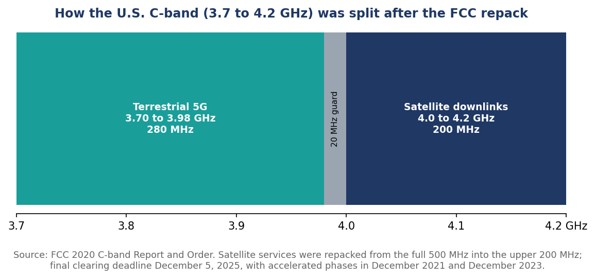
When the FCC repacked the C-band, it cleared the lower 280 MHz of the band (3.7 to 3.98 GHz) for terrestrial 5G and moved satellite services into the upper 200 MHz (4.0 to 4.2 GHz), with a 20 MHz guard band in between. Satellite distribution kept working, but in less than half the spectrum it had used before.
The decision was driven by demand for mid-band 5G spectrum rather than by broadcast needs, yet it landed directly on the infrastructure many networks used to share live content with their stations.
The 2020 order set a final clearing deadline of December 5, 2025, with accelerated phases due on December 5, 2021 and December 5, 2023 for operators that chose to move early. The auction of the cleared spectrum, Auction 107, began in December 2020 and offered 5,684 licenses. According to the FCC’s own summary of the C-band transition, all five eligible satellite operators elected the accelerated schedule, the lower band transition was completed in 2023, and 5G licensees are now using that spectrum.
For broadcasters, the repack meant filters on receiving dishes, retuned services, and a period of planning around transition dates. It also put distribution strategy on the agenda at a time when IP alternatives had matured, which is why the C-band years overlap with many networks testing internet-based feed sharing.
How does IP live video distribution work in practice?
IP live video distribution works by sending each feed over the public internet or private networks using transport protocols built to recover lost packets, then routing it through a cloud platform that controls who receives what. The receiving station decodes the feed back to SDI or ingests it directly as a stream.
- Transport protocols: Common formats include SRT and RTMP, along with vendor protocols designed for bonded or lossy networks. Most platforms accept several so that feeds from different sources can meet in one place.
- Curation: A central desk previews incoming feeds, labels them, and decides which affiliates or partners get access, replacing the fixed schedule of satellite windows with on-demand sharing.
- Edge hardware: Rackmount transceivers at each station can switch between sending and receiving SDI channels, so the same box handles both contribution and distribution.
- Discovery: Some platforms add directories so organizations can find and exchange feeds with other users outside their own group.
A well-known example came from CBS Newspath, which reached a multi-year agreement to use the Matrix cloud service for contribution and delivery of live content to more than 200 affiliates and seven global news bureaus. In TV Technology’s coverage of the CBS Newspath agreement, the network’s vice president of news services described the change as central to reducing its reliance on satellite and fiber while gaining flexibility in newsgathering and content sharing.
Does IP distribution replace satellite completely?
IP distribution does not replace satellite completely for most networks; it shifts the balance. Satellite remains efficient for linear channels that must reach a very large number of sites at once, while IP is better suited to the growing volume of ad hoc, event-driven, and multi-camera feeds that change from hour to hour.
The practical result is a hybrid. Scheduled programming may stay on satellite, while breaking news, regional sports, and partner exchanges move over IP because they need flexibility more than one-to-many broadcast reach. Multi-camera live transmission is a good example: sending several synchronized angles from one event to several stations is simpler to arrange on demand over IP than by booking additional satellite capacity.
What should a network evaluate before shifting distribution to IP?
A network should evaluate resilience, latency, control, and integration before shifting distribution to IP, because the internet is shared infrastructure and the platform must make up for that with recovery and management features.
- Resilience: Check how the platform handles packet loss and network jitter, and whether feeds can travel over more than one path.
- Latency: Confirm end-to-end delay is low enough for live two-way segments, not just for recorded packages.
- Access control: Make sure the central desk can grant and revoke access to individual feeds quickly and see who is receiving what.
- Integration: Verify that feeds land in the formats each station already uses, whether SDI into a router or streams into a production system.
- Recording: Check whether incoming feeds can be recorded centrally so stations can use material after the live window closes.
Frequently Asked Questions
What is the difference between video contribution and distribution?
Contribution brings live feeds from the field or a venue into a broadcast facility, while distribution sends live feeds from one facility out to many others, such as a network sharing content with its affiliates.
What happened to the C-band in the United States?
The FCC reallocated the lower 280 MHz of the C-band to terrestrial 5G and moved satellite services into the upper 200 MHz, from 4.0 to 4.2 GHz, with a final clearing deadline of December 5, 2025.
Can live TV feeds be distributed over the internet?
Yes. Broadcasters distribute live feeds over the internet using transport protocols such as SRT along with cloud platforms that manage which stations receive each feed.
Is satellite still used for live video distribution? Satellite is still widely used, especially for linear channels that must reach many sites at once, though many networks now send event-driven and breaking news feeds over IP.
