
| Key Takeaways • A fast medium format lens has a wide maximum aperture, and with leaf-shutter lenses it can also mean a high flash sync speed. • In the 645 leaf-shutter prime range, the fastest maximum aperture is f/2.8, at 55 mm, 80 mm, 110 mm and 150 mm. • An f/2.8 lens admits roughly 2.6 times the light of an f/4.5 lens, because light scales with aperture area. • Leaf-shutter lenses can synchronize with flash at up to 1/1600 s, which lets photographers control bright ambient light with strobes. |
What does “fast” mean for a medium format lens?
A fast lens is one with a wide maximum aperture, meaning a low f-number, so it lets more light reach the sensor and allows faster shutter speeds or shallower depth of field. In medium format, the word carries a second meaning as well: how fast a lens can synchronize with flash. Lenses with a built-in leaf shutter can sync with strobes at much higher shutter speeds than a camera’s focal-plane shutter, which matters as much to studio and location photographers as aperture does.
Both meanings are worth separating before comparing lenses. For low light and subject isolation, maximum aperture is the figure to watch. For controlling ambient light with flash, especially outdoors, the maximum flash sync speed is the figure that decides what is possible. One published leaf-shutter lens lineup is a useful reference point because it lists both figures for each lens.
How much more light does a fast medium format lens let in?
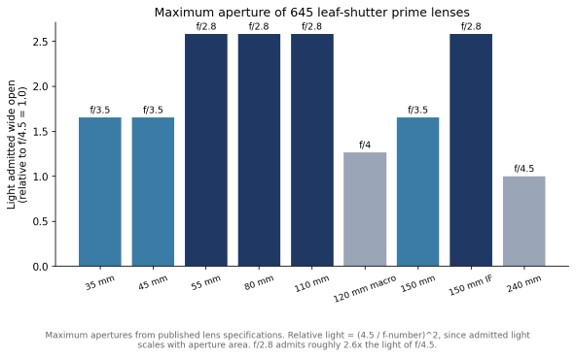
Each full stop on the f-number scale halves or doubles the light reaching the sensor, so an f/2.8 lens admits roughly 2.6 times as much light as an f/4.5 lens and about twice as much as f/4. The reason is geometric. The f-number is the focal length divided by the diameter of the aperture, and the light collected depends on the aperture’s area, which scales with the square of its diameter.
Georgia State University’s HyperPhysics project gives a physics explanation of aperture stops that shows why halving the f-number admits four times the light. For medium format photographers, the practical upshot is that the gap between f/2.8 and f/3.5 is about two thirds of a stop, while the gap between f/2.8 and f/4.5 is close to a stop and a half.
Which are the fastest medium format lenses by focal length?
Across the 645 leaf-shutter prime range, the fastest maximum aperture is f/2.8, found at 55 mm, 80 mm, 110 mm and in a 150 mm internal-focus design. Wide angles are typically a little slower: the 35 mm and 45 mm leaf-shutter primes open to f/3.5, which reflects the difficulty of designing wide, fast lenses that still resolve edge to edge on a large sensor.
| Focal length | Maximum aperture | Typical use |
| 35 mm | f/3.5 | Wide-angle architecture and interiors |
| 45 mm | f/3.5 | Wide environmental and location work |
| 55 mm | f/2.8 | Semi-wide editorial and lifestyle |
| 80 mm | f/2.8 | Standard focal length, general studio |
| 120 mm macro | f/4 | Close-up product and detail |
| 150 mm | f/2.8 (IF) or f/3.5 | Portraits and fashion |
| 240 mm | f/4.5 | Longer telephoto portraits and landscape |
Within that list, the 150 mm f/2.8 is described as the fastest telephoto in the range, giving very thin depth of field at f/2.8 and smooth out-of-focus backgrounds for portraiture. The 55 mm f/2.8 is a low-distortion semi-wide lens with a natural perspective, and the 80 mm f/2.8 serves as the standard focal length for the system.
Why does flash sync speed matter as much as aperture?
Flash sync speed matters because it sets the fastest shutter speed at which a strobe can light the whole frame, and a higher sync speed lets photographers darken bright ambient light while still using flash. A focal-plane shutter exposes the sensor through a moving slit at short speeds, so a brief flash would only light part of the frame. A leaf shutter sits inside the lens and opens fully for every exposure, so the flash can fire at any speed the shutter supports.
The Schneider Kreuznach “Blue Ring” leaf-shutter lenses for the medium format body those lenses mount on support flash synchronization up to 1/1600 s, with some longer lenses such as the 240 mm rated lower. In practice, that headroom lets a photographer shoot a portrait outdoors at a wide aperture in daylight, underexpose the sky and use a strobe to light the subject, which is difficult at the slower sync speeds typical of focal-plane designs.
Do fast lenses matter more on high-resolution medium format sensors?
Fast lenses matter more on high-resolution medium format sensors because the sensor will reveal every optical weakness, so a lens has to stay sharp wide open to be useful at its fastest aperture. Medium format sensors in systems like the XF Camera System are about 2.5 times larger than the sensors in high-end 35mm DSLRs, which already produces shallower depth of field at the same framing and f-number. A fast lens on that sensor gives a degree of subject separation that is hard to reproduce on smaller formats.
Optical design and focus precision follow from that. The leaf-shutter primes are built for edge-to-edge sharpness with minimal distortion, and each lens receives an individual focus calibration to support autofocus accuracy at wide apertures, where the margin for focus error is smallest.
Should medium format photographers choose primes or zooms?
Primes remain the route to the widest apertures in medium format, while zooms trade one to two stops of speed for flexibility on location. The fastest leaf-shutter zoom in the range, a 75 to 150 mm design, opens to f/4 at the short end and f/5.6 at the long end, compared with f/2.8 for the fastest primes covering similar focal lengths. That gap is enough to change depth of field and handheld shutter speeds noticeably, which is why many portrait photographers still carry an 80 mm and a 150 mm prime instead.
Zooms earn their place when changing lenses is impractical, such as during fast-moving location shoots or events, and when the photographer is working at mid apertures anyway. Medium format systems that accept a broad catalog, in the XF case more than 60 lenses including focal-plane, leaf-shutter and legacy designs, let photographers mix both approaches rather than commit to one.
When is a slower lens the better choice?
A slower lens is often the better choice when the job needs extended depth of field, close focusing or a specific focal length more than it needs the widest aperture. Product and still-life photographers frequently work at f/8 or smaller anyway, so the f/4 macro is no handicap for them, and a leaf-shutter zoom such as the 75 to 150 mm f/4 to 5.6 can replace several primes on location. Leaf shutters also produce very little vibration, which suits nature and landscape work on a tripod.
The most practical way to choose is to decide which kind of speed the work actually needs. Portrait and fashion photographers who isolate subjects in mixed light benefit from both f/2.8 and high sync speeds, while architectural and product photographers usually value distortion control, close focus and edge sharpness over the last fraction of a stop.
Frequently Asked Questions
What is the fastest medium format lens aperture?
In the 645 leaf-shutter prime range, the fastest maximum aperture is f/2.8, available at 55 mm, 80 mm, 110 mm and in a 150 mm internal-focus design.
What flash sync speed do medium format leaf shutter lenses offer?
Medium format leaf-shutter lenses such as the Schneider Kreuznach Blue Ring range support flash sync up to 1/1600 s, with some longer lenses rated lower.
How much more light does f/2.8 let in than f/4?
An f/2.8 aperture admits about twice as much light as f/4, because each full stop doubles or halves the light reaching the sensor.
Why do leaf shutter lenses sync with flash at higher speeds?
A leaf shutter sits inside the lens and opens fully for every exposure, so a flash can light the entire frame at any shutter speed the leaf shutter supports.
