
| Key Takeaways • An autonomous business uses agentic AI and other adaptive systems to make decisions and take actions with limited human intervention, which Gartner describes as the next wave after digital business. • Gartner names five components of autonomous business: autonomous operations, augmented workforce, auto-adapting products, machine customers, and the programmable economy. • Gartner predicts at least 15% of day-to-day work decisions will be made autonomously through agentic AI by 2028, up from 0% in 2024. • Gartner also expects over 40% of agentic AI projects to be canceled by the end of 2027, with inadequate risk controls among the main causes. |
What is an autonomous business?
An autonomous business is an organization in which AI systems, primarily agentic AI, sense what is happening, make decisions, and take action with limited human intervention, creating new kinds of value rather than only automating existing tasks. Gartner describes autonomous business as the next significant wave of transformation after digital business, driven by self-improving, adaptable technologies such as agentic AI, robotics, and automation.
The concept goes further than workflow automation. Traditional automation follows predefined rules, while an autonomous business relies on systems that adapt to changing conditions and decide what to do next. That difference is what makes the model attractive to executives, and it is also what makes it a security and governance question rather than purely an operations one, one that purpose-built controls designed for autonomous AI agents are starting to address.
What are the five components of an autonomous business?
Gartner identifies five components of autonomous business: autonomous operations, augmented workforce, auto-adapting products, machine customers, and the programmable economy. Each component describes a different place where machines take on decisions that people used to make.
- Autonomous operations are systems that monitor performance around the clock, make decisions on live data, and correct problems without waiting for IT.
- An augmented workforce pairs people with intelligent systems; Gartner predicts that 40% of services will be AI-augmented by 2028.
- Auto-adapting products improve after launch based on how customers use them, and Gartner warns that companies slow to adopt this approach risk losing up to 25% market share by 2030.
- Machine customers are nonhuman buyers, such as software agents that purchase goods or services, which Gartner estimates could drive or influence $18 trillion in purchases by 2030.
- The programmable economy uses smart contracts and programmable payments so that transactions settle automatically when agreed terms are met.
The full breakdown is set out in Gartner’s explainer on autonomous business, which frames the shift as a strategic choice for leaders: lead the transition or risk displacement by early adopters.
Every one of these components shifts trust from people to software. When a supply chain reroutes itself or a software agent buys on a company’s behalf, the question of who authorized the action, with which permissions, and on what data, no longer has an obvious human answer. That is why autonomy and AI security tend to arrive on the executive agenda together.
How quickly is agentic AI entering everyday business decisions?
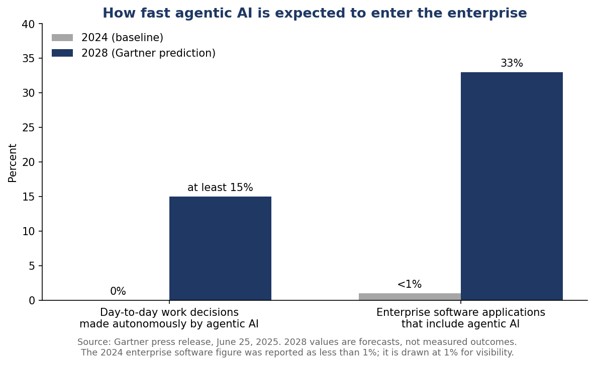
Gartner predicts that at least 15% of day-to-day work decisions will be made autonomously through agentic AI by 2028, up from 0% in 2024. The same forecast expects 33% of enterprise software applications to include agentic AI by 2028, compared with less than 1% in 2024. Those two numbers describe the practical foundation of an autonomous business: decisions moving from people to software, and software gaining the ability to act.
Why do so many agentic AI projects fail?
Many agentic AI projects fail because of escalating costs, unclear business value, or inadequate risk controls, and Gartner predicts that over 40% of agentic AI projects will be canceled by the end of 2027 for those reasons. Gartner also flags agent washing, the rebranding of existing chatbots, assistants, and robotic process automation as agentic without real agentic capability, and estimates that only about 130 of the thousands of agentic AI vendors are genuine.
The Gartner forecast on agentic AI project cancellations is a useful corrective to the hype. It does not argue against autonomy; it argues that autonomy without clear value and without risk controls tends to stall before reaching production. Inadequate risk controls appear explicitly in that list of failure causes, which places security and governance on the critical path of any autonomous business strategy.
Which human oversight model fits which kind of decision?
The right human oversight model depends on the stakes of the decision: high-impact actions call for human approval before execution, while high-volume, lower-risk decisions can run autonomously under human supervision. Most autonomous businesses will use all three models below at once, assigned decision by decision rather than system by system.
| Oversight model | How it works | Best suited to |
| Human-in-the-loop (HITL) | A person reviews and approves an AI action before it takes effect | Payments, contract changes, access grants, and other high-impact or irreversible actions |
| Human-on-the-loop (HOTL) | The AI acts on its own while a person monitors outcomes and can intervene or halt it | High-volume operational decisions where per-action approval would erase the benefit |
| Fully autonomous | The AI acts without a person in the decision path, within predefined guardrails | Low-risk, reversible, well-understood tasks with strong monitoring |
Placing human-in-the-loop checkpoints in the right spots is one of the most consequential design choices in an autonomous system. Too many checkpoints, and the business loses the speed it adopted AI to gain. Too few, and a single manipulated or mistaken agent can take an irreversible action at machine speed.
What security controls does an autonomous business need?
An autonomous business needs continuous visibility into which AI agents exist, what data and systems each one can reach, and what each one actually does, combined with policies that can stop or escalate risky actions in real time. Periodic audits are not enough when decisions happen continuously. The control layer has to operate at the same speed as the agents it governs.
In practice that means a living inventory of agents, least-privilege permissions for every tool connection, runtime monitoring of agent behavior, and clear escalation paths into the oversight models above. Oriel Vaturi, co-founder and CEO of AI security company Ovalix, has argued that every AI agent effectively becomes a non-human identity with its own credentials and permissions, and that security teams need to see an agent’s full operational lifecycle: its objective, the decisions it made, the tools and systems it touched, the permissions it exercised, the data it handled, and the complete chain of actions. Risk in an autonomous business, in that view, rarely shows up in a single event; it emerges across a sequence of steps that each look legitimate on their own. A broader enterprise guide to agentic AI security covers how these controls map onto the most common agent architectures.
How should leaders start the move toward autonomy?
Leaders should start the move toward autonomy with a small number of high-value, well-bounded use cases, each with defined oversight, measurable outcomes, and security controls in place before the agent reaches production. Gartner itself recommends pursuing agentic AI only where it delivers clear value or return on investment, which argues for depth over breadth in the early stages.
Before any agent goes live, it helps to work through a pre-deployment checklist covering permissions, data access, monitoring, and rollback. The organizations most likely to reach a genuinely autonomous business are not the ones that deploy the most agents first, but the ones whose early agents are still running safely a year later.
Frequently Asked Questions
What is the difference between automation and an autonomous business?
Automation follows predefined rules to complete tasks, while an autonomous business uses adaptive AI systems, mainly agentic AI, that make decisions and take actions on their own as conditions change.
What are the five components of autonomous business according to Gartner?
Gartner lists autonomous operations, augmented workforce, auto-adapting products, machine customers, and the programmable economy as the five components of autonomous business.
How many agentic AI projects does Gartner expect to be canceled?
Gartner predicts that over 40% of agentic AI projects will be canceled by the end of 2027, citing escalating costs, unclear business value, and inadequate risk controls.
What is human-on-the-loop oversight?
Human-on-the-loop oversight lets an AI system act on its own while a person monitors its outcomes and keeps the ability to intervene or stop it, without approving each individual action.
