
Why does Retool adoption create a security blind spot?
Retool makes internal development incredibly accessible, which is exactly why it spreads so quickly inside organizations: a business user with a real, specific problem can build a working internal app without waiting on an engineering team’s backlog. Kanopy Security’s Retool security offering frames the resulting risk plainly: as Retool adoption grows, it often creates a blind spot for security teams, since internal applications built this way now connect directly to databases, SaaS systems, and APIs, often with broad permissions, and outside the visibility and reach of traditional IT security review.
What specific risks come with citizen-built Retool apps?
| Risk | Why it happens |
|---|---|
| Over-privileged access | A builder connects an app to a data source using whatever credentials were easiest to obtain, often broader than the app actually needs. |
| Injection risks | Apps built quickly by non-security-trained builders may not sanitize inputs the way a professional engineering team would by default. |
| Stale, exposed apps | An app built for a short-term need keeps running long after its purpose ends, with no process flagging it for review or retirement. |
| Unmonitored data flows | Data moves between systems through an app that IT never knew existed, so nobody is watching what it actually does with that data. |
How big is the citizen developer platform category becoming?
This isn’t a niche problem confined to a handful of adventurous business users. Gartner’s own market forecast for low-code development technologies tracks Citizen Automation and Development Platforms (CADP), the category Retool and similar tools fall under, as one of the fastest-scaling segments of the broader low-code market, growing from $554 million in global revenue in 2021 to a projected $1.232 billion by 2024. Gartner also projects that by 2026, developers outside formal IT departments will make up at least 80% of the low-code user base, up from 60% in 2021, underscoring how much building activity is shifting toward exactly the population citizen developer security has to account for.
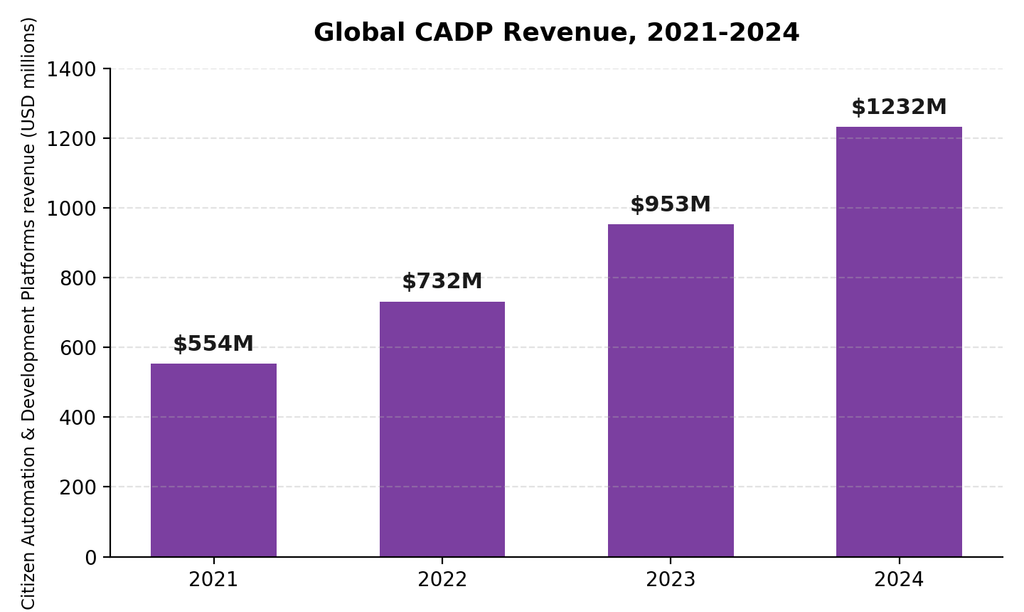
Global Citizen Automation and Development Platforms (CADP) revenue, 2021 to 2024, according to Gartner.
What does citizen developer security actually require?
Citizen developer security starts from a different assumption than traditional AppSec: the people building these apps were never expected to think like security engineers, and holding them to that standard after the fact doesn’t scale. The practical requirements follow from that starting point rather than fighting it.
- Full visibility first: an inventory of every Retool app, automation, data connection, and permission has to exist before anything else can happen.
- Findings routed to the right owner: a security team flagging a problem is only useful if the person who can actually fix it, usually the app’s builder, gets a clear, actionable notification.
- Guardrails, not gatekeeping: the goal is catching risk automatically as apps are built, not requiring every citizen-built app to clear a manual security review before shipping.
- Continuous monitoring, not a one-time scan: new apps and automations get built constantly, so a periodic audit is out of date almost immediately.
How does this play out for an organization adopting Retool at scale?
Kanopy’s own announcement of its Retool integration describes the practical goal well: giving builders the guardrails they need to innovate safely, without security ever getting in their way. In practice that means the Kanopy platform connects to Retool and produces an automated inventory of internal apps within minutes, rather than requiring a manual audit project every time leadership wants to understand what’s actually running. That combination, fast visibility plus guided remediation routed to the right owner, is what lets organizations keep the speed advantage citizen development offers while still meeting the data integrity and compliance standards security and audit teams are accountable for.
What does a typical Retool security rollout look like?
Most organizations adopting Retool security follow a similar sequence, moving from not knowing what exists to actively managing it:
- Connect and discover: the platform connects to Retool’s own APIs and produces an automated inventory of every app, data connection, and permission, typically within minutes rather than weeks.
- Prioritize by risk: findings get ranked so the handful of apps with genuinely dangerous over-privileged access or exposed data surface first, instead of a flat, undifferentiated list.
- Route to owners: each finding is matched to the person who actually built or maintains the app, with clear, actionable guidance rather than a generic security alert.
- Monitor continuously: new apps and changes to existing ones get picked up automatically, so the inventory stays current as citizen development keeps moving.
What are the signs an organization has outgrown ad hoc Retool oversight?
Many security teams first realize they need a formal approach to Retool security only after a near-miss or an audit finding, but a few warning signs tend to show up well before that point. If nobody on the security team can say how many Retool apps are currently in production, that’s usually the clearest signal. Other common indicators include app owners who have left the company while their apps keep running unmaintained, data connections using credentials nobody can immediately identify the source of, and internal apps that were built for a single short-term project but have quietly become part of someone’s daily workflow months later.
Frequently Asked Questions
Why does Retool specifically create more risk than traditional enterprise software?
Traditional enterprise software typically goes through a procurement and security review process before deployment. Retool apps are built directly by business users, often connecting to production data sources, without that same review step, which is what creates the blind spot for security teams.
Does securing Retool mean restricting who can build apps?
Not necessarily. The goal of citizen developer security is usually to add visibility and automated guardrails around what’s being built, rather than gatekeeping who is allowed to build in the first place, since restricting access defeats much of the speed advantage citizen development offers.
How quickly can an organization get visibility into its existing Retool apps?
With an integration built for this purpose, an automated inventory of internal Retool apps, their data connections, and their permissions can typically be produced within minutes of connecting the platform, rather than requiring a manual audit project.
Is citizen developer security only relevant to Retool?
No. The same underlying risks, over-privileged access, unmonitored data flows, and stale exposed apps, apply across the broader citizen development ecosystem, including platforms like Power Automate, Copilot Studio, Salesforce, and ServiceNow.
