
Why is edge processing becoming central to military situational awareness?
Traditional situational awareness architectures often centralized video and sensor analysis at a command post, requiring continuous, reliable data links back to that central point. Maris-Tech’s analysis of edge computing in defense platforms describes why that model is shifting: compact, SWaP-optimized architectures now deliver powerful edge AI video processing inside defense-grade enclosures, letting tactical systems detect and interpret their surroundings continuously rather than depending on a distant analysis point. This approach scales naturally across unmanned vehicles, drones, and mobile ISR platforms, since each platform can carry its own intelligence rather than requiring a dedicated, always-available link to a centralized system.
What defines a genuinely capable tactical situational awareness system?
A tactical situational awareness system has to hold up across a wide range of deployment scenarios, each with its own constraints, rather than being optimized for just one use case. Real-world tactical deployments span drone-based battlefield intelligence streaming live video from surveillance drones back to mobile command units, vehicle-mounted encoders sending high-resolution perimeter footage from armored vehicles to remote operators, and even helmet-mounted wearables used by special operations teams to stream encrypted video back to base while detecting anomalies like weapons or unauthorized movement in real time.
| Deployment scenario | What the system needs to deliver |
|---|---|
| Drone-based battlefield intelligence | Real-time video streaming from tactical UAVs to mobile command units. |
| Border surveillance vehicles | High-resolution perimeter footage transmitted over secure 4G/5G networks. |
| Special operations wearables | Compact, helmet-mounted encoding with onboard anomaly detection. |
| Naval ISR platforms | Coastal and maritime monitoring from unmanned surface vessels and patrol boats. |
How is the market for ISR and situational awareness capabilities evolving?
Sustained defense investment continues to expand demand for these capabilities globally. Future Market Insights’ ISR market analysis projects the global ISR market to grow from $44.4 billion in 2025 to $76.5 billion by 2035, a compound annual growth rate of 5.6%. That sustained growth reflects a broader shift in defense procurement priorities toward systems that can deliver continuous, real-time intelligence rather than periodic or delayed reporting, a shift that favors exactly the kind of onboard edge processing capability increasingly built into modern tactical platforms.
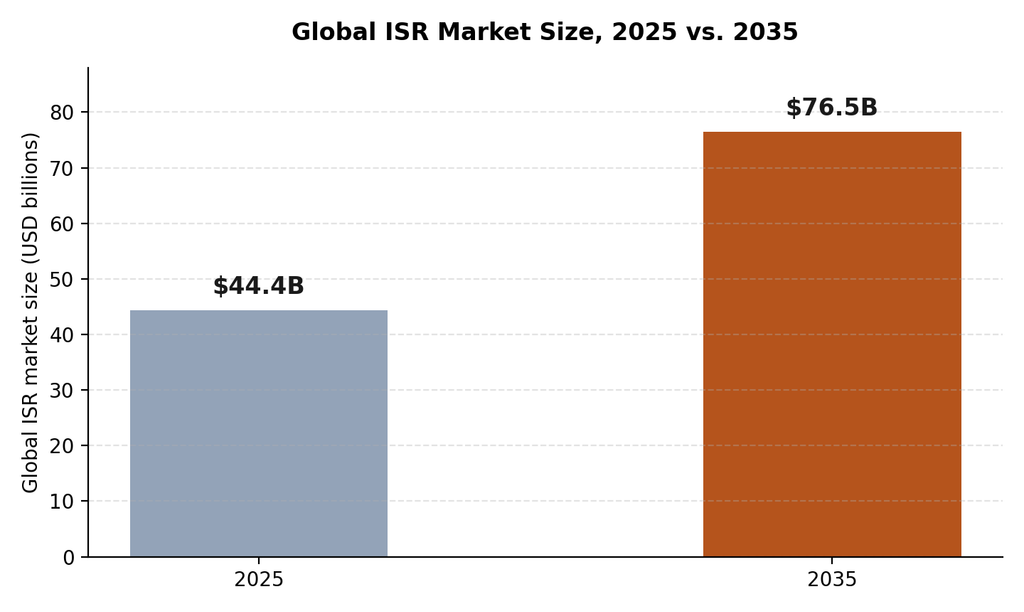
Global ISR market size, 2025 versus 2035, according to Future Market Insights.
What does the shift from centralized to distributed edge intelligence actually mean operationally?
The importance of edge intelligence in defense contexts will naturally keep increasing as the underlying architecture shifts. Instead of centralized control, where a single command point processes and interprets data gathered from the field, future defense systems increasingly consist of networks of intelligent edge platforms collaborating in real time. Each platform, whether a drone, an unmanned ground vehicle, or a wearable system, carries enough onboard intelligence to interpret its own surroundings and flag what matters, rather than transmitting a continuous stream of raw, unfiltered data for someone else to interpret later.
What should a defense organization evaluate in a tactical situational awareness system?
- Reliability without continuous connectivity: the system should remain operationally useful even if its link back to command is degraded or temporarily lost.
- Size, weight, and power constraints: a wearable system faces very different SWaP limits than a vehicle-mounted or airborne platform.
- Environmental ruggedness: field conditions demand hardware that performs reliably in extreme temperatures, moisture, and physical shock.
- Onboard analytics capability: the ability to detect anomalies, track objects, and flag threats directly on the device, not only after data reaches a command post.
How does naval ISR extend the same situational awareness architecture to a different domain?
Coastal and maritime monitoring presents a distinct set of operating conditions from land or airborne tactical use, but the underlying situational awareness requirements carry over directly. Unmanned surface vessels and patrol boats used for coastal monitoring depend on the same combination of onboard video capture, compression, and, increasingly, onboard AI analysis that airborne and ground-based tactical systems rely on, adapted to withstand salt exposure, vessel motion, and the specific communication constraints of maritime environments. That consistency matters operationally: a defense organization already familiar with one domain’s edge processing architecture can extend a broadly similar approach to naval ISR rather than building an entirely separate technology stack from scratch.
Why does response time matter as much as detection accuracy in tactical situational awareness?
A system that eventually identifies a threat accurately but takes too long to deliver that information provides limited practical value in a fast-moving tactical situation. Response time, the interval between an event occurring in the field and that information reaching a decision-maker, depends on every stage of the pipeline working quickly together: capture, encoding, any onboard AI analysis, transmission, and finally display to an operator. Edge-based architectures specifically compress this timeline by performing detection and classification at the point of capture rather than only after data reaches a centralized analysis point, which is precisely why response time, not just eventual accuracy, has become a defining requirement for modern tactical situational awareness systems.
Frequently Asked Questions
What’s the difference between military situational awareness and a tactical situational awareness system?
Military situational awareness is the broader operational goal, understanding the battlespace in real time. A tactical situational awareness system is the specific hardware and software architecture, often edge-based, that delivers that awareness at the unit or platform level.
Why does edge processing matter more for tactical systems than centralized systems?
Tactical environments often involve unreliable or contested communication links. A system with onboard edge processing can continue detecting and interpreting its surroundings even when a connection to a centralized command post is degraded or unavailable.
Can the same underlying technology support both drones and wearable systems?
Yes, in principle, since both rely on the same core edge AI video processing pipeline: acquisition, encoding, AI analysis, and secure transmission. The physical form factor and power budget differ significantly, but the underlying architecture can scale across both.
Is ISR market growth being driven mainly by traditional military spending or newer technology adoption?
Both factors play a role, but sustained investment increasingly reflects a shift toward continuous, real-time intelligence capabilities rather than simply expanding traditional platform counts, which favors modern edge-processing architectures specifically.
