
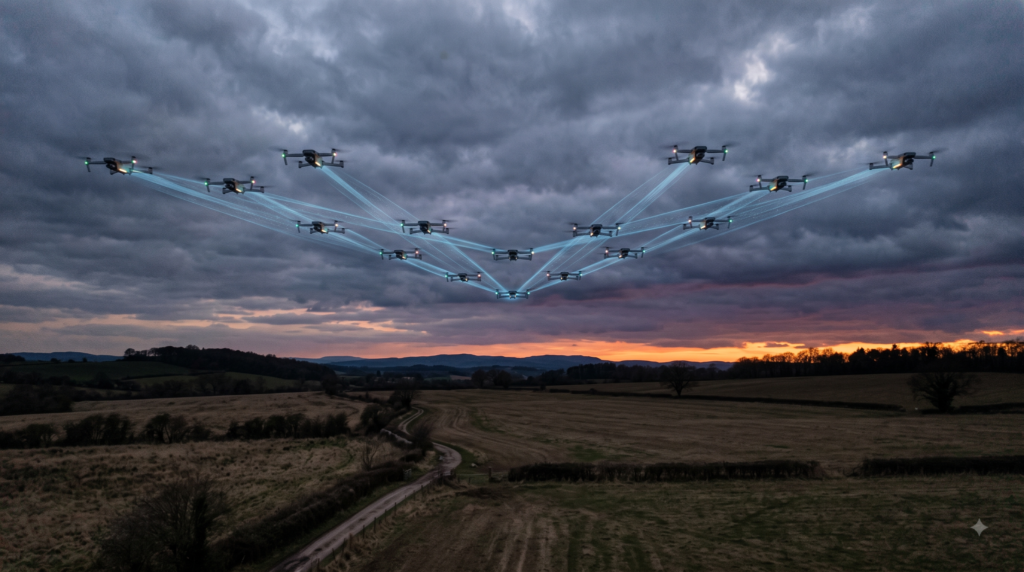
| Key Takeaways • A true drone swarm is defined by coordination under a shared architecture, not simply by flying multiple drones in the same airspace. • Drones coordinate through one of four established models: centralized control, consensus voting, hierarchical squads, or emergent behavior based on reacting to nearby units. • The global counter-drone swarm systems market was valued at about $785 million in 2025 and is projected to reach roughly $2.3 billion by 2035 as multi-drone threats grow more common. • Communication bandwidth, energy efficiency at scale, and security of the coordinating AI remain the primary open challenges limiting large real-world swarm deployments. |
What is a military drone swarm, and how is it different from a group of drones?
A military drone swarm is a set of unmanned aerial vehicles that operate as a single coordinated system rather than as individually piloted aircraft, sharing sensor data and splitting tasks among themselves in real time. Researchers draw a sharp line here: a true swarm functions collaboratively under a shared architecture, while “a multitude of uncoordinated unoccupied systems does not constitute a swarm; it represents a flood.” a peer-reviewed review of swarm coordination techniques breaks down the models researchers use to describe that coordination, from consensus voting among drones to a single centralized controller.
How do drones coordinate with each other inside a swarm?
Drones inside a swarm coordinate through one of a small number of established control models: centralized control, where one controller assigns tasks; coordination by consensus, where units vote or bid on actions; hierarchical control, where squad-level agents report to a higher controller; and emergent coordination, where behavior arises from units simply reacting to their neighbors, similar to schools of fish. Artificial intelligence is what makes the difference at scale, letting many low-cost drones “function as a cohesive system instead of isolated units,” which raises both decision speed and the swarm’s overall survivability without a human operator managing each aircraft individually. Which model a given system uses tends to track its mission: a small reconnaissance swarm might rely on hierarchical control so a single operator retains oversight, while a larger defensive shield made up of dozens of low-cost units leans more on consensus or emergent coordination, since no single point of failure should be able to take the whole formation down. a deeper technical look at how swarm coordination models work in practice walks through how these coordination layers interact with the video and telemetry each drone is capturing.
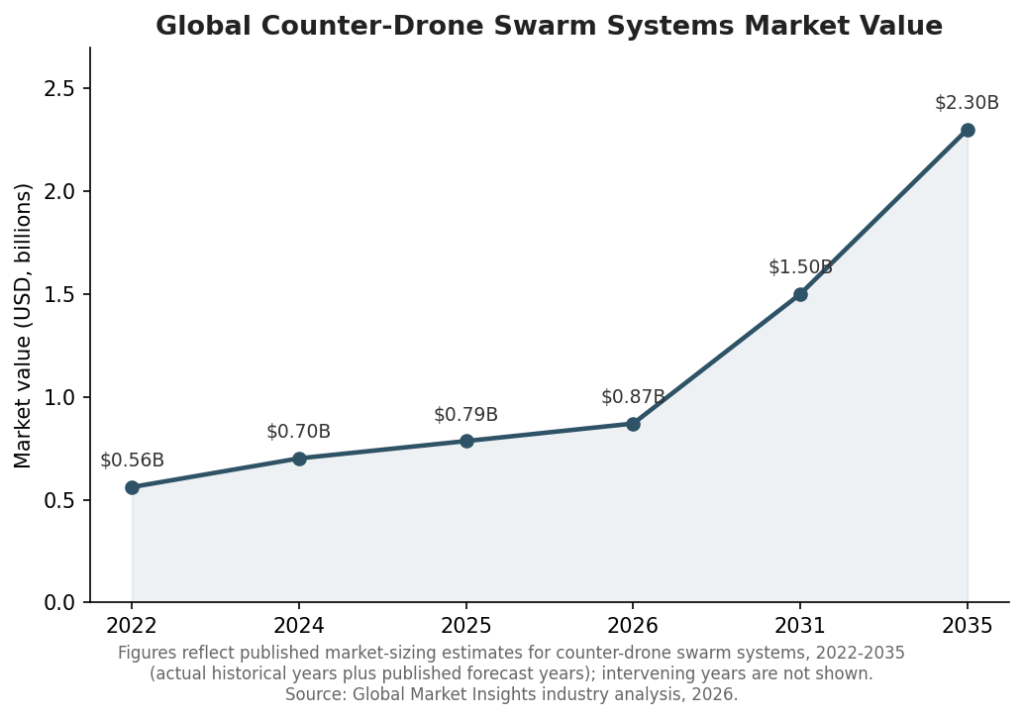
Global counter-drone swarm systems market value, 2022-2035 (published base years and forecasts). Source: Global Market Insights.
Why are militaries investing in counter-swarm defense right now?
Militaries are investing in counter-swarm defense because low-cost, mass-produced drones can now be launched in numbers large enough to overwhelm traditional point-defense systems built for one threat at a time. U.S. Africa Command demonstrated this shift directly: in February 2026 it tested a system called Project CURTAIN CALL, which “strategically integrates commercially available drones and sensors” to generate “a synchronized swarm of unmanned aerial vehicles, forming a coordinated defensive shield against inbound attacks.” As AFRICOM’s Lt. Col. Jared Bindl put it, “we need agile and affordable solutions to protect our forces,” and using swarms as a defensive shield rather than custom-built interceptors is precisely how the program keeps cost down. The test was run specifically for force protection across the African continent, where deployed troops face a growing threat from cheap, mass-produced drones that would be expensive to counter one at a time with traditional, purpose-built interceptor systems. AFRICOM’s own account of the CURTAIN CALL demonstration details how the test was run and what it means for force protection going forward.
How do defense agencies actually test a new counter-swarm system before fielding it?
New counter-swarm systems are typically tested through controlled demonstrations that run under a formal experimentation program rather than jumping straight to full deployment, so weaknesses show up on a range before they show up in an actual engagement. The CURTAIN CALL demonstration is a case in point: it was run in partnership with Joint Staff J7’s Warfighter Laboratory Incentive Fund, a program specifically set up to trial promising but unproven concepts, and organizers described the test as having “successfully identified both strengths and limitations to inform future development phases” rather than declaring the system finished. That framing matters for how quickly these systems can actually reach the field: a program built around commercially available drones and sensors, evaluated iteratively, can move from concept to a working demonstration far faster than a traditional custom-engineered defense acquisition program.
What is attritable autonomy, and why does it matter for swarm tactics?
Attritable autonomy refers to low-cost, expendable autonomous systems that a force can afford to lose in a high-risk mission, which is exactly the economic logic that makes large drone swarms viable in the first place. Rather than fielding a small number of expensive, hard-to-replace platforms, a swarm built on attritable autonomy spreads risk and sensing capability across many cheaper units, so losing any single drone barely changes the mission outcome.
What still limits drone swarm technology today?
The biggest limits on drone swarm technology today are communication reliability and real-world scale: published research notes that “delays in communication, packet loss, and bandwidth constraints may disrupt collaborative operations among agents,” and that most published solutions remain simulation-driven or limited to small, uniform swarms rather than the large, mixed fleets militaries actually want to field. Energy efficiency at scale and security of the machine-learning models coordinating the swarm are also flagged as open problems rather than solved engineering, since a multi-agent system that is easy to jam or spoof loses most of its tactical advantage regardless of how well its coordination logic performs in a controlled test. On the hardware side, each aircraft in a swarm still needs to capture, compress and transmit its own video feed reliably under those same bandwidth constraints, which is why compact drone video and payload systems designed specifically for small, power-limited airframes matter as much as the coordination software sitting on top of them. a field guide to how UAV video data links keep drones connected covers that single-aircraft data link problem in more depth, which only gets harder once dozens of aircraft need their own reliable link at the same time.
How is drone swarm technology used outside the military?
Outside the military, drone swarms are already used for environmental monitoring, disaster response, search and rescue, and large synchronized light-show displays; Intel flew 2,018 UAVs in a single coordinated display back in 2018, an early public demonstration of swarm-scale coordination. Disaster response teams have looked at the same coordination logic for search and rescue, where a swarm can divide a large search area among many aircraft and report back faster than one aircraft flying a single search pattern over the same ground. Package delivery and logistics networks are exploring the same coordination models for a different reason: covering a wide delivery area with many small, cheap vehicles instead of a few large ones. The underlying technical challenge, keeping many aircraft synchronized on limited bandwidth, is the same one defense programs are working through, which is part of why research from both sectors keeps referencing the same coordination frameworks.
Frequently Asked Questions
What is the difference between a drone swarm and a group of drones flying together?
A drone swarm is coordinated under a shared architecture so the aircraft act as one system, while a group of drones flying independently without shared coordination is not considered a true swarm by researchers, even if it looks similar from the ground.
How many drones are needed to form a swarm?
There is no fixed minimum, but demonstrations have ranged from a handful of coordinated aircraft in early military tests up to over 2,000 drones in large-scale civilian light displays, with the coordination model, not the raw count, defining whether it qualifies as a swarm.
What is a counter-drone swarm system?
A counter-drone swarm system is a defensive technology designed to detect, track and neutralize incoming drone swarms, and the global market for these systems was valued at roughly $785 million in 2025 and is projected to grow to about $2.3 billion by 2035.
What is attritable autonomy?
Attritable autonomy describes low-cost autonomous systems that a military force can deploy in large numbers and afford to lose in high-risk missions, which is a key economic reason drone swarm tactics are becoming more common.
