
A drone is only as useful as the video it can get back to an operator. The airframe, the flight controller and the battery all matter, but none of them do much good if the footage never makes it to the ground in a usable, timely form. That job falls to the video payload and the data link carrying its signal, two pieces of the system that rarely get the attention they deserve until something goes wrong in the field.
What is actually inside a drone video payload
A typical drone video payload systems setup is really three components working together: a camera or sensor (electro optical, thermal, or both), an encoder that compresses the resulting video for transmission, and a transmitter that pushes the compressed stream over a wireless link. Each stage has to fit within a drone’s tight size, weight and power budget, which is why this category of hardware tends to look nothing like consumer video equipment. According to Fortune Business Insights, camera and sensor payloads, particularly electro optical and infrared systems, account for close to 40 percent of the entire drone payload market by capability type, underscoring how central video specifically is to what most UAVs are actually deployed to do.
Why compression choice matters more on a drone than almost anywhere else
Every other article about video encoding treats bandwidth as a cost to manage. On a drone, it is a hard physical limit. The wireless spectrum available to a small aircraft is narrow, often contested, and shared with control and telemetry data that cannot be interrupted without risking the aircraft itself. That is why UAV specific encoders lean heavily on modern, efficient codecs rather than legacy standards. Getting more visual information through the same limited channel, without adding processing delay, is the entire point of the exercise.
The data link is where most field problems actually happen
A UAV data link carries video, telemetry and control signals over a single wireless connection, and it is usually the first thing to degrade as range increases, terrain interferes, or the operating environment gets electronically noisy. A few factors determine whether a data link holds up.
- Range and line of sight. Signal strength drops with distance and any obstruction, which is why link budget calculations matter as much as encoder efficiency.
- Latency. A live feed that arrives half a second late is of limited use for time sensitive missions like reconnaissance or target tracking, even if the image quality is excellent.
- Resilience to interference. Forward error correction and similar techniques let a receiver reconstruct a clean signal even when some data is lost in transit, which matters enormously in contested or crowded electromagnetic environments.
- Security. Encrypted drone video transmission prevents a feed from being intercepted or spoofed, a requirement that has become non negotiable for defense and many commercial operators alike.
How this fits into a growing market
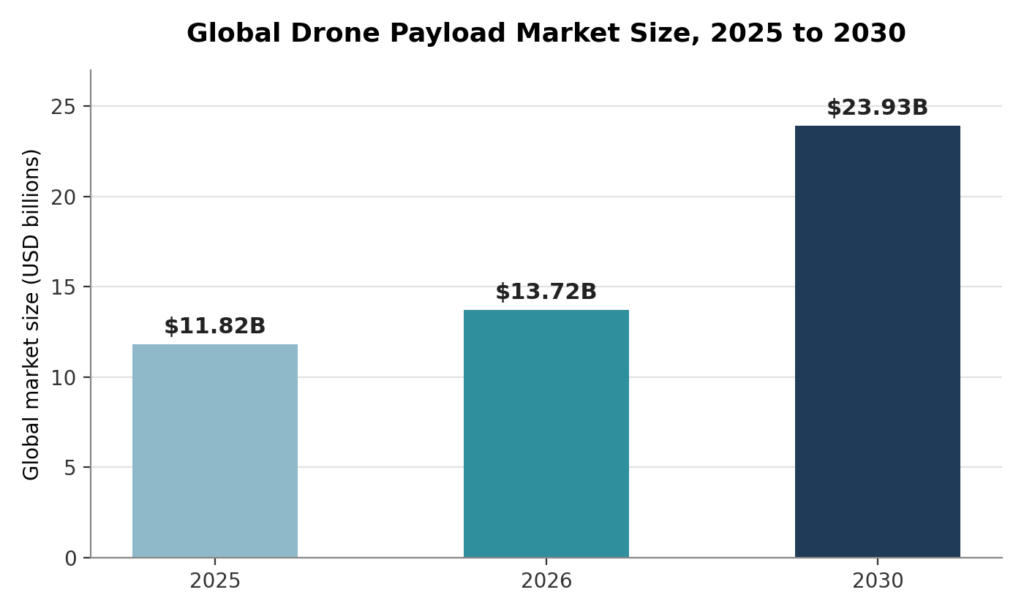
The numbers back up how much attention this category is getting. Research published via Fortune Business Insights puts the global drone payload market at 11.82 billion US dollars in 2025, growing to 13.72 billion dollars in 2026 and a projected 23.93 billion dollars by 2030, a compound annual growth rate of nearly 15 percent. Growth at that rate is being driven less by new airframes and more by demand for better sensors, sharper video, and more reliable links, exactly the components covered above.
Miniaturization is the other half of the story
Alongside compression and link reliability, physical size has become its own competitive category. Smaller drones, particularly in the tactical and covert category, can only carry payloads that fit within very tight size, weight and power allowances, sometimes measured in grams rather than kilograms. That constraint has pushed manufacturers toward highly integrated boards that combine encoding, and in some cases onboard AI processing, into a footprint that used to require a much larger enclosure. The tradeoff is that smaller payloads generally support fewer simultaneous video streams or lower resolutions, so mission planners still have to weigh size against capability for each specific platform.
Frequently asked questions
What is the difference between a drone video payload and a regular video camera? A drone payload integrates a camera or sensor with a purpose built encoder and transmitter designed to operate within the tight power, weight and bandwidth limits of an unmanned aircraft, something a standard consumer camera is not built to do.
How far can a UAV data link transmit video? Range depends heavily on frequency, transmit power, antenna design and terrain, and can vary from a few kilometers on small tactical drones to well beyond visual line of sight on larger platforms with dedicated relay infrastructure.
Why does latency matter so much for drone video? For missions that involve tracking a moving target or flying near obstacles, even a half second of delay between what the camera sees and what the operator sees can be the difference between a timely decision and a missed one.
Can drone video be transmitted securely? Yes, encryption and secure data link protocols are standard on defense grade systems specifically to prevent interception or spoofing of the video feed.
