
| Key Takeaways • Google handled about 98% of search in Israel in June 2026, so B2B SEO there is effectively Google SEO. • Bing held about 3.55% of desktop search and 0.08% of mobile search at the host level in Israel in June 2026, which makes it a low-priority channel. • Google recommends declaring Hebrew and English versions of a page explicitly with hreflang, and each version must list itself and all the other versions. • Buyers decide the language mix: English for international buyers, Hebrew for local ones, and native writing for each. |
How is B2B SEO in Israel different from SEO in larger markets?
B2B SEO in Israel is effectively Google SEO, because Google handled about 98% of search in the country in June 2026. StatCounter’s search engine data for Israel puts Google at 98.33%, Bing at 1.14%, Yandex at 0.33% and DuckDuckGo at 0.1% for that month. In markets where several engines split the audience, teams must plan separate programs, but in Israel the engine question is settled, and the real differences come from language, audience and how far the buyer is from the company. Companies that sell to local buyers and to international ones at the same time often need two search strategies inside one website. For companies in that position, an international search strategy for technology companies is built around the markets they want to reach, so the target markets are decided before any keyword work begins.
Should a B2B site in Israel publish in Hebrew, English, or both?
A B2B site should publish in the language its buyers search in, which for many Israeli technology companies means English for international buyers, Hebrew for local ones, or both. The decision follows the sales strategy rather than the company’s location. A company that sells mainly to buyers in North America or Europe needs strong English content, while a company serving Israeli hospitals, factories or government bodies needs Hebrew pages that match how local buyers phrase their searches. Some companies need both, and the content for each audience should be written natively, not translated line by line. Software companies can find a related overview in a B2B SaaS digital marketing resource, since a software vendor’s search terms differ from those of a hardware manufacturer.
How do you tell Google about Hebrew and English versions of a page?
Use hreflang annotations so Google can point searchers to the version of a page that matches their language or region. Google’s guide to localized versions of a page says it may find alternate versions without annotations, but recommends declaring them explicitly. The rules are specific: each language version must list itself as well as all the other versions, the alternate URLs must be fully qualified, and if two pages do not point to each other the tags are ignored. Google also suggests an x-default fallback for unmatched languages, which suits a home page that offers a language selector. The annotations can be placed in HTML head elements, HTTP headers or an XML sitemap, and Google describes the three methods as equivalent.
Translation depth matters as well. Google treats localized versions as duplicates only if the main content stays untranslated, so a Hebrew page where only the navigation and footer are translated does not count as a distinct version. For a deeper reference, Google’s guide to localized versions of your pages lists the exact syntax for each method.
Does Bing matter for B2B SEO in Israel?
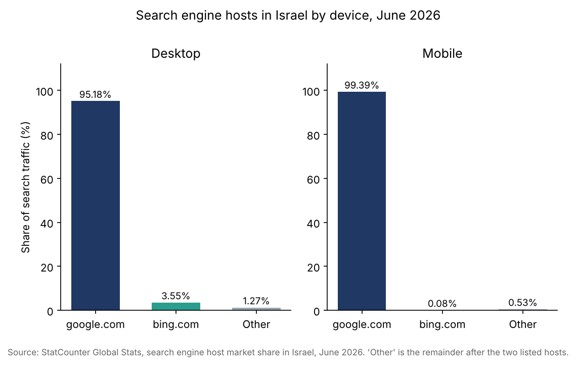
Bing matters only slightly, but its share is larger on desktop than on mobile. In June 2026, StatCounter’s host-level data shows google.com at 95.18% and bing.com at 3.55% of desktop search in Israel, while on mobile google.com reached 99.39% and bing.com only 0.08%. Because B2B research often happens during working hours, a desktop-heavy audience is plausible for some products, which makes a basic Bing check reasonable. It is a low-priority item, however: the largest gains for nearly every B2B site in Israel will come from work that serves Google.
What should a B2B SEO program in Israel cover first?
A practical B2B program starts with a short list of priorities, matched to the market and the sales cycle:
| Priority | Why it comes first | What to check |
| Target markets | Determines language, keywords and page structure | Which countries and languages the buyers search from |
| Language versions | Prevents duplicate or misdirected pages | Hreflang pairs, x-default, fully translated main content |
| Technical foundations | Lets Google crawl and understand the site | Crawlable templates, right-to-left layout for Hebrew pages, page speed |
| Buyer-intent content | Matches long, research-heavy sales cycles | Pages for problems, comparisons and technical evaluation |
| Reporting | Shows what is working by market and language | Search Console data split by country and page |
Hebrew is written right to left, so templates, forms and tables on Hebrew pages need layout testing in addition to translation. Technology companies often need subject-matter input as well, since the buyers often include engineers and technical managers who judge a page by its precision. Content that explains a standard, a specification or a technical trade-off clearly can serve both the reader and the search engine better than general marketing copy.
How can Search Console show whether the right countries are finding the site?
Filter the Search Console Performance report by country and compare impressions and clicks for each target market. A B2B site in Israel that sells abroad can use this view to check whether buyers in North America, Europe or Asia are reaching the pages written for them, and whether Israeli visitors are landing on the Hebrew versions. Comparing the top pages for each country shows when an English page is attracting the wrong audience or when a language version is not being shown at all. Reviewing the country split every month, alongside the language versions published, turns a general SEO program into one that can be held accountable to specific markets. When one market shows impressions but few clicks, the page title and description for that language are the first things to revisit.
How should a company choose an SEO partner for B2B in Israel?
Choose a partner on evidence of B2B and technical capability, multilingual implementation experience and transparent reporting, rather than on promises of rankings. Capabilities worth checking include in-house development resources, experience with the markets the company targets, and the ability to implement multilingual structures such as hreflang correctly. Israel-based agencies such as Inter-Dev list B2B technology focus, in-house development resources and multilingual implementation among their SEO capabilities, which maps closely to the checklist above. Whichever agency a company evaluates, asking how reporting is split by country and language shows quickly whether the team understands the multi-market problem.
Questions about the process help as well. Ask how keywords are chosen for products with long sales cycles, how content is reviewed by technical experts, and how results are reported to sales and marketing leaders. Clear answers to these questions say more about a partner’s approach than a list of past clients or an award badge.
Frequently Asked Questions
Which search engine do people use in Israel?
Google is used for about 98% of searches in Israel, with Bing at about 1.1% and Yandex at about 0.3% in June 2026 according to StatCounter.
Do I need hreflang for a Hebrew and English website?
Yes, Google recommends declaring language versions explicitly with hreflang annotations, and each version must list itself and all the other versions for the tags to work.
Does Bing matter for B2B SEO in Israel?
Bing is a minor channel in Israel, with about 3.55% of desktop searches and about 0.08% of mobile searches at the host level in June 2026, so it is a low-priority check.
Should B2B companies in Israel write content in Hebrew or English?
They should write in the language their buyers search in, which means English for international buyers, Hebrew for local buyers, or both, with each version written natively.
