
| Key Takeaways • A custom equipment case is engineered around the exact dimensions and handling needs of one device instead of adapting a stock size. • Custom, semi-custom and standard cases differ mainly in fit, protection level, brand customization, compliance control and speed to market. • Custom cases carry tooling cost upfront, so they tend to become more economical as production volume rises. • A shaped interior limits movement in transit, and protection should be verified by testing the case with the real equipment inside. |
What is a custom equipment case?
A custom equipment case is a protective case engineered around the exact dimensions, weight and handling needs of one piece of equipment, instead of a stock size adapted to fit. Tooling, materials and interior layout are all chosen for that device.
The approach starts with how the equipment is used: where it travels, how often it is opened, which accessories go with it and what regulations apply. Custom carrying cases engineered around exact product specifications are typically developed from prototype to production, with the manufacturing technology chosen to fit the device rather than the other way around. For readers new to the topic, what a custom-made equipment case involves is a useful starting point.
How do custom, semi-custom and standard cases differ?
A custom case is fully engineered around the device and offers the highest protection and control, a semi-custom or hybrid case adds logo and foam options to a proven platform, and a standard case uses fixed sizes with minimal adaptation. The trade-off is mainly between fit, control and speed.
| Factor | Custom case | Semi-custom (hybrid) | Standard case |
| Fit and integration | Fully engineered | Semi-custom | Standard sizes |
| Protection level | Maximum | Semi-rigid | Standard |
| Brand customization | Fully integrated | Logo and foam options | Minimal |
| Compliance control | Full | Strong | Limited |
| Typical order size | Larger programs | Any quantity | Any quantity |
| Speed to market | Medium | Immediate | Immediate |
Fully custom is only one option. A comparison of fully custom, semi-custom and padded hard case options shows how the middle tier can serve programs that need some tailoring without a full tooling investment.
When does a custom equipment case cost less than an off-the-shelf case?
A custom case tends to cost less overall once volume is high enough to spread its tooling cost and once the avoided cost of modifications and damage is counted. Below that point, a stock or semi-custom case usually wins on price.
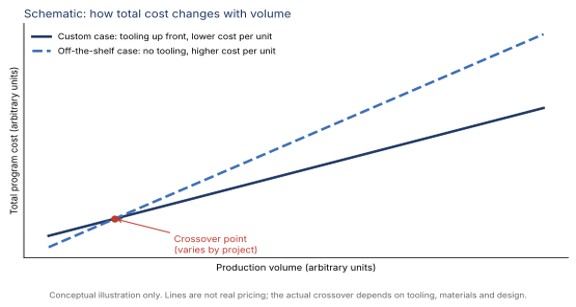
Three effects drive the shift. First, off-the-shelf cases are designed for a broad audience, so they can include features the equipment does not need, such as high-level water resistance or heavy locks, and those extras add up at scale. Second, stock cases often need modifications, including cutting holes for connectors, resizing compartments or adding reinforcement, and each change adds cost. Third, scaling a single design reduces cost per unit, which stock options rarely allow.
Volume guidance varies by manufacturer. Shell-Case, for example, notes that custom projects typically begin at around 500 units and that, above that level, they often become more cost effective than adapting stock cases. Real decisions depend on the tooling required, the materials chosen and the cost of damaged equipment, so a quotation is the only reliable answer.
How does a custom fit protect equipment better?
A shaped interior holds the equipment in place so it cannot shift during transport, and movement is one of the main ways products get damaged. Where loose fill can migrate and lose its protective function, a form-fitted insert stays where it was designed to be.
Packaging trade press makes the same point about foam in general: molded foam is manufactured to fit the product it protects, which lets it cushion effectively while reducing wasted volume. Loose void fill, by contrast, can shift to the bottom of a container during shipping and stop protecting the product.
Fit is not the whole story, because protection also has to be verified. ASTM D4169 offers a uniform system for evaluating shipping units at test levels meant to represent actual distribution, and drop testing with the real equipment inside shows whether the interior, the shell and the closures work together.
What does the custom case process look like?
Custom case projects generally move through four stages: define the requirements, design and engineer the case, validate it with prototypes and testing, and then produce it at scale. Validation is the stage that catches problems before they reach the field.
- Define: gather the technical requirements, usage scenarios and quality standards for the device.
- Design: develop the architecture, materials, branding and ergonomics, and prototype how the case interacts with the product.
- Validate: build tooling and prototypes with real materials, and verify durability and compliance before mass production.
- Produce: transfer the design into scalable manufacturing with documented quality assurance.
Compliance runs through all four stages. Industries such as healthcare, aerospace and defense have regulatory requirements that stock cases may not meet without retrofitting, so building compliance into the original design is usually cheaper than adding it later.
What should a brief for a custom equipment case include?
A good brief describes the device, the environment and the program, because those three sets of facts decide the technology, the materials and the price. The more precisely they are written down, the fewer redesigns follow.
- Device facts: dimensions, weight, ports, controls and the accessories that travel with it.
- Use conditions: how often the case is opened, who carries it and what it is exposed to, such as water, dust, cleaning agents or repeated drops.
- Compliance needs: the quality system, material restrictions and cleaning requirements that apply to the device and its market.
- Brand requirements: logo placement, colors, embossing and finishing details.
- Program facts: expected volume, delivery regions and the schedule for launch and reorders.
Writing the brief also exposes decisions that are easy to postpone. If the equipment must be operated or charged while it stays inside the case, for example, the opening and port layout belong in the first concept rather than in a late revision.
When is an off-the-shelf or semi-custom case the better choice?
An off-the-shelf or semi-custom case is the better choice when quantities are small, the schedule is short or the equipment design is still changing. These cases ship immediately, avoid tooling and still allow branding and foam interiors.
The wheeled Hybrid 500 illustrates the semi-custom route: it accepts custom foam inserts cut to the device, which suits smaller runs that need organization and protection without a dedicated mold. If the program later grows, the same device can move to a fully custom case with the benefit of what the semi-custom stage revealed about real usage.
Frequently Asked Questions
What is the difference between a custom and an off-the-shelf equipment case?
A custom case is engineered around one device with its own tooling, while an off-the-shelf case uses fixed sizes and features designed for a broad audience.
At what quantity does a custom equipment case make sense?
One manufacturer’s published guidance puts the typical starting point for custom projects at about 500 units, although the real figure depends on tooling, materials and design.
Can custom equipment cases include branding?
Yes, custom cases can integrate logo plates, brand colors, embossed surfaces and custom zipper pulls into the design from the start.
Is a custom case slower to get than a stock case?
Yes, custom cases have a medium speed to market because design, tooling and prototyping come first, while stock and semi-custom cases are available immediately.
