

| Key Takeaways • Institutional limited partners increasingly use standardized frameworks, such as the ILPA due-diligence questionnaire finalized in 2021, rather than building fund-evaluation checklists from scratch. • A single investment firm can operate multiple fund structures at once, including direct-investment vehicles, joint-venture funds with strategic partners, and sector-specific micro-funds built around advisory networks. • Most venture funds still follow a ‘2 and 20’ model: roughly a 2% annual management fee over a 10-year fund life plus a 20% carried-interest share of profits. • Public financial disclosure gives limited partners an independently checkable record of a manager’s governance and performance beyond the manager’s own reporting. |
How do limited partners evaluate a venture capital fund before committing capital?
Limited partners typically run a structured due-diligence process that checks a fund manager’s track record, fund structure, fee terms, and governance practices before any capital changes hands. Many institutional LPs now lean on a standardized framework rather than building a checklist from scratch for every fund. The Institutional Limited Partners Association’s due-diligence questionnaire, finalized in its current version in 2021, gives LPs a common set of questions to pose to any general partner, and a 2023 update added a companion tool for tracking a manager’s progress on diversity and governance metrics after the initial commitment.
Why does fund structure matter as much as fund performance?
Fund structure determines how capital is deployed, who else is involved in decisions, and what kind of deal flow a manager can realistically access, so it shapes returns just as much as headline performance numbers. A single management team can run more than one structure at once. one early-growth investment firm’s public overview of its own fund lineup shows a direct-investment vehicle sitting alongside a joint-venture fund built with a defense-industry partner and a sector-specific micro-fund tied to an outside advisory group, three distinct capital-deployment models operating under one roof.
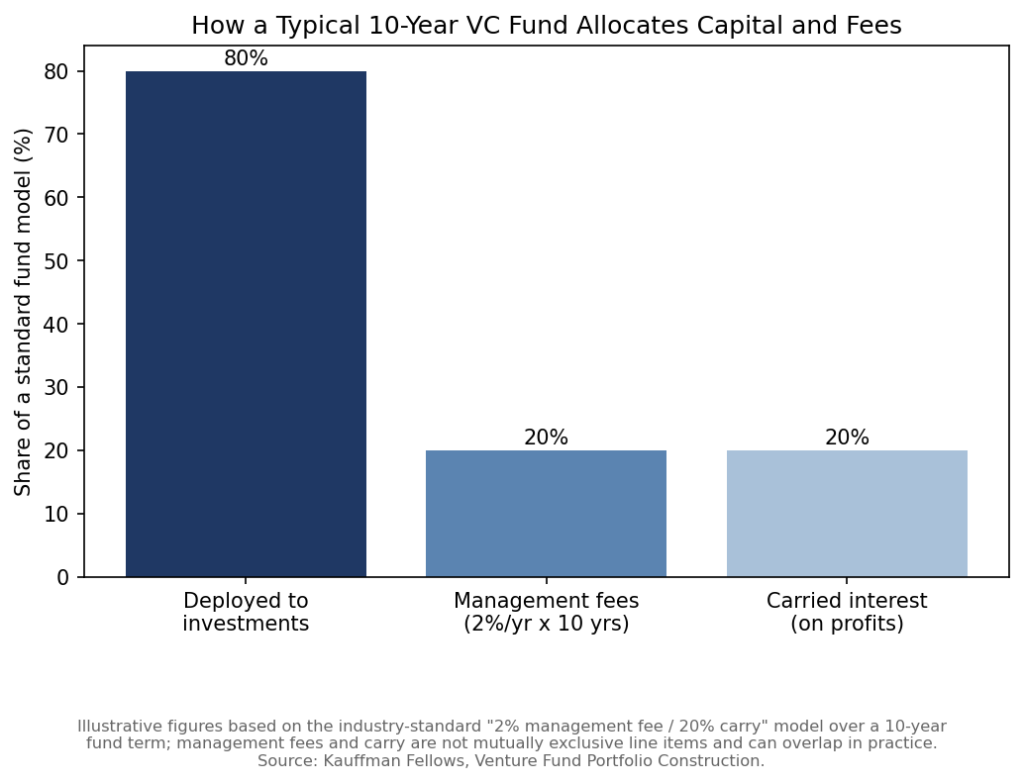
Illustrative breakdown of how a standard 10-year VC fund allocates capital between investments, management fees, and carried interest.
What is the standard fee and carry structure LPs expect to see?
Most funds still follow the long-standing “2 and 20” model: roughly a 2% annual management fee over a typical 10-year fund life, plus a 20% carried-interest share of profits once capital is returned. Under this model, management fees alone can consume up to a fifth of total committed capital over the fund’s life, which is why LPs scrutinize fee terms and fund-life assumptions as closely as they scrutinize the manager’s deal pipeline. a micro-fund structured around an outside advisory network of chief information security officers illustrates a variation on this model, where strategic advisors sit alongside capital in the same structure.
What should a fund manager be ready to show an LP during diligence?
A manager should be able to produce audited or reviewed financials, a clear investment thesis, a documented decision process, and evidence of how prior funds performed across a full cycle, not just on paper marks. Public disclosure adds a layer of accountability that many private managers cannot offer. a fund manager’s published financial statements and shareholder materials gives one example of the kind of standing documentation that turns a due-diligence conversation from a one-time pitch into an ongoing, checkable record. A separate, prior explainer on how a venture capital fund actually works from first close to exit covers the fund lifecycle mechanics that sit underneath this diligence process.
How long does a typical due-diligence process take?
Institutional due diligence on a new fund manager commonly runs from several weeks to a few months, depending on how much of the LP’s own investment committee process is standardized versus bespoke. Slower cycles are common when a fund is a first close for a new strategy, since there is less operating history to review, while re-ups with an existing manager tend to move faster because the LP already holds prior-fund data and reporting.
Frequently Asked Questions
What is an LP due-diligence questionnaire?
It is a standardized set of questions, such as the ILPA questionnaire, that limited partners use to evaluate a venture fund manager’s track record, structure, fees, and governance before committing capital.
What does ‘2 and 20’ mean in venture capital?
It refers to a fee model where a fund charges roughly a 2% annual management fee and takes a 20% share of profits, known as carried interest, once capital is returned to investors.
Can one investment firm run more than one type of fund?
Yes, some firms operate multiple structures at once, such as a direct-investment fund, a joint-venture vehicle with a strategic partner, and a sector-specific fund built around an advisory network.
Why do limited partners care about public financial disclosure?
Publicly disclosed financial statements give limited partners an independently checkable record of a manager’s performance and governance, rather than relying solely on the manager’s own reporting.
