
| Key Takeaways • Gartner forecasts that task-specific AI agents will appear in 40% of enterprise applications by the end of 2026, up from under 5% in 2025. • Agentic AI security focuses on monitoring and constraining what autonomous agents actually do at runtime, not just reviewing the code that defines them. • “Excessive agency”, an agent acting beyond its intended scope, is one of the most cited risks as enterprises move from AI assistants to autonomous agents. • Effective agent oversight requires real-time policy enforcement and full visibility into each agent’s decision chain, not just after-the-fact log review. |
What is agentic AI security, and how is it different from traditional application security?
Agentic AI security is the set of controls that monitor, constrain, and audit what an autonomous AI agent actually does once it has been granted permission to act, rather than reviewing only the code that defines it. Traditional application security assumes a human approves each meaningful action; agentic systems remove that assumption by design, since the agent is built to plan and execute multi-step tasks on its own, often chaining together decisions across several connected tools before a person is even aware the task is running. That shift moves the security question from “was this code written safely” to “is this agent’s behavior, at every step, staying inside the scope it was given,” which is a fundamentally different thing to monitor since the same agent, prompt, and permissions can still produce different action sequences from one run to the next. A platform built to monitor and govern autonomous AI agent behavior is one response to that shift, focused on tracking agent decisions and enforcing policy while tasks are still in progress rather than after the fact, since by the time a static log review catches an issue, the agent has typically already completed the action.
How fast is agentic AI actually being adopted inside enterprises?
Adoption is accelerating far faster than most security programs are built to handle. Gartner forecasts that task-specific AI agents will be integrated into 40% of enterprise applications by the end of 2026, up from less than 5% in 2025, an eightfold jump in a single year. The same research projects agentic AI could represent roughly 30% of enterprise application software revenue by 2035, potentially exceeding $450 billion, up from about 2% of that revenue in 2025. For security and IT leaders, that trajectory means agent-driven workflows are moving from pilot projects to default functionality inside the software enterprises already run, often faster than governance policies are updated to account for them. It also means the agents showing up inside a given enterprise’s software stack are frequently arriving embedded in tools that were procured and approved long before anyone evaluated them for agentic risk specifically, which is a very different rollout pattern than deliberately adopting a new AI platform.
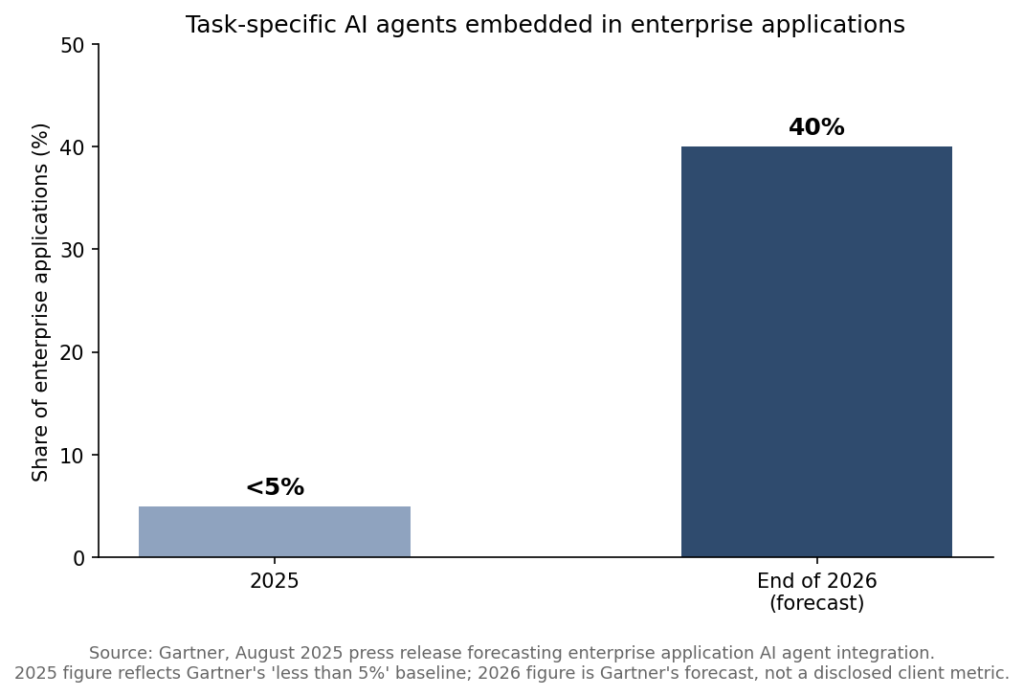
Gartner forecasts task-specific AI agents will appear in 40% of enterprise applications by the end of 2026, up from under 5% in 2025.
What can go wrong when an AI agent is given too much autonomy?
The most commonly cited failure mode is “excessive agency”: an agent operating beyond the scope it was actually intended to have, whether by generating harmful outputs, exceeding the permissions it was granted, or being manipulated by an outside party into taking an action it should have refused. Because agents are designed to chain decisions together without a human confirming each one, a single misjudged step can cascade into actions across connected systems before anyone notices, particularly when an agent has access to multiple internal tools, data stores, or third-party integrations as part of its normal operating scope. A broader breakdown of the enterprise AI risks security teams are tracking this year places excessive agency alongside shadow AI and data exfiltration as one of the risk categories enterprises are actively building controls around, rather than treating it as a future problem. A closer look at where AI guardrails tend to break down under real agentic workloads examines several concrete ways static guardrails fail once an agent is handling multi-step, real-world tasks instead of a single scripted response, which is a useful reminder that a guardrail designed for a chatbot doesn’t automatically transfer to a system capable of taking real-world actions.
What specific categories of risk does an enterprise need to build controls for as agent adoption scales?
Three categories tend to recur across agentic deployments: agents producing harmful or noncompliant outputs, agents exceeding the permissions they were explicitly granted, and agents being exploited by an outside actor who feeds them manipulated instructions or data. Each of these maps to a different kind of control. Output-related risk calls for policy enforcement on what an agent is allowed to say or generate; permission-related risk calls for tightly scoped, auditable access rather than broad standing credentials; and exploitation-related risk calls for the same kind of adversarial-input awareness that application security teams already apply to more conventional attack surfaces, extended to cover how an agent interprets data it wasn’t explicitly told to trust. Enterprises evaluating agent security controls typically want visibility into all three at once, since a single incident often touches more than one category, for example an exploited input that causes an agent to exceed its intended permissions and then produce a harmful downstream action.
What does effective agentic AI security actually require in practice?
Effective oversight requires full visibility into an agent’s decision chain from start to finish, not a log review after the task is already complete. That means mapping each step an agent takes, applying an organization’s policies in real time as the agent executes, and being able to detect and block a noncompliant or malicious action before it lands rather than flagging it afterward. This differs meaningfully from conventional monitoring tools built for static applications, since agent behavior can vary between runs even when the underlying model and prompt stay the same, which means point-in-time testing alone can’t guarantee an agent will behave the same way in production next week. Gartner’s latest enterprise software forecast is one signal of how quickly this becomes an operational requirement rather than an edge case, given how much enterprise software is expected to carry agentic functionality within the next year. Requesting a walkthrough of agent-level guardrail enforcement is a reasonable next step for teams that are already running agents in production without a dedicated oversight layer in place.
How should security teams think about agentic AI security going forward?
As a moving target rather than a project with a defined end state, since the agents themselves, the permissions they’re given, and the systems they connect to all tend to change independently of one another over time. An agent that was scoped narrowly at launch can quietly accumulate broader access as new integrations get added, and a policy written for one version of an agent’s workflow may no longer match how it actually behaves a few releases later. That makes ongoing monitoring, rather than a one-time security review, the practical baseline for any organization deploying agents at scale, particularly as adoption accelerates in line with the trajectory Gartner has forecast for the next several years.
Frequently Asked Questions
What is “excessive agency” in the context of AI agents?
Excessive agency refers to an AI agent acting outside the scope it was intended to operate within, such as exceeding its granted permissions, taking unapproved actions, or being manipulated into behavior it should have refused.
Do AI agents need different security controls than traditional software?
Yes. Traditional software security largely reviews code and access before deployment, while agentic AI security also has to monitor and constrain the agent’s actual behavior in real time, since agents plan and execute multi-step actions autonomously.
How quickly is agentic AI expected to spread across enterprise software?
Gartner forecasts that task-specific AI agents will be built into 40% of enterprise applications by the end of 2026, up from less than 5% in 2025.
Can guardrails fully prevent an AI agent from taking an unintended action?
No single guardrail eliminates the risk entirely. Guardrails reduce exposure, but they require continuous monitoring and updates as agent workflows and the systems they touch keep changing.
