
Electronic warfare and radar systems increasingly need to sense, jam, or analyze signals across a wide slice of the microwave and millimeter-wave spectrum, not just a single narrow band. A broadband RF over fiber solution is one way engineers are addressing this, replacing traditional coaxial signal runs with fiber links that carry RF energy from an antenna to a receiver or processing rack with far less loss over distance.
Why coverage above 6 GHz matters for EW
Many off-the-shelf RF-over-fiber modules are built for cellular or GPS frequencies, generally below 6 GHz. That range is too narrow for a modern EW receiver, which may need to intercept, analyze, or jam signals well up into the millimeter-wave region, roughly 24 GHz and beyond through Ka-band. A generic RFoF link designed for cellular bands simply cannot transport signals at those higher frequencies without redesigning the optical and RF front end.
Purpose-built systems close that gap. Some EW and radar signal-transport products cover frequencies from DC up through 67 GHz across a family of off-the-shelf modules, letting a single vendor’s product line address everything from legacy VHF systems to modern mmWave radar without a custom redesign for each band.
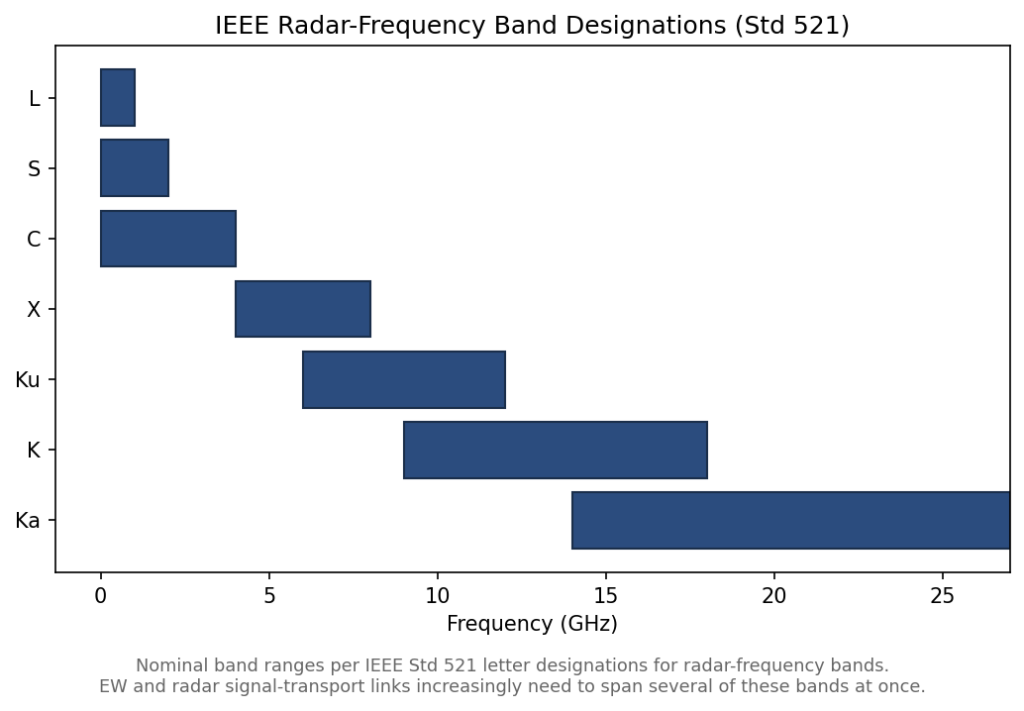
IEEE Std 521 radar-frequency band designations, illustrating the span an EW receiver may need to cover in a single system.
Dynamic range and phase matching in practice
Two engineering details separate a generic fiber link from one built for defense-grade EW work. The first is dynamic range: a link with high spurious-free dynamic range (SFDR) lets a receiver pick out a weak signal in the presence of a much stronger one nearby in frequency, without intermodulation distortion burying the target underneath false tones. The second is phase matching across multiple parallel signal paths. Direction-finding and phased-array systems compare the same signal arriving at several antenna elements, so any timing or phase mismatch introduced by the transport links directly corrupts the direction calculation. Wavelength-division-multiplexed multi-link fiber systems are built specifically to keep phase behavior consistent across every parallel path.
A direction-finding case in point
One recurring EW challenge illustrates why this matters: a direction finder’s accuracy improves as its antenna tower gets taller, but coaxial cable losses put a practical ceiling on how tall that tower can be before the signal degrades too much to use. Replacing the coax run with an environmentally hardened, multilink programmable fiber link removes that distance penalty, letting the antenna go higher without the corresponding cable loss.
Hardening against interference
Beyond bandwidth and phase performance, defense-grade signal transport is often expected to survive environments with electromagnetic pulse events or heavy RF interference nearby, since sheltered processing equipment needs protecting from external disruption as much as the signal itself does. This is part of why EW and radar deployments tend to specify ruggedized enclosures and shielded fiber runs rather than commercial-grade hardware.
Frequently Asked Questions
Why can’t a standard RF-over-fiber module handle EW frequencies?
Most off-the-shelf RFoF modules are optimized for cellular or GPS bands below 6 GHz. EW and radar work often requires coverage into the millimeter-wave range, which needs different optical and RF front-end design.
What is SFDR and why does it matter for EW receivers?
Spurious-free dynamic range measures how well a system can detect a weak signal near a strong one without distortion products masking it. High SFDR is important for EW receivers that must find faint signals in a crowded spectrum.
Why does phase matching matter in multi-link systems?
Direction-finding and phased-array systems rely on comparing signal timing across multiple antenna paths. If the transport links introduce inconsistent phase delay, the resulting direction calculation becomes unreliable.
