
A page of faded manuscript, a painting with a reworked figure beneath the surface, a document scorched in a fire: none of these give up their secrets to ordinary photography. The information is there, but it sits outside the narrow band of light the human eye and a standard camera sensor can register. Multispectral imaging is the technique built specifically to close that gap, and it has quietly become one of the more consequential tools available to conservators, archivists, and researchers who need to know what a document or object actually contains, not just what it looks like on the surface.
What does a camera see that the human eye does not?
The human eye is tuned to a narrow slice of the electromagnetic spectrum, roughly 400 to 700 nanometers. Materials that look identical within that range can behave very differently just outside it. A pigment applied centuries ago may reflect near-infrared light in a way that reveals a preliminary sketch beneath a finished painting. Ink that has faded to illegibility under visible light can still absorb or reflect ultraviolet light in a pattern that a sensor can capture and a human can then read. Multispectral imaging works by systematically photographing a subject across a sequence of these bands, from ultraviolet through the visible range and into the near-infrared, and assembling the results into a stack of images that together contain far more information than any single exposure could.
How does narrowband imaging actually work?
In a typical narrowband setup, a subject is illuminated with LED lighting and photographed through a sequence of roughly sixteen distinct wavelength bands spanning UV, visible, and near-infrared light. Because only low-energy, non-destructive light is used, the process does not add heat or ultraviolet exposure risk to fragile originals the way some older imaging methods could. Each captured band contributes one layer to the image stack, and the stack is typically converted to grayscale on the fly so that the layers can be compared and analyzed statistically. This is what makes cultural heritage digitization projects that once required destructive testing, sampling, or invasive conservation techniques increasingly able to rely on imaging alone.
Why does automation matter for fragile material?
Manual multispectral capture is slow and technically demanding. Calibrating lighting and filters correctly, keeping a subject perfectly still across a long sequence of exposures, and manually aligning the resulting frames all add time, and time is exactly what conservators want to minimize when handling something irreplaceable. Automated systems collapse this into a single capture sequence: a subject is positioned once, and the system runs through the full band sequence with a single button press, automatically registering, aligning, and correcting each frame for distortion before delivering a finished, analysis-ready stack. Less handling and less time under light both translate directly into lower risk for the object being documented.
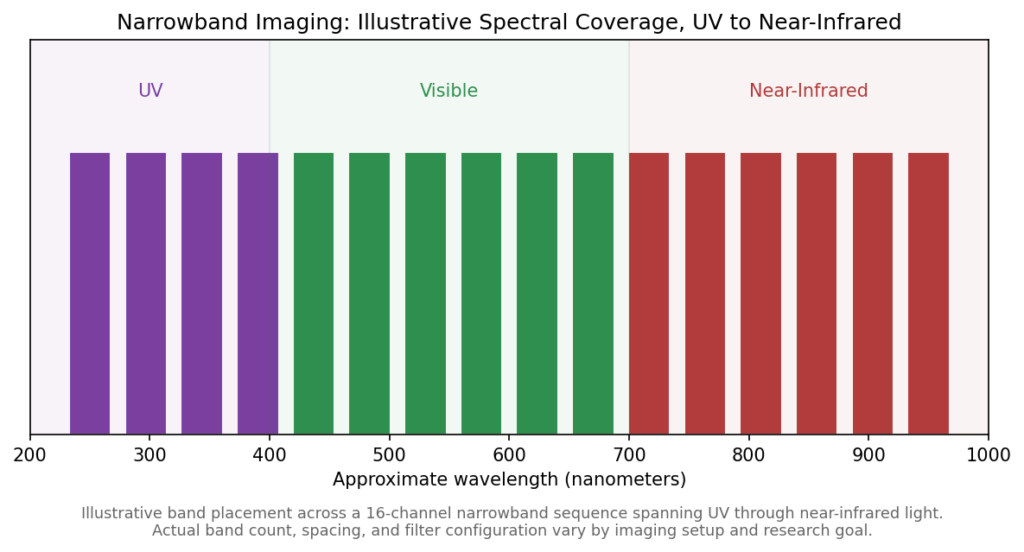
Illustrative spectral coverage of a narrowband multispectral imaging sequence, spanning ultraviolet through near-infrared light.
What can this kind of imaging actually uncover?
The output of a multispectral capture is rarely the end goal by itself; it is the raw material for analysis. Built-in statistical tools such as principal component analysis, independent component analysis, and k-means clustering are commonly used to separate and highlight patterns across the band stack that would otherwise be buried in the data. In practice, this has been used to recover text on documents damaged by fire, water, or age; to reveal underdrawings and pentimenti beneath finished paintings; to distinguish pigments and materials for dating and authentication work; and, outside the museum context entirely, to support forensic analysis of fabrics, residues, and trace evidence. The common thread is non-invasive access to information that would otherwise require physical intervention, or that would simply remain permanently hidden.
Does every heritage project need this level of capture?
No, and it is worth saying plainly: multispectral imaging is a specialized tool for a specific class of problem. A straightforward reproduction of a well-preserved photograph or a clean, legible manuscript page does not require it. Where it earns its cost is in exactly the cases described above, damaged, overpainted, faded, or otherwise ambiguous material where standard high-resolution photography reaches its limit. Institutions increasingly build their digitization programs around standards from bodies such as the Federal Agencies Digital Guidelines Initiative, which help set consistent expectations for image quality and long-term usability across a collection, and multispectral capture is typically layered on top of that baseline for the subset of items that genuinely need it.
As collections continue to be digitized at scale, the pressure to do more with each capture session, rather than requiring a second, separate scientific pass, has pushed multispectral tools from a niche research instrument toward a more standard part of the serious digitization toolkit. For institutions weighing whether a given collection warrants the investment, the deciding factor is usually not budget alone, but how much of the collection’s value is genuinely locked behind what ordinary photography cannot see.
Frequently Asked Questions
What is multispectral imaging used for in cultural heritage work?
It is used to reveal information that is not visible under ordinary light, including faded or damaged text, underdrawings beneath paintings, and material composition useful for dating and authentication.
Is multispectral imaging damaging to fragile objects?
Properly implemented systems use low-energy LED lighting rather than intense or UV-heavy light sources, and automated capture reduces the time an object spends under any light source compared with manual methods.
How is multispectral image data actually analyzed?
Captured band stacks are commonly processed using statistical techniques such as principal component analysis, independent component analysis, and clustering, which help separate patterns that are not visible in any single image.
