
Most PCB technology decisions aren’t really about which option is “best.” They’re about which trade-off a given product can actually afford. A standard rigid board, an HDI PCB, a rigid-flex design, and an RF-optimized board each solve a different constraint, and picking the wrong one tends to show up later as either wasted cost or a design that can’t hit its footprint or performance target.
The core trade-off, side by side
| Technology | Layer Density | Mechanical Flexibility | High-Frequency Performance | Typical Use Case |
| Standard Rigid PCB | Low to Moderate | None | Adequate below a few GHz | General electronics, low-cost consumer products |
| HDI PCB | High | None | Good | Smartphones, compact medical devices, dense digital boards |
| Rigid-Flex PCB | Moderate | High | Moderate | Wearables, foldables, space-constrained avionics |
| High-Frequency (RF) PCB | Moderate | None | Excellent | Radar, satellite comms, 5G infrastructure |
When does HDI actually earn its added cost?
HDI construction uses microvias, thinner dielectrics, and finer line/space geometry to fit significantly more routing into the same board area as a conventional design. That density gain is what makes modern smartphone motherboards and compact medical devices possible in the first place. It’s rarely worth specifying, though, unless the product genuinely can’t fit its routing at standard geometry, since the tighter tolerances typically extend fabrication lead time.
When does rigid-flex win over two separate rigid boards?
Rigid-flex combines rigid sections with flexible circuit layers in a single board, removing the connectors and cabling that would otherwise link separate rigid boards together. Fewer connection points generally means fewer failure points, which is a large part of why flexible printed circuits show up so heavily in wearables, foldable devices, and any enclosure where a board genuinely needs to fold or flex during normal use, not just during assembly.
When does a design actually need purpose-built RF materials?
Above a few gigahertz, ordinary FR-4 substrates introduce enough dielectric loss and impedance variability to noticeably degrade signal quality. Purpose-built high frequency PCB materials, typically PTFE- or ceramic-filled laminates with tightly controlled dielectric constants, exist specifically for that regime. Below a couple of gigahertz, though, the added material cost usually isn’t buying anything the design actually needs.
The variable underneath all three: substrate material
Whichever technology a design lands on, the dielectric material beneath the copper does as much to determine electrical performance as the geometry does. Low-loss, low-Dk laminates and other advanced PCB substrate material options are increasingly specified wherever signal integrity, thermal stability, or RF performance turns out to be the actual limiting factor, independent of which structural approach (HDI, rigid-flex, or standard) is chosen.
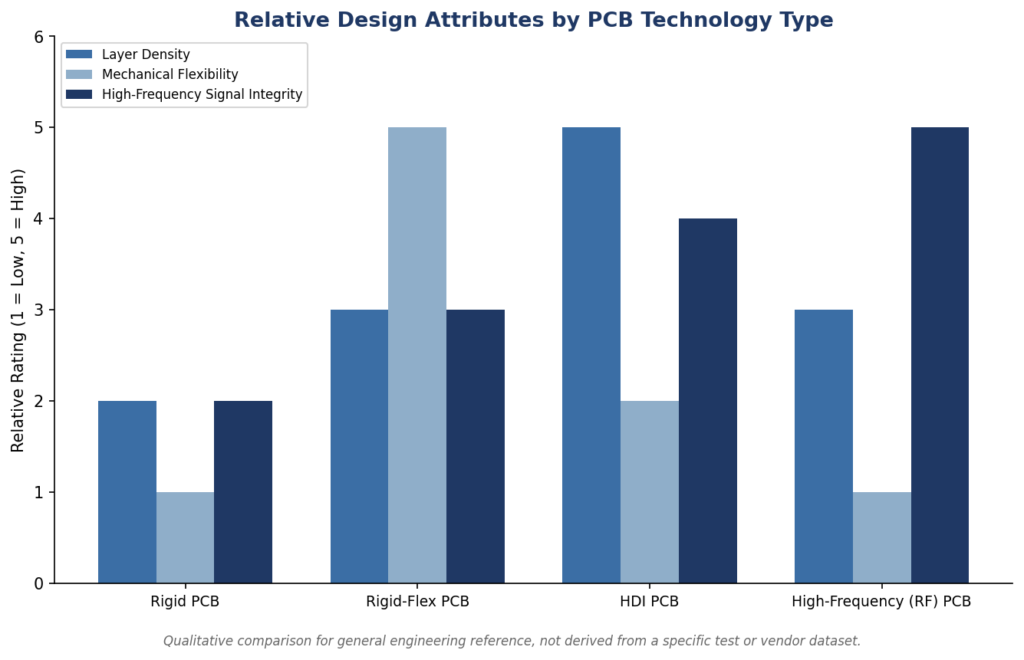
Qualitative comparison of relative design attributes across PCB technology types, for general engineering reference, not derived from a specific test or vendor dataset.
The practical takeaway is that these four options aren’t ranked from worst to best. They’re a menu, and the right one depends entirely on which constraint (space, flexibility, signal integrity, or cost) is actually binding on a given product.
Frequently Asked Questions
What is an HDI PCB?
An HDI (High-Density Interconnect) PCB uses microvias, thinner dielectric layers, and finer line/space geometry to fit significantly more routing into the same board area compared with a standard PCB.
Is rigid-flex more expensive than using two rigid boards with a connector?
Often yes on a per-unit material basis, but it can be cheaper overall once the cost and reliability risk of the connector, cabling, and extra assembly steps are factored in.
Can a standard FR-4 PCB be used for RF applications?
It can at lower frequencies, generally below a couple of gigahertz, but above that range dielectric loss and impedance variability in FR-4 typically become significant enough that purpose-built RF laminates are used instead.
