
For most of the last decade, the default answer to where AI processing should happen was simple: send the data to the cloud, let a data center do the heavy lifting, and send the result back. That model still works well for tasks that can tolerate a delay of a second or more. It works far less well for anything that needs to react in the time it takes a vehicle to cross an intersection, a drone to clear an obstacle, or a camera to flag a person entering a restricted area. That gap is why AI edge computing, running models directly on the device that captures the data, has moved from a niche engineering choice to a mainstream architecture.
The latency problem the cloud cannot solve
Every round trip to a remote server adds delay: time to transmit the raw data, time to queue and process it, and time to send a result back. On a fast connection that might only add up to a few hundred milliseconds. In the field, over degraded, congested or intermittent networks, it can stretch far longer, or fail outright. For applications like autonomous navigation, threat detection or industrial safety systems, that unpredictability is often worse than a slower but consistent alternative. AI edge computing sidesteps the problem by keeping the decision on the device itself, so there is no network round trip standing between a sensor reading and a response.
What actually changed
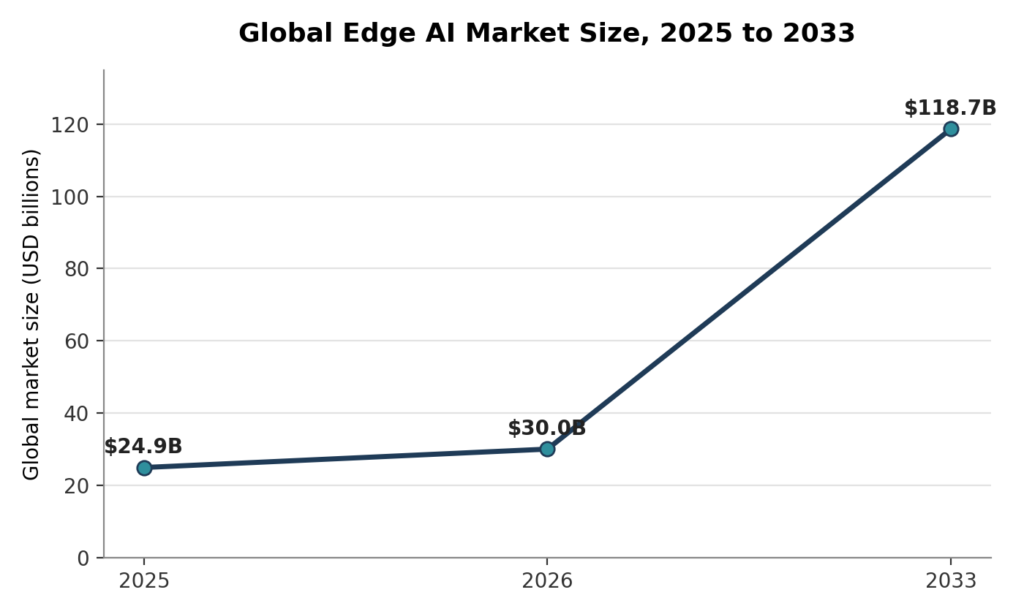
Edge AI was theoretically possible years ago, but the hardware needed to run meaningful machine learning models inside a small, power constrained enclosure has only become practical relatively recently. Purpose built AI accelerators, more efficient neural network architectures, and better power management have combined to let devices the size of a deck of cards run inference workloads that used to require a server rack. That shift is reflected in market data: according to Grand View Research, the global edge AI market was valued at roughly 24.9 billion US dollars in 2025 and is projected to reach about 30.0 billion dollars in 2026, growing toward an estimated 118.7 billion dollars by 2033 at a compound annual growth rate of close to 22 percent. Growth at that pace does not happen because a technology is nice to have. It happens because it is solving a problem organizations were previously forced to work around.
Where the pressure is coming from
A few forces are pushing processing toward the edge at the same time.
- Real time operations. Defense, security, industrial automation and autonomous systems all depend on decisions being made in milliseconds, not seconds, which rules out anything that depends on a stable, low latency network connection.
- Bandwidth and connectivity limits. Sending raw high resolution video to a remote server for every frame is expensive and often impossible in the field, on a moving platform, or in an environment where connectivity cannot be guaranteed.
- Data sensitivity. Keeping sensitive footage and sensor data on device, rather than transmitting it continuously, reduces the attack surface and simplifies compliance in regulated industries.
- Operational resilience. A system that can keep functioning when its network connection drops is inherently more reliable than one that depends on it.
Video is where edge AI is proving itself first
Video and AI edge computing tend to arrive together, because video is one of the heaviest and most latency sensitive data types a system can generate. An ai video analyzer running on the same device that captures the footage can detect, classify and track objects in real time, flagging what matters instead of forwarding every frame to a human or a distant server for review. That approach is increasingly standard in surveillance, reconnaissance and industrial monitoring, where the volume of footage generated vastly exceeds what any team could review manually, and where the value of a detection often depends entirely on how quickly it reaches a decision maker.
The tradeoffs are real, not just marketing
Edge AI is not a free upgrade. Running inference on device means working within tighter constraints on power, heat and physical size than a data center ever has to consider, and it means updating models across a distributed fleet of devices rather than a single central server. Organizations adopting AI edge computing typically end up choosing between a handful of tightly optimized models running well within those limits, rather than the largest, most capable model available, since the largest models are usually still built for cloud scale hardware. That tradeoff, smaller and faster instead of largest and slowest, is precisely why edge AI has become its own engineering discipline rather than simply the cloud, but closer.
What this means going forward
The organizations getting the most value from edge ai solutions are treating the move to the edge as an architectural decision made early, not a bolt on optimization added after a cloud based system proves too slow. As sensors keep generating more data than networks can realistically carry, and as more decisions need to happen in milliseconds rather than seconds, the case for processing at the source, rather than after a round trip, will keep getting stronger.
