
Most companies shipping IT, telecom, or data center hardware internationally eventually run into two terms that sound related but carry very different legal weight: Importer of Record and Exporter of Record. Confusing the two, or assuming a freight forwarder already covers them, is one of the more common reasons a shipment gets held at customs. This piece breaks down what each role actually does, when a business needs one, the other, or both, and why the distinction matters more for regulated technology hardware than it does for ordinary cargo.
What an Importer of Record Actually Does
An Importer of Record is the legal entity named on import documentation who accepts responsibility for a shipment once it reaches the destination country. That includes filing the customs declaration, paying duties and taxes, and carrying legal liability if something about the import fails to comply with local regulations.
For a company with no registered legal entity in the destination market, this is not optional paperwork, it is the only mechanism through which the shipment clears customs at all. A dedicated IOR and EOR services provider takes on this role so the shipper or buyer does not need to establish a local entity just to receive one shipment.
What an Exporter of Record Actually Does
The Exporter of Record is the counterpart on the way out. Before goods leave the origin country, someone has to classify the item under the correct export control code, determine whether an export license applies, screen for dual use or denied party restrictions, and file the export declaration with customs at departure.
For ordinary cargo, this step rarely raises complications. For IT and telecom hardware specifically, it does, because networking equipment, security appliances, and anything with built in encryption can fall under export control regardless of how freely the product is sold commercially. An exporter of record provider exists specifically to carry that classification and licensing exposure.
Why the Two Roles Get Confused with a Freight Forwarder
A freight forwarder books cargo space, prepares transport documents, and coordinates customs clearance through a broker, but throughout that process it acts as an agent, not as the legally named importer or exporter. That distinction between principal and agent is what actually determines who customs authorities hold accountable when something goes wrong.
- A freight forwarder arranges the physical movement of goods and the surrounding paperwork
- An Importer of Record is the named legal party on arrival, responsible for duties, taxes, and compliance
- An Exporter of Record is the named legal party on departure, responsible for classification and licensing
- None of these roles substitute for another; each covers a different point in the shipment’s life cycle
When a Business Needs Both, Not Just One
The situation where this becomes unavoidable is reverse logistics. A return or warranty replacement shipment moves in two directions at once: the faulty unit leaves the customer’s country as an export, and a replacement often enters as a fresh import. That means the same relationship can require both an Exporter of Record and an importer of record role simultaneously, not one after the other.
A few other scenarios that typically require both roles at once:
- Temporary imports for proof of concept or demo equipment, which must later be re-exported under a defined timeline
- Shipments under DDP terms, where the seller assumes full customs and duty responsibility on arrival
- Encryption capable networking, security, or telecom equipment moving between multiple jurisdictions
- Any shipment where neither the shipper nor the buyer holds a registered legal entity at one end of the route
Legal Responsibility, Side by Side
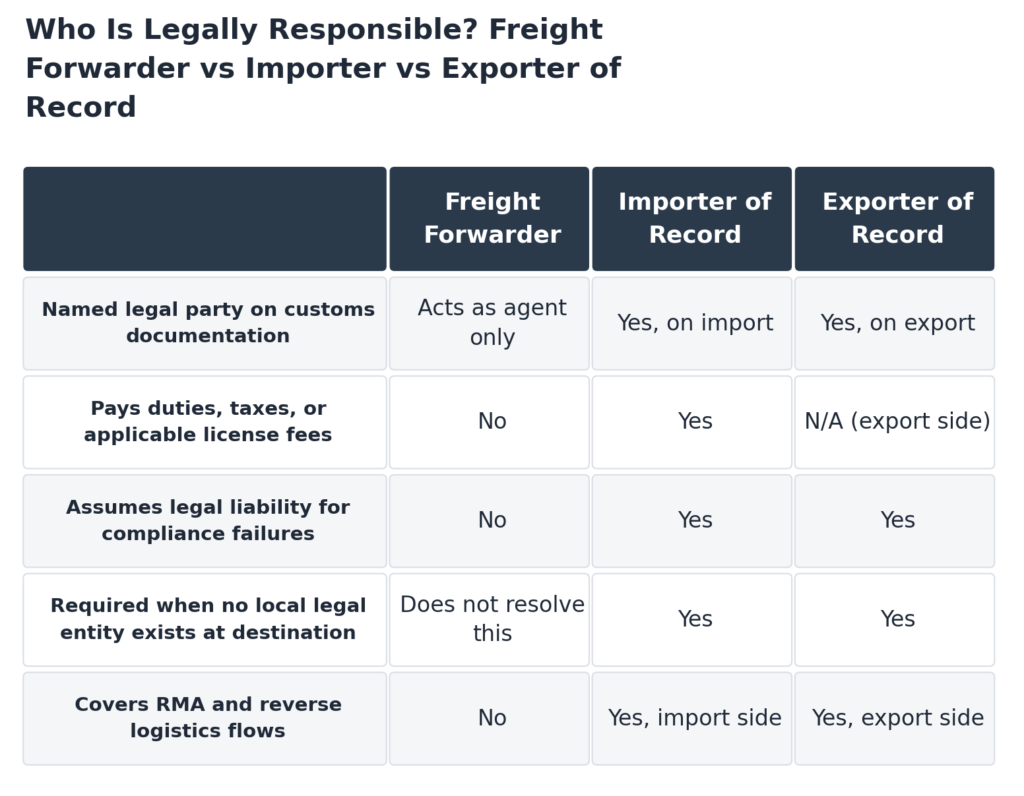
Who is legally responsible: freight forwarder vs importer of record vs exporter of record
A Practical Example
Consider a networking equipment company that needs to send evaluation hardware to a prospective customer in a country where neither party has a local entity. The freight forwarder can book the shipment and prepare transport documents, but someone still has to be named as the legal importer to clear customs on arrival, and if the same unit is later re-exported after the trial, someone has to be named exporter as well. Handling both roles under one relationship avoids the coordination gap that shows up when a freight forwarder, a customs broker, and the buyer are all assuming someone else has it covered.
Questions Worth Asking Any Provider You’re Evaluating
- Are you the named importer or exporter on customs documentation, or acting only as an agent?
- Do you carry legal liability for compliance failures, or does that risk sit elsewhere?
- Can you cover both directions of an RMA or warranty shipment under one relationship?
- Do you have in house classification expertise for encryption controlled or dual use equipment?
According to a general overview of import practice on Wikipedia, the importer of record is the party legally responsible for the declaration and payment of customs duties, regardless of whether that party is the owner of the goods, the purchaser, or a licensed broker acting on their behalf. That principle is exactly why the role cannot simply be assumed away by a shipping arrangement.
Frequently Asked Questions
What is the simplest way to tell IOR and EOR apart?
An Importer of Record covers goods entering a country, and an Exporter of Record covers goods leaving one. Most companies with international reverse logistics eventually need both.
Can one provider handle both roles?
Yes, and it is generally simpler than coordinating two separate vendors, particularly once RMA or repeated cross border shipments are involved.
