
Deploying specialized BiDi transceivers cut fiber costs by up to 50% across modern carrier, utility, and corporate enterprise networks without requiring expensive structural overhauls. Fiber infrastructure remains an expensive physical asset to build out. Whether an operator is deploying municipal metro rings or running backhaul channels across remote utility substations, civil engineering expenditures scale rapidly. BiDi architectures provide a direct response to this financial constraint by allowing systems to transmit and receive data over a single fiber strand instead of two.
This single-strand physical layer functionality halves the total fiber capacity required for any specific link. Consequently, companies can expand their network footprint instantly without laying additional cables. This review evaluates how bidirectional optics function, highlights where they deliver the most immediate financial returns, and outlines critical criteria for fleet procurement.
Wavelength Multiplexing Mechanisms in Single-Fiber Links
A standard optical configuration uses two independent strands to establish communication paths, designating one for transmitting data and the other for receiving it. A bidirectional setup alters this paradigm by employing wavelength-division multiplexing (WDM) inside a single optical housing. This component splits transmission waves so that different light frequencies travel concurrently over the exact same glass strand. For example, one side of the connection transmits data at 1310 nm and receives at 1490 nm, while its complementary counterpart reverses the orientation.
Under IEEE 802.3 Ethernet standards, single-fiber bidirectional routing is a well-established industrial approach. The technique is fully mature across 1G, 10G, 25G, and 100G link speeds. Because the underlying multiplexing mechanics have seen continuous field optimization for over twenty years, modern modules provide exceptional geometric stability, low insertion loss, and reliable transceiver form factors.
Fiber Strand Allocations Across Network Topologies
The financial argument for integrating single-strand optical nodes goes far beyond the baseline acquisition cost of individual optics. Trenching and conduit installations regularly range from $10 to over $100 per linear foot depending on local terrain profiles. Furthermore, multi-strand cable procurement, splicing labor, and patch panel footprints in central offices introduce major compounding expenses.
The chart below outlines how standard duplex requirements compare directly to bidirectional strand allocations:
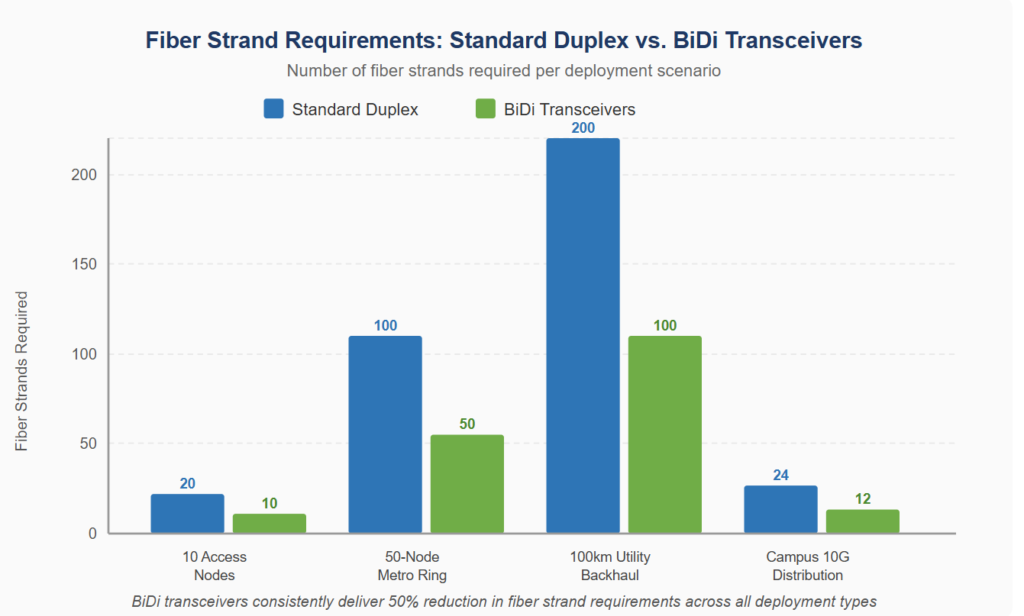
| Link Type | Duplex Strands Required | BiDi Strands Required | Strand Reduction Ratio |
| 10 Access Nodes | 20 strands | 10 strands | 50% reduction |
| 50-Node Metro Ring | 100 strands | 50 strands | 50% reduction |
| 100-km Utility Backhaul | 200 strand-km | 100 strand-km | 50% reduction |
| Campus 10G Distribution | 24 strands (12 links) | 12 strands (12 links) | 50% reduction |
High-Value Environments for Bidirectional Upgrades
While bidirectional optics are not a universal replacement for every single data center application, they deliver massive financial returns in congested sectors. For instance, metro aggregation nodes often suffer from packed conduits where adding physical strands requires disruptive civil excavation. Similarly, long utility corridors cross hazardous, remote geographic spaces where strand costs dictate total project viability.
Furthermore, dense 5G xHaul fronthaul developments introduce intense link density requirements that make optical efficiency a core architectural constraint. To optimize existing loops, network engineers deploy specialized hardware like the 100G BiDi QSFP28-DD adaptor to scale high-capacity links without replacing backend patch infrastructure. Operators frequently use these pluggable modules alongside aggregated access transceivers to bypass dark fiber leasing fees entirely.
Scaling Performance to 100G Hardware Speeds
Early bidirectional field installations were restricted to low-bandwidth 1G channels. However, modern optical development has scaled the technology across 10G, 25G, and high-capacity 100G backhaul roles. At the 100G threshold, components leverage advanced 2x50G PAM4 modulation schemes on each wavelength layer. This modulation delivers complete, uncompromised 100G line-rate throughput over a single fiber strand up to distances of 10 km.
Consequently, this performance jump allows operators to upgrade legacy 10G infrastructure directly to next-generation speeds. This transition requires zero adjustments to the buried fiber plant, making it highly attractive for growing regional infrastructure networks.
Procurement Criteria for Bidirectional Fleets
When selecting bidirectional hardware, systems engineers must ensure absolute wavelength pairing compatibility across both ends of the link. In addition, confirm that the selected form factors align with existing port density and power budget limits. Outdoor or industrial environments demand extended temperature range variants certified to operate reliably between -40°C and +85°C.
Finally, prioritize strict Multi-Source Agreement (MSA) compliance to verify multi-vendor interoperability and prevent restrictive hardware lock-in.
Conclusion
Integrating high-performance bidirectional components shows how BiDi transceivers cut fiber costs by up to 50% while maximizing the data capacity of existing physical assets. The combination of validated multi-source standards, diverse speed options, and immediate installation savings makes this hardware migration a highly predictable, low-risk optimization strategy. Planners who proactively transition their congested rings to single-strand duplex paths can successfully accommodate growing 5G and IoT bandwidth demands without budget inflation.
