
Unmanned aerial systems have fundamentally changed how defense forces, border agencies, and public safety organizations gather intelligence. However, raw flight capability is only part of the equation. Without a reliable, low-latency video downlink, even the most advanced UAV becomes operationally blind. Modern drone video streaming solutions — the hardware and software stack that captures, encodes, transmits, and decodes aerial footage in real time — have therefore become mission-critical infrastructure. This article examines what separates capable systems from inadequate ones, the technical benchmarks that matter most, and why the market is converging on edge AI as the next decisive advantage.
Constraints of UAV Video Network Hardware
Unlike terrestrial video systems, drone video payload systems operate under four simultaneous constraints that rarely apply on the ground. These limits include strict size, weight, and power (SWaP) allocations, variable RF bandwidth, electromagnetic interference, and changing atmospheric conditions. For example, a surveillance drone that transmits footage with a two-second lag cannot deliver true situational awareness.
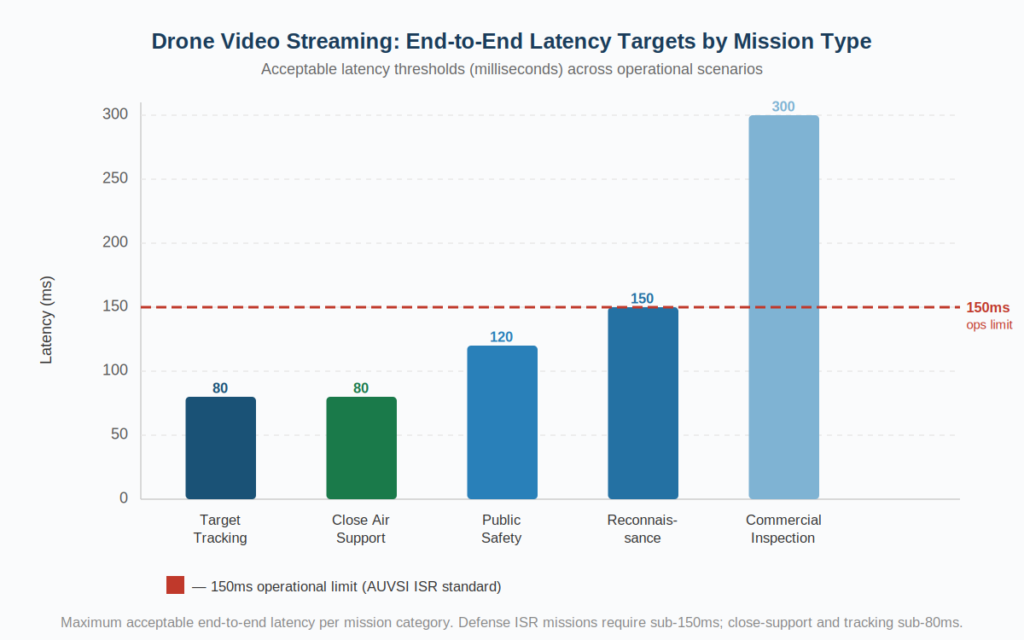
According to a 2024 analysis published by the Association for Unmanned Vehicle Systems International (AUVSI), latency above 150 milliseconds is operationally unacceptable for most ISR missions. Furthermore, an end-to-end latency below 80 ms remains the absolute target for close-air-support coordination scenarios.
This is precisely where specialized low-latency streaming hardware engineered specifically for the defense market differs from commercial video encoder products. They are optimized not for maximum bitrate, but for minimum latency at acceptable quality under constrained bandwidth.
End-to-End Latency Targets by Mission Type
To understand where transmission lag introduces operational vulnerability, systems architects must isolate each deployment category. While industrial inspection setups allow higher tolerances, tactical defense operations require immediate frame propagation.
The chart below maps the maximum acceptable latency thresholds across standard operating environments:
| Parameter | Reconnaissance | Target Tracking | Public Safety |
| End-to-End Latency | < 150 ms | < 80 ms | < 120 ms |
| Video Resolution | 1080p / 4K | 1080p (stabilized) | 1080p |
| Compression Standard | H.265 / HEVC | H.265 | H.264 or H.265 |
| Datalink Range | 20–50 km | 5–15 km | 10–30 km |
| Onboard AI | Optional | Required | Beneficial |
| SWaP Budget | < 100 g / < 10 W | < 60 g / < 8 W | < 150 g / < 15 W |
Codec Options for Modern Drone ISR Platforms
The shift from H.264 to H.265 (HEVC) has been the single most impactful codec transition for UAV video. H.265 achieves roughly twice the compression efficiency of H.264 at equivalent visual quality. This means a drone can transmit 4K footage over the same bandwidth that previously carried 1080p. For systems operating in contested environments where RF bandwidth is scarce, this is the difference between a functional downlink and a dropped connection.
Platforms focused on professional UAV video encoding architectures have standardized on HEVC hardware encoding. Software encoding introduces unacceptable latency at the compute budgets available on small payloads. In contrast, hardware-accelerated H.265 encoding at the edge keeps compression latency below 10 ms.
Moving Intelligence Processing to the Edge
Until recently, AI analysis of drone footage required transmitting raw or compressed video to a ground station where GPU servers performed object classification. This round-trip adds latency, consumes bandwidth, and creates a critical vulnerability if the datalink degrades. Therefore, the industry has moved decisively toward onboard, edge-resident AI architectures. Running target detection and object tracking directly on the UAV payload removes these network dependencies.
Edge AI integration means operators receive metadata-enriched streams pre-annotated with detected objects, bounding boxes, and confidence scores. This dramatically reduces the cognitive load on analysts. For example, compact edge computing modules designed for small unmanned systems exemplify this architecture by integrating edge acceleration directly into low-SWAP hardware.
Deploying Multi-Stream Tactical Encoders
Modern ISR missions frequently require simultaneous video from multiple sensors, including electro-optical day cameras, thermal imagers, and wide-area motion imagery (WAMI) sensors. A payload that handles only one stream forces operators to choose between sensor feeds. Multi-stream drone encoders solve this by handling simultaneous encoding, compression, and transmission of several video channels from a single hardware unit. This is especially relevant in maritime surveillance, border monitoring, and persistent area-surveillance missions where sensor fusion is operationally necessary.
Understanding the total system latency requires breaking down the video pipeline into its constituent stages:
- Capture and sensor readout: 5–15 ms depending on frame rate and sensor type.
- Hardware encoding (H.265): 5–12 ms with dedicated silicon.
- Packetization and transmission queuing: 2–5 ms.
- RF propagation and datalink stack: 5–30 ms depending on range and protocol.
- Receiver decode and display: 10–30 ms.
The cumulative result places well-engineered drone video streaming solutions in the 30–80 ms range end-to-end. Systems that rely on software encoding or consumer-grade datalinks will consistently land above 200 ms, which makes them operationally inadequate for most defense applications.
Selection Criteria for Defense-Grade Payloads
Procurement teams and engineering directors evaluating new aerial streaming components should rigorously assess end-to-end latency specifications under RF-contested conditions. Furthermore, the SWAP envelope must match the platform’s payload budget, and the enclosure must feature military-grade environmental ruggedization. Choosing a platform engineered around hardware-accelerated H.265 compression directly removes the risks associated with dropped links, ensuring that long-term intelligence operations remain uninterrupted.
Conclusion
As UAVs become more central to defense, security, and commercial operations, the performance of the drone video streaming solutions they carry will increasingly determine mission success. Low latency, efficient compression, edge AI, and multi-stream support are the four pillars of a capable system. Organizations procuring or designing drone platforms should evaluate these parameters rags-to-riches, rather than treating the video link as a commodity component. Selecting a hardware-accelerated architecture ensures that intelligence is generated even when datalinks are degraded or intermittent, delivering critical clarity right where it is needed most.
