
The field of cultural heritage digitization resolves the severe operational bottlenecks that traditional imaging hardware introduces within modern institutional archives. National libraries, state archives, and international museums manage massive collections of delicate physical records that face unavoidable structural decay. Therefore, preserving fragile manuscripts, rare historical volumes, and microscopic film negatives requires a delicate balance between material preservation and digital access.
Traditional archival scanning equipment—such as mechanical flatbed scanners or adjusted consumer-grade camera arrays—frequently struggles when handling centuries-old source materials. For example, these legacy setups often require intense physical document manipulation that can fracture historical bindings. Furthermore, they consistently fall short of strict international preservation standards due to sensor noise or optical distortions.
Institutional Benchmarks in cultural heritage digitization
Modern institutions are moving away from multi-purpose photographic equipment toward integrated reprographic systems designed from the ground up for historical preservation. These specialized solutions combine large-format, high-resolution sensors with custom-calibrated lenses, stable mechanical copy stands, and cool, narrow-spectrum lighting arrays.
Consequently, by replacing mechanical document scanning with high-fidelity single-exposure optical captures, archives can systematically protect delicate source materials. This single-exposure method captures fine structural details, ink characteristics, and paper textures with flawless accuracy.
The Requirements of Modern Preservation Standards
Institutional digitization projects are strictly governed by international quality frameworks designed to ensure absolute image fidelity and consistency over time. Guidelines such as the Federal Agencies Digital Guidelines Initiative (FADGI) in the United States and Metamorfoze in Europe define strict metric benchmarks for spatial resolution, color accuracy, noise levels, and geometric distortion. Under these rigid frameworks, standard high-speed scanners often fail to achieve top-tier certifications due to lens softness, uneven lighting distributions, and sensor limitations.
Achieving a true FADGI 4-star rating requires specialized hardware that maintains uniform pixel distribution and perfect tonal neutrality across the entire image plane. Luckily, utilizing an industrial-grade, ultra-high-resolution reprographic system allows preservation specialists to exceed these strict benchmarks easily. This capability is vital for high-resolution archival scanning practices, where every digital copy must serve as a legally valid, geometrically perfect replica of an irreplaceable historical artifact.
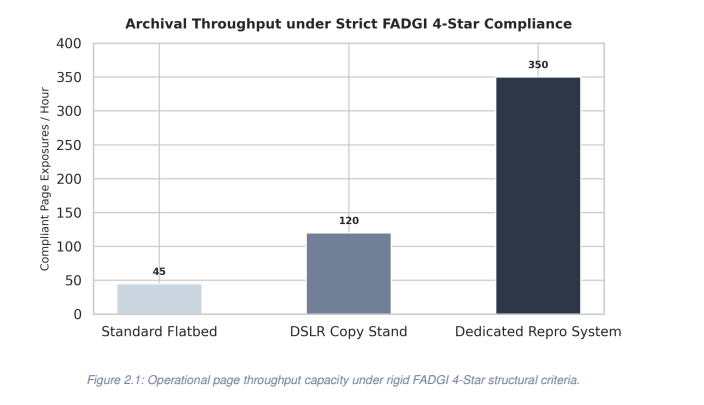
Archival Throughput under Strict FADGI 4-Star Compliance
A common misconception is that achieving strict international quality benchmarks requires sacrificing production speed. In reality, the configuration of the camera system directly dictates field productivity. Manual flatbed configurations require constant positioning adjustments and slow linear sensor sweeps. In contrast, single-exposure medium format systems capture full pages instantaneously.
The chart below shows how choice of equipment affects both imaging speed and adherence to strict FADGI 4-star quality standards during large-scale archive preservation projects:
| Operational Metric | Traditional Office & Production Scanners | Dedicated Cultural Heritage Platforms |
| Physical Document Handling | Contact-heavy; mechanical rollers or flat friction glass | Non-contact optical capture; adjustable pressure-free cradles |
| Image Resolution Limits | Fixed optical interpolation; prone to linear sensor artifacts | Native high-resolution large-sensor capture; zero interpolation |
| Vibration Control | Moving mechanical sensor bars introduce fine vibrations | Stationary sensor with electronic shutters; zero internal motion |
| Workflow Adaptability | Limited to standard paper sizes and flat document types | Modular setups for book digitization, film digitization, and large flat art |
Core Hardware Elements for Large-Scale Scanning
The physical characteristics of historical materials introduce complex technical hurdles that require specialized optical and mechanical configurations. For instance, fragile bound manuscripts cannot be pressed completely flat without destroying their original structures. This reality requires specialized V-shaped cradles and adjustable glass platens to ensure uniform focus across curved gutters.
In addition, digitizing transparent historical assets like glass-plate negatives, microfiche, and acetate film rolls requires extreme spatial density. This extreme density allows systems to capture original silver halide grains without interference patterns.
Furthermore, illumination sources must be carefully controlled using cross-polarization filters and specialized copy stand lighting. This configuration eliminates specular glare from metallic inks, varnished oil paintings, and glossy photographic emulsions. Finally, standard high-intensity studio lighting emits heat wavelengths that can accelerate the degradation of organic materials. As a result, cold, UV-free LED illumination has become a critical requirement for safe, long-term preservation workflows.
Mechanical Subsystems in cultural heritage digitization Workflows
A comprehensive setup relies on several closely integrated components working together to ensure operational speed, physical safety, and compliance with archival standards:
- The Repro Camera Assembly: At the core of the imaging workflow is a dedicated, high-resolution repro camera built around specialized medium-format or large-format architectures. Unlike standard commercial cameras, a professional repro camera utilizes an electronic leaf shutter system that completely eliminates physical shutter vibrations. This design ensures absolute pixel-to-pixel sharpness during rapid, repetitive preservation campaigns.
- Rigid Copy Stands and Lighting Control: The stability of the camera support structure directly determines the repeatable accuracy of the digitization workflow. Deploying a heavy-duty, metrically indexed copy stand configuration ensures that the camera remains perfectly parallel to the copy plane, eliminating keystoning errors. This rigid alignment is paired with specialized copy stands and consistent studio illumination solutions that provide perfectly uniform lux distribution across the entire workspace. To achieve this level of physical precision, preservationists integrate their setups using professional photography system components built for absolute mechanical stability.
- Advanced Multispectral Imaging Applications: For deeply degraded or altered manuscripts, standard visible light imaging is often insufficient. Integrating an advanced narrowband illumination setup allows conservators to illuminate artifacts with precise, narrow bands of light ranging from ultraviolet (UV) to infrared (IR). This non-destructive analytical technique reveals hidden text layers, faded historical inks, underlying sketches, and subsequent restoration work without exposing delicate materials to harmful heat. Institutions routinely implement these complex analytical captures by routing workflows through an adaptive medium format digital camera system backend.
Selecting a Long-Term Preservation Architecture
Procurement committees and archive managers evaluating new archival scanning systems must prioritize hardware that ensures physical safety, image quality, and long-term reliability. Choosing modular equipment that adapts easily to flat copy, bound books, and transparent film formats prevents institutions from needing multiple incompatible systems down the road.
Industry studies indicate a strong market move toward single-exposure, medium-format setups that combine high spatial clarity with gentle handling of delicate materials. Investing in dedicated, metrically stable digitization solutions protects irreplaceable physical history, transforming fragile collections into accessible, permanent digital assets.
Conclusion
Industrial cultural heritage digitization platforms have moved from a premium niche technology to an operational standard for world-class archival repositories. Combining high-resolution sensors, stable mechanical copy stands, and advanced multispectral capabilities allows modern institutions to preserve fragile history with unmatched fidelity. As global archive networks expand online access, the choice of high-performance reprographic equipment remains central to successful long-term preservation—ensuring physical history is safely protected while being shared accurately with the world.
