
“Specialty vegetables” is a specific legal and economic category, not just a marketing phrase. Under federal statute, specialty crops cover fruits, vegetables, tree nuts, dried fruits, and horticulture and nursery crops, and USDA’s most recent Census of Agriculture put the farm-level value of this category at roughly $115 billion in annual sales across around 240,000 US farms. A specialty vegetable portfolio sits inside that broader category, distinguished by breeding for flavor, appearance, and eating quality rather than sheer yield or shelf stability alone.
What separates “premium” from commodity produce
In commodity vegetable production, breeding priorities have historically centered on yield per acre, disease resistance, and transportability. Premium specialty lines add another axis: measurable eating quality, most commonly tracked through Brix, a measure of dissolved sugar content used as a proxy for sweetness. Higher-Brix pepper variety collection and tomato variety lineup breeding programs select specifically for this trait, alongside crunch, color consistency, and uniform size, all factors that matter more to a retail buyer stocking a premium produce section than to a bulk commodity handler.
The economics behind specialty crop investment
Growers’ willingness to plant premium specialty varieties is tied closely to risk management. USDA Economic Research Service data shows the value of specialty crops covered under the Federal Crop Insurance Program nearly doubled over roughly a decade, reflecting both expanding acreage and rising per-acre value in this category.
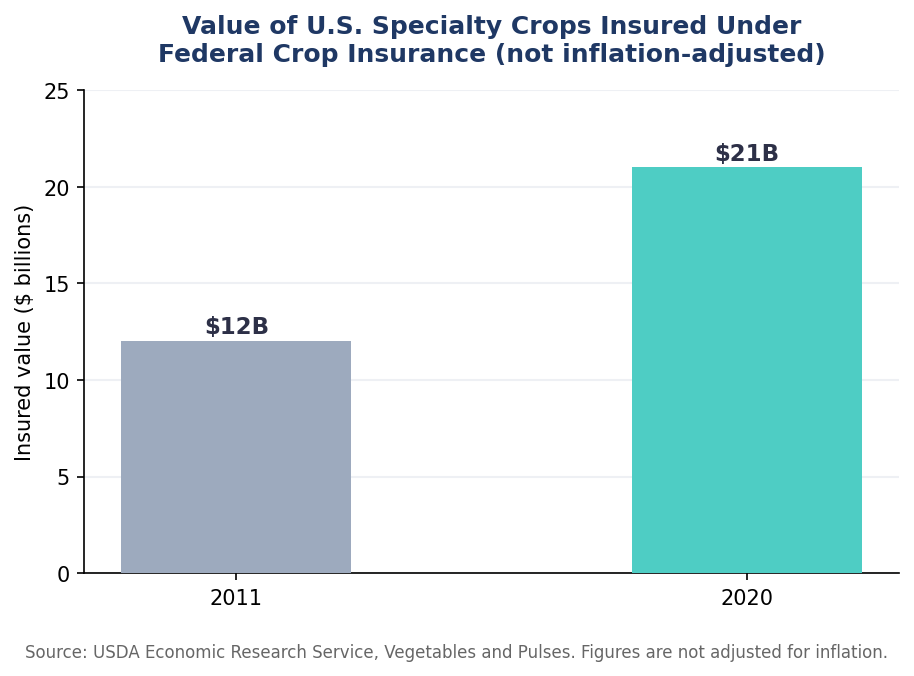
The value of specialty crops insured under the Federal Crop Insurance Program grew from about $12 billion in 2011 to about $21 billion in 2020, per USDA ERS.
Why consumer demand is shifting toward specialty formats
Consumer research on fresh produce purchasing consistently points to flavor, freshness, and perceived health benefits as leading purchase drivers, and specialty vegetable categories are positioned to capture that demand more directly than undifferentiated commodity produce. That is part of why premium specialty peppers and tomatoes increasingly appear in dedicated retail sections rather than mixed in with standard bulk bins.
What to look for in a specialty vegetable supplier
- Documented Brix or sweetness data for the specific variety, not just marketing claims
- Disease resistance packages appropriate to your growing region and season
- Consistent size and color grading suited to premium retail merchandising
- A track record of supplying both greenhouse and field production systems
How premium positioning affects retail merchandising
Retailers increasingly separate premium specialty produce into dedicated sections rather than mixing it into standard commodity bins, a merchandising shift that mirrors what has already happened with specialty tomatoes and, more recently, specialty peppers. This separation lets retailers communicate a clearer value proposition to shoppers willing to pay more for documented flavor and quality attributes, while keeping standard commodity produce priced competitively for cost-conscious buyers.
This dual-track approach to merchandising has grown alongside broader consumer research showing that flavor and freshness consistently rank among the top reasons shoppers cite for produce purchasing decisions. Premium specialty vegetables are, in effect, a direct response to that demand signal: a category built specifically around the attributes shoppers say they care about most, rather than around cost or shelf life alone.
Regional and seasonal considerations
Because premium specialty vegetable breeding often targets specific eating-quality traits like Brix and texture, growing conditions can meaningfully affect how well a given variety performs relative to its breeding potential. Temperature swings, water availability, and day length all influence sugar development in fruiting vegetables, which is one reason premium specialty crop production has expanded significantly in controlled-environment and greenhouse settings, where growers can manage these variables more precisely across a longer growing season than open-field production typically allows.
For growers evaluating whether to add premium specialty lines to an existing operation, regional climate fit is often as important as the variety’s on-paper quality specifications. A high-Brix variety bred and trialed primarily in one climate zone may not express the same eating-quality traits when grown in a substantially different environment, which is why reputable specialty vegetable breeding programs typically publish regional trial data alongside their variety descriptions.
Sourcing considerations for retailers and foodservice buyers
Buyers evaluating premium specialty vegetable suppliers generally look beyond a single season’s crop to a breeding program’s overall track record: how consistently a given variety performs across multiple growing regions and years, and whether the supplier can provide documented quality data rather than relying on qualitative marketing claims alone. This is particularly relevant for foodservice buyers, who typically need predictable specifications, size, color, and flavor consistency, across every delivery, in a way that a single strong season from an unproven variety cannot guarantee.
The role of federal risk management programs
Specialty crop growers can participate in the Federal Crop Insurance Program alongside more general agricultural risk-management tools, and the steady rise in insured specialty crop value over the past decade suggests growing confidence in the category’s long-term viability, both from growers expanding acreage and from insurers extending more coverage. This matters for anyone sourcing premium specialty vegetables, since a grower base with access to reliable risk management is generally better positioned to make the longer-term breeding and infrastructure investments that premium specialty production requires, compared to operations without that financial backstop.
Frequently Asked Questions
What legally counts as a specialty crop in the US?
Federal law defines specialty crops as fruits, vegetables, tree nuts, dried fruits, and horticulture and nursery crops, including floriculture.
Is “specialty vegetable” the same as “organic”?
No. Specialty crop status is about the type of crop, not the growing method. A specialty vegetable can be grown conventionally or organically.
How is produce quality measured in premium specialty breeding?
Brix, a measurement of dissolved sugar content, is a common proxy for sweetness, often used alongside criteria like uniform size, color, and disease resistance.
