
TL;DR: A story breaking in the field no longer requires a truck and a full crew to get on air. A smartphone app and a handful of supporting tools now let one or two people broadcast live from almost anywhere, without lowering the bar on reliability.
The old constraint: a truck for every story
A decade ago, going live from the field meant a satellite truck, a dedicated engineer, and hours of lead time. That constraint shaped which stories got covered live at all. A breaking story without enough notice to deploy a truck simply did not make it to air in real time, no matter how newsworthy it was. The bottleneck was never the story, it was the equipment required to tell it.
The phone became the first piece of broadcast equipment
The shift started with a live broadcast app that could turn a standard smartphone into broadcast-grade transmission hardware, combining the phone’s WiFi and cellular connections into one bonded uplink. Suddenly a reporter could go live using hardware they already carried every day. That same shift also changed how interviews get done. Apps built on this model increasingly let a remote guest join a live segment directly from their own phone or laptop, with no special hardware on the guest’s end, replacing a meaningful share of in-studio interview segments with a source or expert joining from home.
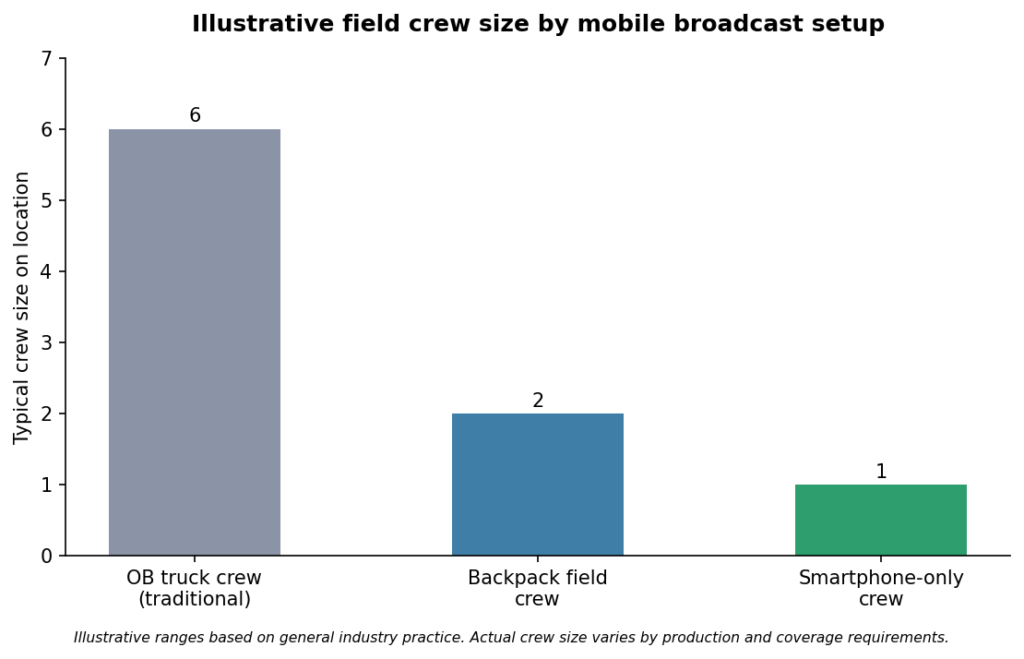
Illustrative field crew size by mobile broadcast setup, based on general industry practice. Actual crew size varies by production and coverage requirements.
The backpack filled the gap the phone couldn’t
A phone camera is not always the right tool. When a story calls for a dedicated camera, a compact encoder carried in a backpack streaming setup fills the same role, bonding multiple cellular connections to transmit camera-quality video without a truck. This approach has its roots in independent and creator-led live streaming, where it proved that broadcast-grade transmission did not require broadcast-scale equipment, and newsrooms have since adopted the same model for field reporting. Not every location has the bandwidth to sustain a live stream at all, which is why the same tools typically include a store-and-forward mode: recording footage locally and uploading it once a stronger connection becomes available, rather than leaving a crew with nothing after covering a story in a coverage dead zone.
Managing a fleet, not just a single unit
None of this scales without two things that rarely get mentioned alongside the cameras and apps. The first is metadata: attaching location, timestamp, and descriptive tags to a clip as it is recorded saves meaningful time once footage reaches the newsroom, often the difference between a clip being usable within minutes versus needing manual logging later. The second is central management, a way to see which field units and apps are live, monitor their connection quality, and step in remotely if one needs help. That is what allows a newsroom to run dozens of mobile crews at once instead of coordinating each one individually.
The common thread across all of this is the same: reduce what a reporter has to carry and set up, without reducing the reliability of what reaches air. That trade-off is what has made mobile broadcast journalism practical at a scale that would have needed a full OB crew per story not long ago.
Frequently Asked Questions
Can a smartphone really replace broadcast equipment for live reporting?
For many field stories, yes. A bonded streaming app combines a phone’s WiFi and cellular connections into a reliable uplink, which is enough for a large share of daily news and field reporting segments.
What is store-and-forward and when is it used?
Store-and-forward records footage locally when there is not enough bandwidth to stream live, then uploads the file once a stronger connection is available, which is common in remote or disaster-affected locations.
Why does metadata tagging matter for field journalism?
Tagging location, timestamp, and descriptive information at the point of capture saves newsroom staff from manually logging that information later, speeding up how quickly footage can be used.
