
| Key Takeaways • Traditional search returns a ranked list of links, while AI search generates a synthesized answer that cites a small set of sources. • Pew Research Center found Google users clicked a traditional result in 8% of visits to pages with an AI summary, versus 15% on pages without one. • Only 8% of one- or two-word Google searches produced an AI summary, compared with 53% of searches of ten words or more. • Google states there are no special requirements to appear in AI Overviews or AI Mode beyond established SEO best practices. |
What is the difference between AI search and traditional search?
Traditional search returns a ranked list of links for the user to evaluate, while AI search generates a written answer that synthesizes several sources and cites a few of them. In Google, the AI layer appears as AI Overviews at the top of the results page and as AI Mode, a conversational experience; standalone engines such as ChatGPT search and Perplexity work on the same principle. The shift began with Google’s Search Generative Experience (SGE) experiment, and an early head-to-head comparison of generative and classic results already flagged the central issue for marketers: how traffic is distributed once an answer appears above the links.
For B2B companies, the change is less about a new channel and more about a new layer sitting between the buyer’s question and the company’s website. A buyer who once opened five vendor pages to compare specifications may now read one generated paragraph first and decide which two vendors deserve a closer look.
How do AI search and traditional search compare side by side?
The two models differ in output format, in what counts as visibility, and in how success is measured. The comparison below summarizes the practical differences for a B2B marketing team.
| Dimension | Traditional search | AI search |
| Output | Ranked list of links and snippets | Synthesized written answer with a small set of cited sources |
| Unit of visibility | Position on the results page | Mention, citation, and how the brand is described inside the answer |
| Query style | Short keyword phrases | Longer questions and full sentences, often with follow-ups |
| Retrieval | One query, one result set | May run several related searches (query fan-out) for one answer |
| User action | Click to evaluate pages | Often read the answer and stop, or refine the question |
| Main metrics | Rankings, impressions, click-through rate | Share of answers, citation frequency, sentiment, plus clicks |
The fundamentals still overlap heavily. Google’s own guidance on AI features and your website states that there are no additional requirements or special optimizations needed to appear in AI Overviews or AI Mode, and that established SEO best practices remain relevant. This is why strong technical and content SEO fundamentals remain the entry ticket for AI visibility rather than a legacy cost.
How does an AI summary change what users click?
An AI summary roughly halves clicks on traditional results. Pew Research Center found that Google users clicked a traditional result link in 8% of visits to pages with an AI summary, compared with 15% on pages without one. The study, based on the browsing data of 900 U.S. adults in March 2025, also found that users ended their browsing session on 26% of pages with an AI summary versus 16% of pages with only traditional results.
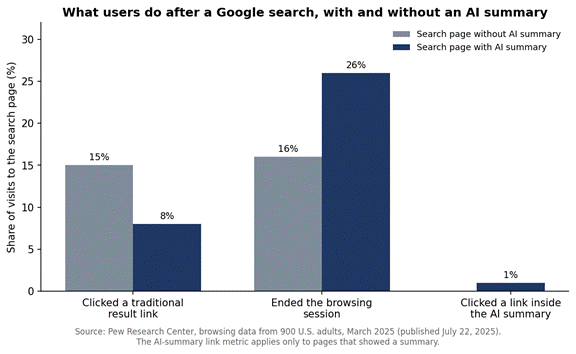
User actions after a Google search, with and without an AI summary (Pew Research Center, March 2025 browsing data).
Links inside the summary itself drew even less attention: users clicked one in just 1% of visits to pages that displayed a summary, according to Pew’s published findings. For a brand, that means being named inside the answer can matter as much as being linked, because many readers form an impression without ever visiting a site.
The answers themselves are short and shared. In the same study, the median AI summary was 67 words long, and 88% of summaries cited three or more sources. A few dozen words split across several sources leaves room for only a handful of brands, which is why the wording a company uses to describe itself, and the evidence it attaches, now carries more weight than a marginal gain in ranking position.
Which searches are most likely to trigger an AI answer?
Longer, question-shaped searches are the most likely to trigger an AI answer. In Pew’s data, just 8% of one- or two-word Google searches produced an AI summary, but the share rose to 53% for searches of ten words or more, and 60% of queries beginning with question words such as who, what, when, or why produced one. Overall, 18% of the Google searches in the study generated an AI summary.
This matters for B2B because buying research is naturally long and specific. A procurement engineer is more likely to ask how to choose a rugged edge computer for an outdoor rail application than to type two words, and that kind of question is exactly where the generated answer now sits above the links.
Is traditional SEO still worth investing in?
Yes. Traditional SEO remains worth the investment because AI features draw on the same indexed, crawlable, high-quality pages that rank in classic results. Google notes that sites appearing in AI features are counted in the overall search traffic reported in Search Console, so AI visibility is measured inside the same framework rather than a separate one. What changes is the emphasis: content needs to answer specific questions directly, back claims with evidence, and describe the company and its products consistently so an engine can quote it with confidence.
The conversation is not new for practitioners. Inter-Dev’s B2B digital marketing podcast, for example, devoted a 2024 episode to SGE versus traditional search and its likely impact on web traffic, well before AI answers became a routine part of the results page.
How should B2B marketers adapt their search strategy?
B2B marketers should keep classic SEO as the foundation and add a citation layer on top of it. The practical adjustments are specific and measurable.
- Map the long, question-style searches buyers use at each stage, since these are the queries most likely to produce an AI answer.
- Rewrite priority pages so each section opens with a direct answer of one or two sentences, followed by evidence and detail.
- Make sure structured data matches the visible text on the page and that key pages are reachable through internal links.
- Track brand mentions and citations inside AI answers alongside rankings and clicks, so a drop in clicks is not mistaken for a drop in visibility.
- Measure conversions and engagement from the visits that do arrive, because fewer but better-informed visitors can still grow pipeline.
The brands that adapt fastest treat AI search and traditional search as two views of the same body of content, not as competing projects.
Frequently Asked Questions
What is the difference between Google AI Overviews and AI Mode?
Google AI Overviews are AI-generated summaries shown at the top of standard search results, while AI Mode is a separate conversational search experience that supports follow-up questions.
Do AI Overviews reduce clicks to websites?
Yes, Pew Research Center found that Google users clicked a traditional search result in 8% of visits to pages with an AI summary, compared with 15% on pages without one.
Is SGE the same as AI Overviews?
SGE, or Search Generative Experience, was Google’s experimental AI search feature, and AI Overviews are the AI-generated summaries that followed it in Google Search.
Does AI search traffic appear in Google Search Console?
Yes, Google states that sites appearing in AI features such as AI Overviews and AI Mode are included in the overall search traffic reported in Search Console.
