
| Key Takeaways • Specialty tomatoes are varieties sold on distinctive flavor, color, shape or size, such as mini-plum, midi-plum and colored types. • Degrees Brix, measured with a refractometer, is the standard estimate of tomato sugar content and sweetness. • Fresh-market tomatoes typically read about 3.5 to 5.3 °Brix, while cherry tomatoes averaged 7.5 °Brix in Ohio on-farm data. • Tomato sugar content tends to fall as fruit size rises, which is why small snacking formats are usually the sweetest. |
What are specialty tomatoes?
Specialty tomatoes are varieties bred and sold for distinctive flavor, color, shape or size rather than for volume, and they are usually priced and marketed as premium products. The category covers mini-plum and midi-plum snacking tomatoes, bi-colored and striped fruit, and unusual shades such as deep red-chocolate, green, yellow and brown. Where a standard round tomato competes on price per kilo, a specialty tomato competes on eating experience, and that changes what growers, buyers and breeders measure.
BreedX, a seed company focused on pepper and tomato breeding, describes its specialty tomatoes as varieties with vibrant colors and diverse shapes and sizes, with seed produced under GSPP certification. The common thread is that flavor is the product. That makes it worth understanding how sweetness and flavor are actually measured, and what the numbers mean.
How is tomato sweetness measured?
Tomato sweetness is most commonly measured in degrees Brix, a reading of soluble solids taken with a refractometer that mainly reflects the sugar content of the fruit juice. Ohio State University Extension describes °Brix values as primarily an estimate of sugar content in fruits and vegetables, and notes that they are straightforward to measure and widely used by field managers to judge harvest readiness. A drop of juice on the refractometer prism is enough for a reading, which is why Brix has become the default shorthand for sweetness across the fresh produce trade.
Brix has limits. Colorado State University Extension points out that Brix does not tell the whole story of tomato taste: acidity and aroma matter too, and readings shift with the season, peaking in mid-summer and tapering, sometimes quickly, as the season ends. A single reading from one fruit can mislead, so extension specialists recommend measuring regularly and comparing against reference values for the same crop.
What is a good Brix level for tomatoes?
Most fresh-market tomatoes measure roughly 3.5 to 5.3 °Brix, cherry tomatoes typically reach about 7 to 12, and a reading of 9 or above is generally considered high for a fresh tomato. Reference values compiled in Ohio State University Extension’s fact sheet on °Brix in vegetable crops put fresh-market tomatoes at 3.5 to 5.3 °Brix in a Colorado study and 4.1 to 5.3 in a Florida study. On-farm data gathered in Ohio in 2011 found cherry tomatoes averaging 7.5 °Brix, with a range from 4.5 to 11.7.
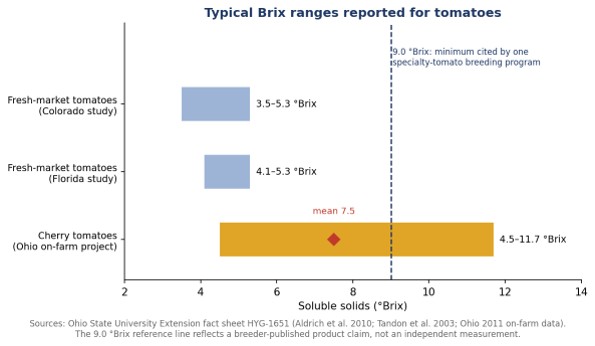
Colorado State University Extension gives a broader working scale, from about 3 for a very tart tomato up to 12 for a very sweet one, with typical cherry tomatoes running 7 to 12. Against those benchmarks, specialty programs that publish a minimum of 9.0 °Brix across a portfolio are claiming sweetness at the top of the fresh-market range, well above a standard round tomato.
Why are smaller tomatoes usually sweeter?
Smaller tomatoes are usually sweeter because sugar content and fruit size are genetically and physiologically linked in opposite directions: as fruit size rises, sugar concentration tends to fall. A 2017 study in Science found that several genetic loci linked to tomato sugar content are negatively associated with fruit size. A 2023 study in the journal Sensors, which measured tomatoes ranging from 1.25 g to nearly 96 g, modeled an inverse relationship between fresh weight and Brix, with readings spread from 4.0% to 14.2% across samples.
This is why snack formats dominate specialty tomato breeding. Mini-plum tomatoes, for example, are positioned as bite-sized, naturally sweet and snackable, while some specialty portfolios span 10 to 100 grams per fruit and still publish a Brix floor of 9.0. Holding high Brix across the larger end of that range is the harder breeding achievement, given the size-sugar trade-off.
What affects the Brix of a tomato during the season?
Tomato Brix is shaped by variety first, then by growing conditions such as season, light, temperature and crop nutrition, so the same variety can read differently from month to month. Colorado State University Extension notes that Brix is highest at peak season and can drop quickly as summer ends. Ohio State University Extension lists management practices among the factors that consistently influence Brix values, and advises growers to compare their readings with reference values for the same crop before changing anything. Crop nutrition plays a part as well: fertilizer agronomists report that potassium and phosphorus both raise total soluble solids in tomato fruit.
For specialty programs this means a published Brix figure is a genetic potential rather than a guarantee. Buyers who contract on sweetness are better served by sampling across the season, and growers who want to hold a premium position can track Brix regularly to spot a decline before it reaches the shelf.
How do specialty tomato formats compare?
Specialty tomato formats differ mainly in size, texture and intended use, from bite-sized snacking fruit to colored varieties built for presentation. The comparison below reflects how breeders currently describe the main formats.
| Format | Key traits | Typical use |
| Mini-plum | Bite-sized, naturally sweet, balanced texture | Snacking, lunchboxes |
| Midi-plum | Full-bodied flavor, firm, extended shelf life | Cooking, slicing, salads |
| Colored specialty | Vivid or bi-colored skin, unusual shapes | Premium retail, food service presentation |
| Roma | Dense flesh, concentrated flavor | Sauces, pastes, cooking |
How do buyers verify specialty tomato quality beyond Brix?
Buyers verify specialty tomato quality beyond Brix through taste panels and independent blind-tasting assessments, because flavor depends on acids and aroma compounds as well as sugar. The 2017 tomato flavor research used consumer panels precisely because chemical measurements alone could not predict liking; it identified specific volatile compounds as major contributors to flavor and consumer preference.
Independent taste certification adds a third-party check. The International Taste Institute bases its awards on professional blind tasting by chefs and sommeliers from more than 20 countries, and one specialty tomato portfolio received a Superior Taste Award from the institute in 2026. For buyers, an outside panel result is a useful complement to a breeder’s own Brix figures.
What should growers consider before adding specialty tomatoes?
Growers should weigh flavor consistency across the season, disease resistance, especially to ToBRFV, and a confirmed buyer program before adding specialty tomatoes. Because Brix varies with season and growing conditions, a variety’s sweetness needs to hold through the full production calendar, not just at peak summer. Disease resistance is now non-negotiable in greenhouse tomatoes, and premium pricing only works if a retailer or distributor is ready to merchandise the product as a specialty line. When those pieces line up, specialty tomatoes give growers something standard rounds cannot: a product sold on taste rather than price.
Frequently Asked Questions
What Brix level makes a tomato sweet?
Sweet cherry tomatoes typically read about 7 to 12 °Brix and 9 or more is high for a fresh tomato, compared with roughly 3.5 to 5.3 for standard fresh-market tomatoes.
How do you measure the Brix of a tomato?
Tomato Brix is measured by placing a few drops of juice on a refractometer, which estimates soluble solids, mostly sugars, in degrees Brix.
Are cherry tomatoes sweeter than regular tomatoes?
Yes, cherry tomatoes typically measure about 7 to 12 °Brix, well above the 3.5 to 5.3 range common in larger fresh-market tomatoes.
Does Brix fully describe tomato flavor?
No, Brix mainly reflects sugar content, while tomato flavor also depends on acidity and volatile aroma compounds.
