
| Key Takeaways • AI data loss prevention extends DLP to leaks through AI model outputs, agent connectors and sharing settings, not just files, email and endpoints. • Sensitive Information Disclosure rose from sixth to second place between the 2023 and 2025 editions of the OWASP Top 10 for LLM Applications. • In a 2026 survey of 200 enterprise CISOs, business builders outnumbered professional developers four to one on average and up to ten to one in some organizations. • Most AI data leakage happens quietly through misconfiguration, oversharing and unexpected data movement rather than through a single visible breach. |
What is AI data loss prevention?
AI data loss prevention is the set of controls that stops sensitive data from leaking through AI tools, AI agents and the business-built apps that feed them, including leaks through model outputs, connectors and sharing settings. It extends traditional DLP from files, email and endpoints into the places where AI now reads, combines and moves data on behalf of users.
The category has grown quickly because the leak paths have changed. The OWASP Top 10 for LLM Applications moved Sensitive Information Disclosure from sixth place in its 2023 list to second place in its 2025 edition, reflecting how often AI systems expose personal data, financial details and confidential business information through their responses. Yet many programs are still built on assumptions that no longer hold. Five of them come up again and again.
Myth 1: Is data safe as long as the AI tool is approved?
Reality: No. Approving a platform does not secure what people build on it, and much of today’s AI leakage happens inside sanctioned tools rather than unknown ones. Employees build agents and automations in approved copilot, CRM and workflow platforms, often without any security review of what those assets can reach.
This is what makes shadow AI inside sanctioned platforms so hard to spot. An agent may be overshared across the organization, weakly authenticated, connected to sensitive data or open to manipulation through its prompt. None of that shows up on a list of approved vendors. The useful unit of control is the individual agent, app or flow, not the platform it runs on.
Myth 2: Does traditional DLP on email and endpoints already cover AI?
Reality: Not fully. Traditional DLP watches files and messages leaving through known channels, while AI leakage often happens through an agent’s output, a connector to another system or a sharing setting that quietly widens access. The data never crosses the perimeter that classic DLP was designed to inspect.
The OWASP guidance on Sensitive Information Disclosure lists scenarios that classic DLP struggles to see, including an attacker bypassing input filters with a targeted prompt to extract sensitive information, and generated responses that inadvertently include confidential business information. OWASP’s recommended mitigations include restricting the data types a model may return, tokenizing or sanitizing sensitive information before it is processed, and guiding users not to enter sensitive data in the first place.
Myth 3: Are only technical teams building things that touch sensitive data?
Reality: No. Business users now build far more of the apps and AI agents that touch company data than professional developers do. In a 2026 survey of 200 enterprise CISOs, respondents reported that business builders outnumber professional developers by four to one on average, and by up to ten to one in some organizations. 98% expected those numbers to keep growing.
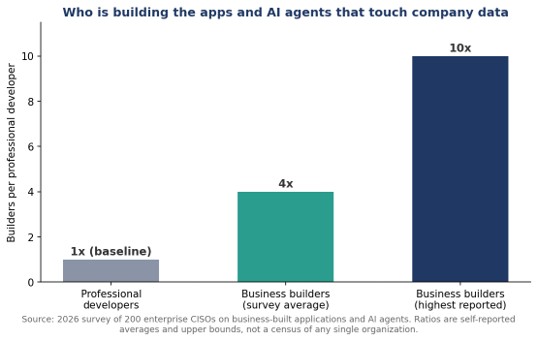
Visibility has not kept pace. In the same survey, more than 70% of CISOs said they do not have complete visibility into the applications and AI agents business users build, with many describing their view as partial or minimal. An AI data loss prevention program that only covers centrally developed systems is therefore watching the smaller part of the estate.
Myth 4: Will a data leak be obvious when it happens?
Reality: Rarely. Data leakage in business-built apps and AI agents usually happens quietly, through misconfigurations, oversharing or unexpected data movement, rather than through a dramatic breach. Exposure is typically the cumulative result of interactions between apps, data sources and sharing configurations.
Effective AI data leakage prevention starts by mapping those interactions. The core signals are an inventory of every data source, connector and integration mapped to the apps, flows and agents that use them; identification of externally exposed data, including public assets and externally triggered processes; visibility into who can access data, including indirect access through app sharing; alerts on data that is overshared publicly, excessively or outside its intended group; and visibility into data stored or processed in personal workspaces.
Agents add one more layer. Security teams need to see every agent’s access paths across the data stores it touches, such as SharePoint, OneDrive, SQL Server or Snowflake, and track where each agent sends data. Mapping every agent’s data access paths is what turns an invisible leak into a reviewable one.
Myth 5: Is blocking AI the only safe option?
Reality: No. Blocking AI outright tends to push usage into less visible channels, while targeted controls and owner-led remediation reduce leakage without stopping the work. The more sustainable model is to find the specific exposure, explain it and route the fix to the person who owns the asset.
That can mean automatic notifications to app or agent owners with clear remediation steps, or alerting workflows that flag issues without enforcing changes automatically. At runtime, it can mean blocking a specific data flow rather than the whole agent. Security leaders appear to be moving in this direction: in the 2026 CISO survey, organizations expected to put policies and controls in place for business-built apps and agents within 6.5 months on average, and 67% reported already having a defined 2026 budget for securing them.
What does an effective AI data loss prevention program include?
An effective program combines continuous discovery, data-flow mapping, exposure alerts and owner-led remediation across every platform where AI and business-built apps touch sensitive data. A practical starting checklist:
- Discover: inventory every AI agent, app and automation, including those built inside approved platforms.
- Map: connect each asset to the data sources, connectors and destinations it uses.
- Restrict: apply least privilege to agent permissions and limit the data types a model may return.
- Detect: alert on public, excessive or out-of-group sharing and on data held in personal workspaces.
- Remediate: send specific fixes to asset owners and block individual risky flows at runtime when needed.
None of these steps require slowing the business down. Organizations that handle AI data leakage well treat it as an ongoing visibility problem rather than a one-time policy exercise. They keep the inventory current as builders create new agents, review sharing settings as teams and projects change, and measure success by how quickly an exposed asset gets fixed by its owner, not by how many tools were blocked.
Frequently Asked Questions
What is the difference between AI data loss prevention and traditional DLP?
Traditional DLP inspects files, email and endpoints, while AI data loss prevention also covers leaks through AI model outputs, agent connectors and sharing settings inside business platforms.
How does sensitive data leak through AI agents?
Sensitive data can leak through AI agents when an agent with broad access retrieves and shares information a user should not see, when a prompt is manipulated to extract data, or when an agent sends data to an external destination.
Is shadow AI only about unapproved AI tools?
No, shadow AI also includes agents and automations that employees build inside approved platforms without security review, which can still expose sensitive data.
Where should an AI data loss prevention program start?
An AI data loss prevention program should start with a complete inventory of AI agents, apps and automations, mapped to the data sources and destinations each one uses.
