
Why don’t GPS and radio signals reach underground?
GPS satellites, and most other radio sources, require a direct line of sight to be received reliably. Rock, concrete, and soil absorb and reflect radio frequency energy so effectively that a GPS receiver more than a few meters underground typically cannot acquire a usable satellite signal at all, regardless of how strong that signal was at the surface. The same physical reality limits ordinary cellular and radio coverage underground, which is why mines, tunnels, and subway systems have historically been dead zones for navigation, timing, and communication unless a signal is deliberately piped in from outside.
How do RF solutions get a GPS signal underground?
The standard approach is conceptually simple, even though the fiber-optic engineering behind it is not: a donor antenna at the surface receives a live GPS signal, an RF-to-optical transmitter converts that signal for transport over fiber, and one or more receivers underground convert it back to RF and rebroadcast it locally. RFOptic’s GPS over fiber (GPSoF) solutions are built around exactly this architecture, and the same GPSoF principle used for highway tunnels and parking structures extends naturally underground: mobile operators and infrastructure owners transfer GPS timing signals from a rooftop antenna to a control room or distribution point using fiber, because coax cable cannot carry the signal past a few hundred meters at GPS frequencies without unacceptable loss.
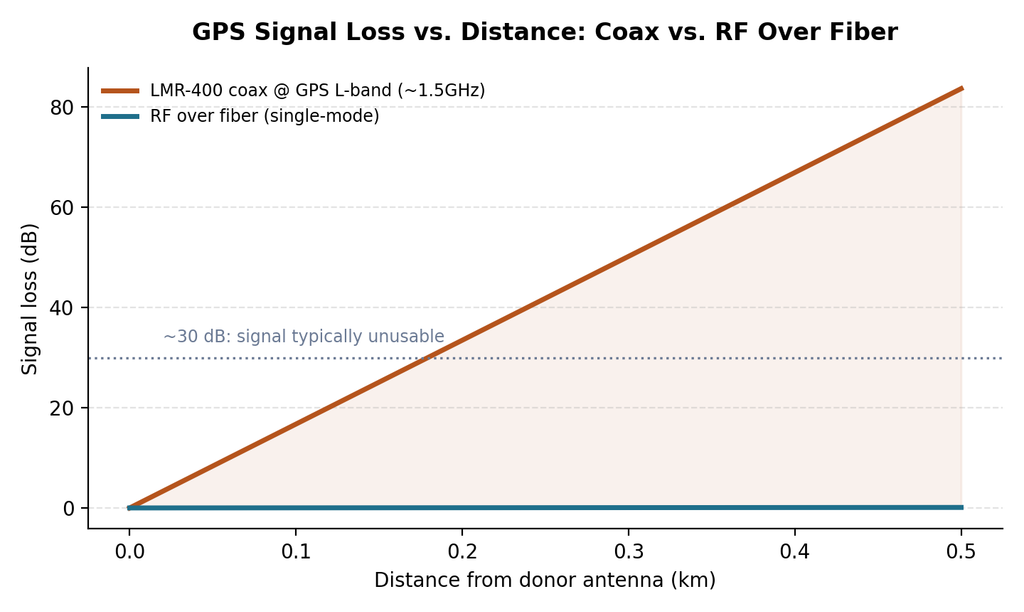
GPS signal loss versus distance for LMR-400 coax at GPS L-band frequencies compared with RF over fiber.
What makes mines and tunnels different from ordinary GPS over fiber?
Mines, tunnels, and underground/subway systems add requirements that a typical building GPSoF deployment does not have to meet. RF solutions built specifically for mines and emergency services account for harsher physical conditions, dust, vibration, humidity, and limited maintenance access, alongside the operational need to support personnel tracking, equipment location, and emergency communications in a space where wireless signals are otherwise limited or absent entirely.
| Environment | Primary use of the RF solution |
|---|---|
| Underground mines | Personnel and equipment tracking, timing synchronization, and emergency communications where no wireless signal otherwise reaches. |
| Highway and rail tunnels | GPS navigation continuity for vehicles and emergency responders passing through the tunnel. |
| Subway and transit systems | Timing and location signals for operational systems and, increasingly, passenger-facing services. |
| Parking structures and data centers | Timing synchronization for systems that depend on an accurate GPS clock reference despite being enclosed. |
How far can a single RFoF link carry a GPS signal?
Where coax cable runs out of usable range within a few hundred meters, RFOptic’s GPS over fiber solution is built to carry the GPS signal several miles without distortion or loss to the original signal, using very low-loss optical fibers and passive splitters to distribute the signal to multiple sheltered locations from a single rooftop donor antenna. Because the deployment can be point-to-point or point-to-multipoint, a single donor antenna and transmitter can feed many separate underground zones, each with its own receiver module rebroadcasting a local GPS signal.
What else has to work alongside the RF signal underground?
Distributing a signal underground is only half the job; keeping that distribution running reliably in a harsh, hard-to-access environment is the other half. A few considerations tend to come up in every mines GPS RF deployment:
- Ruggedized enclosures: equipment installed underground has to tolerate dust, moisture, vibration, and temperature swings that a typical indoor installation never sees.
- Redundant links: a monitoring system can watch both a primary and backup optical link, automatically switching over if a fault is detected in the primary path.
- Remote diagnostics: field technicians benefit from being able to check link status without traveling underground every time an issue is suspected.
- Passive splitting: optical splitters let one donor signal reach many separate zones without adding active electronics, and therefore additional failure points, at every branch.
Frequently Asked Questions
Can a GPS-over-fiber system be used for both mines and ordinary buildings?
Yes, the underlying architecture is the same: a donor antenna, an RF-to-optical transmitter, fiber distribution, and one or more receivers. Mines and tunnels typically add ruggedization and redundancy requirements on top of that same core design.
Why can’t a repeater or amplifier just boost the GPS signal underground instead?
A simple repeater still needs a usable incoming signal to amplify, and coax feeding that repeater runs into the same distance and frequency loss limits described above. RF solutions built on fiber avoid that bottleneck by keeping loss low over the entire run from the donor antenna to each underground zone.
How many separate zones can one donor antenna support underground?
It depends on the optical budget of the specific link and how the splitters are configured, but point-to-multipoint GPSoF deployments commonly feed multiple separate zones from a single donor antenna and transmitter.
Is this technology limited to GPS, or can it carry other RF signals underground too?
The same RF-over-fiber principle applies to other RF signals, including cellular and two-way radio frequencies, which is why RF solutions for mines and emergency services often combine GPS distribution with broader communications coverage in the same underground environment.
