
Key Takeaways
- Seedless mini peppers remove the single biggest friction point in snacking on sweet peppers, the seeds and core, without sacrificing the crunch and sweetness that make peppers appealing as a fresh snack in the first place.
- This category exists because of a deliberate strategic choice to breed for the consumer rather than the commodity, prioritizing eating experience and convenience over simply maximizing yield or shelf life alone.
- The global vegetable seeds market was valued at $8.91 billion in 2025 and is projected to reach $12.88 billion by 2032, a compound annual growth rate of 5.40%, according to Fortune Business Insights, reflecting sustained global demand for improved vegetable varieties.
- Premium specialty vegetables succeed commercially when they solve a genuine
What problem do seedless mini peppers actually solve?
Premium specialty vegetables succeed by solving exactly this kind of everyday friction. Sweet peppers have always been a healthy, popular snacking option in theory, but seeds and a fibrous core create real friction in practice, especially for a fruit meant to be eaten out of hand with minimal preparation. Removing that friction entirely, not reducing it, but eliminating it, is what separates a genuinely useful seedless mini pepper from a marginal improvement on an existing product. The trait had to be completely reliable to matter: a pepper that’s usually seedless but occasionally isn’t defeats the entire convenience proposition the category depends on.
Why does breeding “for the consumer, not the commodity” matter here?
This distinction shapes which varieties actually get developed and brought to market. BreedX’s own account of its breeding philosophy draws a clear line: in most cases, growers and retailers don’t particularly care whether a pepper has seeds or not, but consumers experience that difference directly every time they eat one. Focusing breeding priorities on the eating and snacking experience itself, rather than on traits that mainly benefit growers or retailers, is what led to segmenting seedless peppers into multiple distinct snack formats instead of treating “seedless” as a single, one-size-fits-all trait.
How does segmenting the category actually serve different consumer preferences?
Rather than a single generic seedless pepper, the category has been deliberately divided into several segments and sub-segments, from one-bite formats through 2-Bite and Mini-Kapia sizes, each targeting a distinct consumer preference and snacking occasion. That segmentation reflects a considered choice about where the company competes: there’s explicitly no intention to enter the mainstream market for seeded sweet peppers or hot peppers, since the strategic focus stays on the specific, differentiated territory these seedless snack segments occupy rather than competing head-to-head across the entire pepper category.
| Consideration | Why it matters for premium specialty vegetables |
|---|---|
| Genuine consumer benefit | The innovation has to solve a real inconvenience (seeds, prep time, inconsistent taste), not just look different. |
| Reliability of the trait | A sometimes-seedless product undermines the entire value proposition; the trait must hold every time. |
| Clear segment targeting | Different snack occasions and preferences are served by distinct product formats, not one generic version. |
| Grower workflow support | New crop types succeed commercially only if growers can realistically adapt existing operations to handle them. |
What challenges come with introducing a genuinely new crop type to growers?
A new crop segment doesn’t succeed on breeding merit alone; it also has to be practical for growers to actually produce. Because seedless peppers are functionally a new crop, growers need to keep them physically separate from their existing seeded varieties, especially during a trial phase, which isn’t a small operational ask. It means changing established workflows, isolating growing areas, and managing harvests with more care than an already-familiar seeded variety would require. Market feedback gathered directly from growers and retailers, including through market visits specifically aimed at assessing reception in new regions, has shaped how the category continues to be positioned and supported as it expands into new markets.
How large is the underlying vegetable seed market supporting this innovation?
Specialty breeding programs like this one operate within a much larger global vegetable seed industry. Fortune Business Insights’ vegetable seeds market analysis values the global market at $8.91 billion in 2025, projected to reach $12.88 billion by 2032, a compound annual growth rate of 5.40%, driven in part by rising awareness of the health benefits of vegetable consumption worldwide. That steady overall growth provides the backdrop against which more specialized, consumer-focused breeding programs, like seedless snack peppers, carve out a differentiated premium niche rather than competing purely on commodity volume.
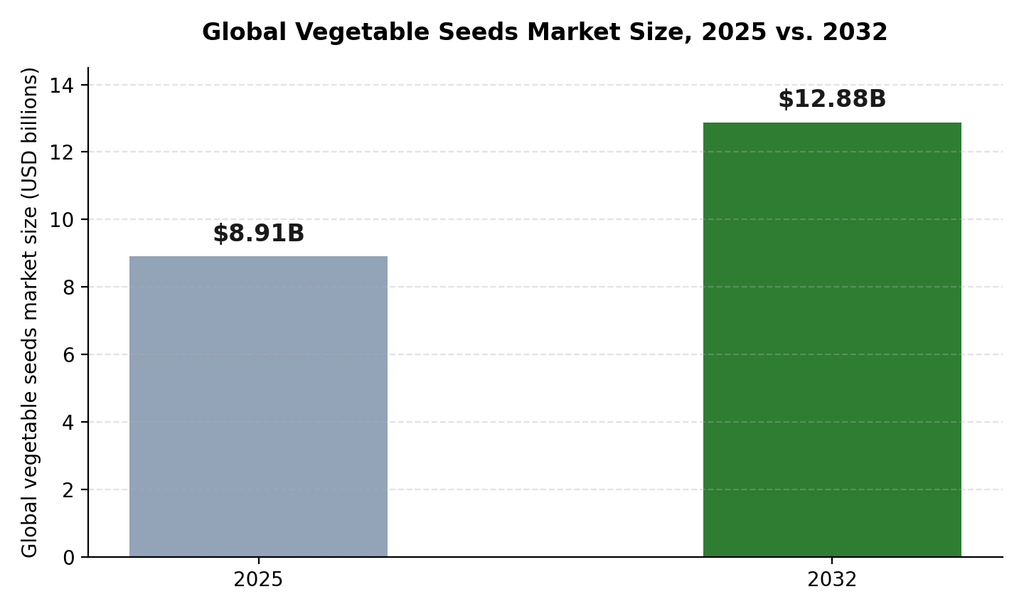
Global vegetable seeds market size, 2025 versus 2032, according to Fortune Business Insights.
What defines a premium specialty vegetable beyond seedlessness specifically?
- A clear, demonstrable consumer benefit, whether that’s convenience, taste, texture, or all three together.
- Differentiation that growers and retailers can actually merchandise, giving the product a distinct shelf position rather than blending into commodity bins.
- A production process that’s realistic to scale, since a trait that can’t be reliably reproduced at commercial volume never reaches consumers at all.
- Alignment with how people actually eat, snacking, convenience, and minimal preparation, rather than only traditional cooking use cases.
How does this approach compare to how most vegetable breeding programs prioritize traits?
Many breeding programs across the vegetable industry optimize primarily for traits that matter most to growers and retailers first: yield per hectare, shelf life during transport, uniformity for automated packing lines, and disease resistance that protects a harvest. Those traits matter and aren’t dismissed here, but they aren’t where a consumer-first breeding program starts. Starting instead from the eating experience itself, and only then working backward to confirm the resulting variety can actually be grown, packed, and shipped at commercial scale, tends to produce a different shortlist of candidate varieties than starting from agronomic performance alone and hoping consumers respond well to whatever survives that filter.
What does market feedback actually change once a new segment launches?
Launching a new premium specialty vegetable segment rarely means the work is finished once seed reaches growers. Direct market feedback, gathered through activities like touring a new region to assess reception firsthand, routinely surfaces adjustments: which sub-segment resonates most in a given market, what packaging or portion size actually moves off shelf fastest, and where grower adoption is lagging because of workflow friction rather than any issue with the variety itself. Treating that feedback loop as ongoing, rather than a one-time validation step before launch, is part of what separates a specialty vegetable program built for long-term category growth from one that treats its first commercial variety as a finished product.
Frequently Asked Questions
Are seedless mini peppers grown differently from regular seeded peppers?
Yes, in practice they’re treated as a distinct crop, requiring separate growing areas from seeded varieties, particularly during a grower’s trial phase, along with adapted workflows and more careful harvest management.
Do seedless mini peppers taste different from regular sweet peppers?
The breeding focus is specifically on preserving, and where possible enhancing, the crunch and sweetness consumers expect from a sweet pepper, while removing the seeds and fibrous core entirely.
Why not just breed one universal seedless pepper instead of multiple segments?
Different consumer occasions call for different formats: a single-bite snacking pepper serves a different use case than a slightly larger pepper meant for stuffing or light cooking, so segmenting the category serves more preferences than a single generic version would.
What makes a specialty vegetable “premium” rather than just different?
A premium specialty vegetable delivers a genuine, reliable consumer benefit, not just novelty, and that benefit has to hold up consistently at commercial scale for growers and retailers to invest in carrying it.
