
| Key Takeaways • Modern live broadcasting relies on bonding multiple independent network connections so no single dropped link interrupts the feed, replacing single-point links like satellite trucks. • The global live-streaming market is projected to grow from about $97.39 billion in 2026 to more than $318.56 billion by 2031, an estimated 26.74% compound annual growth rate, according to Mordor Intelligence. • Field-transmission hardware has shrunk from multi-ton broadcast trucks to backpack-sized units capable of 4K HDR video and multiple bonded network connections. • Choosing a field-transmission setup depends on required video resolution, latency tolerance, the number of redundant network paths, and whether cloud-based distribution tools are included. |
What does it actually take to broadcast live from any location today?
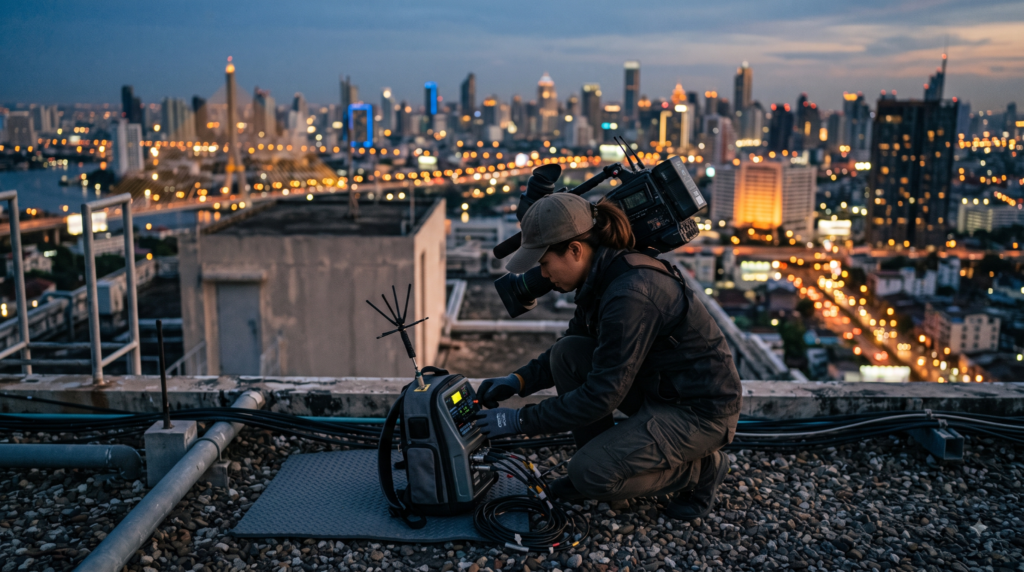
Getting a broadcast-quality signal out of an unpredictable location comes down to three things: enough combined network capacity to hold a stable connection, redundancy so a single dropped link never kills the feed, and hardware compact enough for one or two people to carry and set up in minutes. That combination has replaced a lot of equipment that used to be considered mandatory. A rooftop, a stadium concourse, or the back of a moving vehicle can now serve as a transmission point, provided the connectivity layer is built to route around a weak or interrupted signal rather than depend on a single one. Productions that need this kind of setup only occasionally, rather than owning it outright, increasingly turn to short-term rental packages for field productions built around the same portable, bonded field units used for owned deployments.
How has IP bonding replaced traditional broadcast trucks and satellite links?
IP bonding replaced trucks and satellite dishes by combining several independent internet connections into a single transport path, so no single network outage takes the whole signal down, and the equipment typically arrives in a backpack instead of a multi-ton vehicle. Under the hood, this means a field unit maintains multiple simultaneous connections, cellular from more than one carrier, Wi-Fi, wired internet where it’s available, and continuously shifts traffic away from whichever path is currently weakest. Packet reordering and adaptive bitrate encoding smooth out the handoffs so the output feed doesn’t stutter every time the network underneath it changes. The shift shows up clearly in how field crews describe their own work: a separate report on how outside-broadcast field production has changed documents crews going live from a stadium corner or a moving vehicle in minutes, with far less equipment on site than a traditional remote-broadcast van required. Purpose-built broadcast-news configurations of this technology are typically covered on a dedicated broadcast-news equipment page, which lists the contribution and distribution tools built specifically for newsgathering.
Why is live-broadcast infrastructure growing faster than the broader streaming market?
Live-broadcast contribution technology is scaling alongside a live-streaming market that’s growing roughly four times faster than most mature technology categories, which is pulling more investment into the hardware and network layer that makes live feeds possible. According to an independent market research report from Mordor Intelligence, the global live-streaming market is projected to grow from about $97.39 billion in 2026 to more than $318.56 billion by 2031, a compound annual growth rate of roughly 26.74%, with video-format streaming accounting for the large majority of that value.
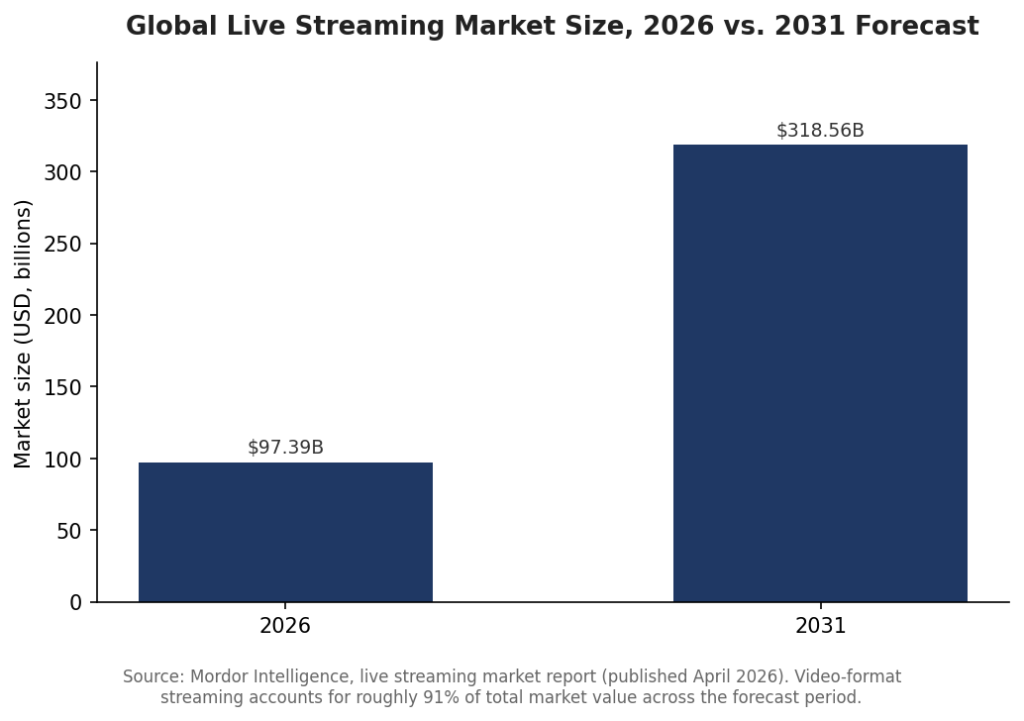
Global live-streaming market size, 2026 versus its 2031 forecast. Source: Mordor Intelligence.
That growth is driven partly by how many destinations a single live event now needs to reach at once, linear broadcast, social platforms, and owned streaming apps simultaneously, which increases the number of transmission and distribution touchpoints a production has to support. Hardware built to serve this many outputs from one field unit is described in more detail across the field-unit product lineup, covering everything from lightweight single-operator encoders to multi-camera field units.
What should a production team check before choosing a field-transmission setup?
Before choosing a field-transmission setup, a production team should confirm four things: the video resolution and dynamic range it needs to deliver, how much latency the format can tolerate, how many independent network paths the unit can bond simultaneously, and whether cloud-based distribution and management tools are included or need to be added separately. Resolution and latency requirements vary a lot by format. A breaking-news hit tolerates a few seconds of delay; a live sports or awards broadcast usually needs sub-second glass-to-glass latency to stay in sync with graphics and commentary. The number of bonded paths matters most in dense environments, stadiums, conference centers, and downtown cores, where a single carrier’s network is more likely to be congested. The broader live-broadcasting solutions overview breaks these considerations down by use case, from newsgathering to enterprise and public-safety deployments, since the right configuration differs meaningfully across them.
Which industries rely on this kind of live-broadcast infrastructure beyond traditional news?
Beyond traditional TV news, this same bonded-connectivity approach now shows up in sports coverage, public-safety operations, and a growing set of enterprise, education, and government use cases that need reliable live video from places without fixed infrastructure. Public-safety agencies use compact field units to transmit video from drones, patrol vehicles, and body cameras back to a command center in close to real time, which is a very different reliability requirement than a scheduled news broadcast but relies on the same underlying bonded-transport principle. Enterprise, education, and government organizations, including houses of worship and campus broadcast teams, increasingly use the same category of hardware for streaming services, ceremonies, and public meetings that used to require a fixed, wired camera setup. What ties all of these use cases together is that none of them can guarantee a stable, wired network connection at the point of capture, which is exactly the constraint bonded-IP transport was built to work around. As more of these sectors adopt live video as a standard part of their operations rather than an occasional add-on, the underlying connectivity layer described above is increasingly treated as core infrastructure rather than a specialty tool reserved for broadcast news. This broadening of use cases also changes how organizations budget for the equipment. A newsroom evaluating a field unit purely against its old satellite-truck costs sees one kind of return on investment; a public-safety agency evaluating the same category of hardware against the cost and delay of getting a helicopter or a fixed camera network into place sees a very different, often more urgent, calculation. The common thread is that the underlying connectivity problem, and the bonded-network approach that solves it, stays the same across all of these otherwise very different buyers.
Frequently Asked Questions
What is IP bonding in live broadcasting?
IP bonding combines multiple independent internet connections, such as cellular and Wi-Fi, into a single reliable transport path so a live feed keeps running even if one connection drops.
Can a live event be broadcast without a satellite truck?
Yes; many productions now use portable, bonded-IP field units instead of satellite trucks, which reduces setup time, crew size, and cost for a wide range of live-event formats.
How fast is the live-streaming market expected to grow?
Industry research from Mordor Intelligence projects the global live-streaming market will grow from about $97.39 billion in 2026 to more than $318.56 billion by 2031.
What video quality can modern field-transmission units deliver?
Many current field-transmission units support up to 4K resolution at 60 frames per second with high dynamic range, along with multiple audio channels for full production sound.
