

| Key Takeaways • RPA bots authenticate to production systems with their own credentials, but unlike human employees, no manager is watching their day-to-day access. • A CISO View report on digital transformation risk found that fewer than half of organizations had a formal privileged access management strategy in place for RPA. • Bots are commonly over-provisioned during setup and rarely reviewed afterward, and abandoned automations often keep running on inherited access long after the project that created them ends. • Because RPA bots don’t live in code repositories or CI/CD pipelines, standard application security tooling frequently never sees them, which is why dedicated discovery and governance approaches are needed. |
What security risks do UiPath and other RPA bots actually introduce?
RPA bots introduce the same category of risk as any other digital identity with system access: excessive permissions, weak credential hygiene, and unreviewed third-party components, but with far less oversight than a human account gets. Each bot is assigned its own login to authenticate with the systems it touches, whether that’s an accounting platform, an email server, or an HR tool, and those credentials are frequently provisioned once and never revisited. A discovery scan built specifically for UiPath environments commonly turns up automations running with excessive privileges, workflows handling sensitive data without encryption, community-sourced packages that were never security-reviewed, and test workflows still executing in production long after they were meant to be retired.
These aren’t edge cases; they map closely to the same failure categories standards bodies use to describe risk in citizen-built software generally, things like unvetted third-party components, security misconfiguration, and weak asset tracking. The difference with RPA specifically is scale and speed: a single automation team can spin up dozens of bots in the time it would take to provision and review one new employee’s access, and each of those bots inherits whatever permissions were fastest to grant at the time.
Why do RPA bots end up with more access than they need?
Bots typically get over-provisioned during setup because it’s faster to grant broad access once than to troubleshoot permission errors repeatedly while a workflow is being built. That shortcut rarely gets corrected later. As the number of bots in an organization grows, so does the complexity of tracking what each one can actually reach, and unlike a human employee, a bot has no manager quietly noticing when its behavior looks unusual. Credential compromise is one of the most cited risks in bot identity management precisely because bots often hold standing access to sensitive systems, making their logins a high-value target if they are reused, shared, or never rotated.
Scale makes the problem self-reinforcing. As bot counts grow across finance, HR, and operations teams, so does the number of distinct credentials, service accounts, and third-party connections that need periodic review, and most organizations don’t have a single team whose job is to look at all of them together. Bots also don’t push back the way a human employee might when asked to accept an unusually broad permission request, which removes one of the informal checks that sometimes catches over-provisioning in traditional IT access requests.
How wide is the gap between automation adoption and automation governance?
It’s wide, and growing. Enterprises have moved from using low-code and no-code tooling for a small share of new applications to relying on it for the majority of what gets built, while formal governance for the automations themselves has not kept pace. A CISO View report on digital transformation risk found that fewer than half of organizations had a privileged access management strategy in place for technologies like RPA, even as automation adoption climbed. The report also pointed to over-privileged robots, weak password rotation practices, and limited visibility into bot behavior as recurring, unaddressed gaps.
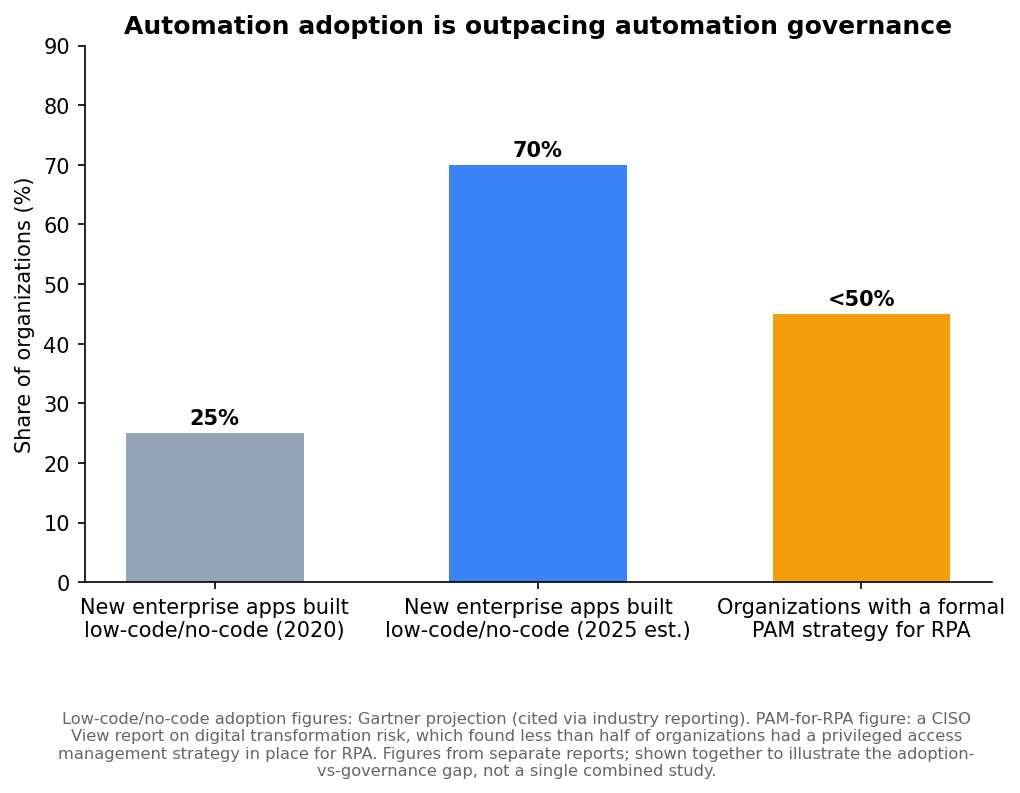
Low-code/no-code adoption figures reflect a widely cited Gartner projection; the privileged-access-management figure comes from a separate CISO View report on digital transformation risk. Shown together to illustrate the adoption-vs-governance gap, not a single combined study.
What happens to bots and credentials after the project that created them ends?
Without active ownership tracking, an RPA bot typically keeps running unchanged after the project or the employee who built it moves on, becoming what’s often called an orphaned automation. Nobody is watching for credential expiration, unnecessary access that’s crept in over time, or the bot quietly failing in a way that goes unnoticed because it isn’t wired into standard monitoring. Mapping automation environments across Power Automate, Salesforce, UiPath, ServiceNow, and Retool is one way security teams have approached this: building a live inventory of bots, their dependencies, and the identities they execute under, rather than relying on whoever built the automation to remember it exists.
The practical risk of an orphaned bot isn’t abstract. A bot with standing access to a customer database or a finance system doesn’t stop being a viable attack path just because the person who understood it has left; if anything, the risk grows, because troubleshooting or revoking its access now requires someone to first figure out what it does and why. That reconstruction work, done manually after the fact, is slower and more error-prone than maintaining an ownership record from the start.
What should a governance program for RPA and citizen-built automation include?
A working governance program needs three things: an up-to-date inventory of every bot and its dependencies, clear ownership so someone is accountable for each automation’s lifecycle, and a way to flag risky configurations, like excessive permissions or unreviewed components, before they turn into incidents. RPA bots don’t live in code repositories and rarely surface in conventional security tooling, which is exactly why they slip through standard application security review even at organizations that are otherwise diligent about access management. Centralized ownership and lifecycle tracking across every app, flow, and agent an organization has running addresses that blind spot directly, surfacing orphaned or stale automations so they can be reviewed, reassigned, or decommissioned instead of running indefinitely on inherited access.
None of that requires slowing automation teams down. The goal isn’t to add a review board in front of every new bot; it’s to make sure that once a bot exists, someone knows it exists, knows what it can access, and gets a signal when that access looks abnormal or the bot goes quiet without being formally retired.
Is RPA adoption actually growing faster than the tools to secure it?
Yes, by most available measures. Analyst research tracking the robotic process automation market has consistently shown continued growth in enterprise RPA spending and deployment scale year over year. A global market analysis of robotic process automation from Gartner is one of several analyst reports tracking this trajectory, and the practical effect for security teams is straightforward: more bots are being deployed into production faster than governance processes for reviewing their access are maturing at most organizations. Treating bot identities as a distinct category, separate from human user accounts and separate from standard service accounts, is a first step toward closing that gap before it becomes an incident rather than an audit finding.
None of this argues against automation; RPA and low-code tooling deliver real efficiency gains, and that isn’t going to reverse. What it argues for is treating the resulting bots the way any other privileged identity would be treated: inventoried, owned by a named person or team, reviewed on a schedule, and retired deliberately rather than left running because nobody remembered to turn it off.
Frequently Asked Questions
Can an RPA bot’s credentials be stolen the same way a person’s can?
Yes. RPA bots authenticate with real credentials to production systems, and because those credentials often carry broad access, they are an attractive target for attackers if they are shared, reused, or never rotated.
Why do RPA bots often end up with more system access than they need?
Bots are frequently provisioned with broad permissions during setup to avoid troubleshooting access errors while a workflow is being built, and those permissions are rarely revisited once the automation is running.
What happens to an RPA bot after the person who built it leaves the company?
Without active ownership tracking, the bot typically keeps running unchanged, becoming an orphaned automation that nobody is monitoring for errors, credential expiration, or unnecessary access.
Is securing RPA bots different from standard application security?
Yes. RPA bots operate outside conventional code repositories and CI/CD pipelines, so many standard application security tools never see them, which is why dedicated discovery and governance approaches are needed.
