
Megapixels get treated as a marketing number more often than they deserve, so it is worth asking plainly what a 100mp camera actually changes about a photograph, beyond the ability to print a file larger before it looks soft. The honest answer involves resolution, but resolution is really only the entry point.
What does 100 megapixels actually buy a photographer?
At its simplest, a 100-megapixel full-frame medium format sensor captures roughly twice the pixel count of a typical high-resolution 45 to 50-megapixel full-frame sensor, which translates directly into more room to crop, larger prints without visible softness, and finer texture rendering in subjects like fabric, skin, or fine detail work such as jewelry and product photography. But resolution on its own is a fairly narrow benefit. What tends to matter more in practice is what comes packaged alongside that resolution on a larger sensor: a bigger photosite per pixel, which generally means better light-gathering ability, wider dynamic range, and cleaner shadows even before any post-processing happens.
Why does sensor size matter as much as pixel count?
A medium format sensor built for this class of camera is typically around 1.5 times the surface area of a full-frame mirrorless sensor. Spread 100 megapixels across a larger physical area rather than cramming them into a smaller one, and each individual pixel stays larger than it would on an equivalent-resolution crop sensor. That translates into published specifications such as up to 15 stops of dynamic range on a current full-frame medium format system, a meaningful jump over what most smaller-sensor cameras can hold in a single exposure, particularly in high-contrast lighting where retaining both highlight and shadow detail matters.
How has this resolution class evolved?
100 megapixels did not appear from nowhere. Medium format digital backs progressed from 50 to 60 to 80 megapixels before reaching 100, with each step driven by sensor manufacturing improvements rather than a single leap. That gradual progression matters for buyers evaluating whether current 100-megapixel hardware is mature technology or an early, untested step: it is squarely the former, built on top of several prior generations of the same sensor and processing lineage.
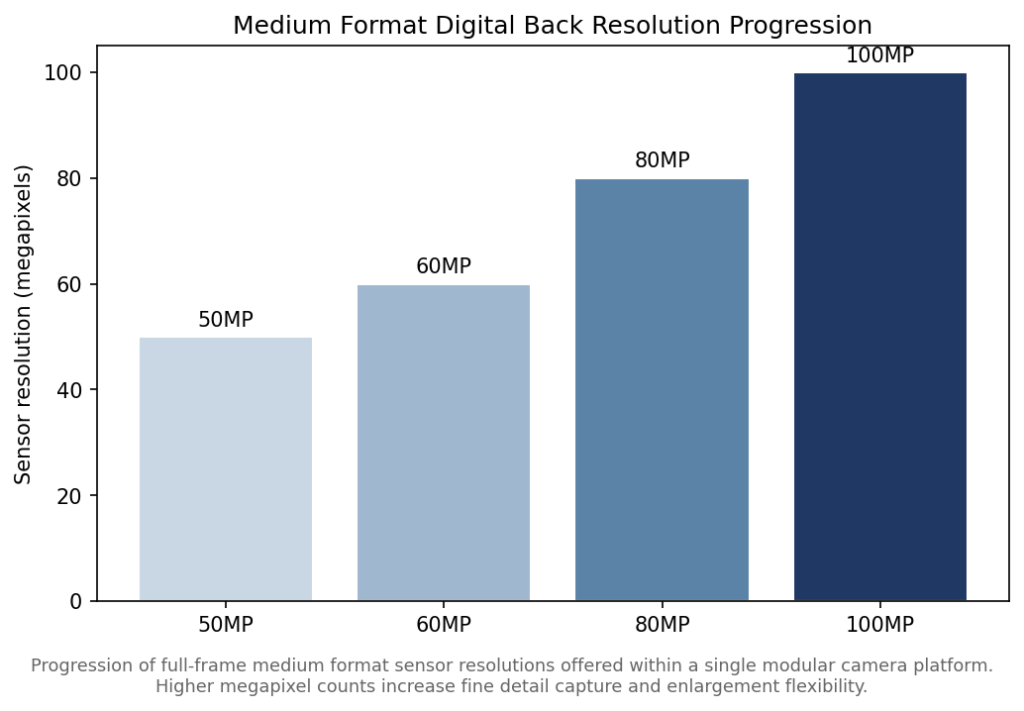
Resolution progression across a modular medium format digital back platform, from 50 to 100 megapixels.
Does higher resolution create any real drawbacks?
Yes, and it is worth being direct about them rather than treating resolution as a free upgrade. Files at this resolution are large, which increases demands on storage, backup, and computer processing power throughout an editing workflow. The gear itself, including a system built around high-resolution medium format lenses designed to resolve enough detail to actually use all those pixels, tends to be heavier and more expensive than smaller-format alternatives. At this level of resolution, camera shake and lens sharpness both become less forgiving, since fine detail that a lower-resolution sensor would simply not record is now visible enough to reveal any softness in technique or optics.
Who actually needs this much resolution?
Not every photographer does, and that is a fair and important caveat. The clearest beneficiaries are studio, product, and fine art photographers who need to print large or crop aggressively without quality loss, along with archival and reproduction work where capturing maximum fidelity in a single exposure genuinely matters. A published hands-on review of a 100-megapixel medium format system summed up the tradeoff bluntly: the resulting image quality is exceptional, but the size, weight, and price mean it is a tool built for people who have a specific, resolution-driven reason to need it, not a general-purpose upgrade for casual shooting. That assessment lines up with how the format has been positioned from the start: a deliberate, higher-cost tool for a specific class of professional work, not a mass-market resolution race.
| Resolution | Sensor class | Typical use case |
| 50MP | Full-frame medium format | General professional and studio use |
| 60MP | Full-frame medium format | Higher-resolution studio and landscape work |
| 80MP | Full-frame medium format | Large-format print and fine detail work |
| 100MP | Full-frame medium format | Maximum resolution studio, product, and archival capture |
A 100-megapixel sensor is not really about the number on the spec sheet. It is about what a larger sensor paired with that resolution enables: more dynamic range, more cropping latitude, and finer detail in exactly the situations where those things are worth their added cost in equipment, storage, and technique. For the work that genuinely calls for it, that tradeoff is an easy one. For everything else, it is worth being honest that more megapixels is not automatically a better photograph.
Frequently Asked Questions
Is a 100 megapixel camera worth it for most photographers?
Not necessarily. It offers the clearest benefit to studio, product, fine art, and archival photographers who need maximum cropping latitude, large prints, or fine detail capture, rather than general or casual shooting.
Why does sensor size matter alongside megapixel count?
A larger sensor spreads the same pixel count across more physical area, which generally improves light-gathering ability and dynamic range compared with cramming the same resolution onto a smaller sensor.
What are the practical downsides of higher resolution cameras?
Larger file sizes increase storage and processing demands, and the added resolution makes camera shake and lens sharpness less forgiving, requiring higher-quality optics and technique to fully use the extra detail.
