
Time Division Multiplexing was supposed to be retired years ago. Instead, a large share of service providers and utilities are still running SONET and SDH based TDM services alongside their packet networks, and for good reason: those circuits carry revenue-generating leased lines and legacy customer contracts that cannot simply be switched off. The real question most carriers are working through is not whether to modernize, but how to do it without disrupting the customers still paying for TDM service. Below is a practical look at the TDM to packet migration approach that is actually being used in the field, along with the timing challenge that trips up a lot of otherwise well-planned migrations.
The Core Challenge: Two Networks, One Budget
Service providers face a specific operational bind: they need to maintain revenue generating legacy TDM services while transitioning to modern packet-based networks, and they often need to integrate leased line services from alternative providers on top of that. Running two parallel transport networks, one for TDM and one for IP and Ethernet, doubles operational overhead and total cost of ownership. Running a single unified network that handles both is the more sustainable path, but it requires equipment that can carry TDM traffic natively across a packet infrastructure rather than forcing an abrupt cutover.
The Migration Approach That Avoids a Forklift Replacement
- TDM pseudowire technology carries framed or unframed E1/T1 or E3/T3 traffic over Ethernet, IP, or MPLS networks, so existing TDM circuits ride on packet infrastructure without being torn out and rebuilt.
- Unified management of TDM and Ethernet services on the same platform simplifies operations and lowers total cost of ownership compared to running separate systems.
- Support for multiple pseudowire termination options allows a heterogeneous first-mile footprint, meaning not every site has to be upgraded on the same timeline.
- This approach allows a full SONET or SDH infrastructure replacement to a packet-switched network without affecting the legacy, high-revenue customers still depending on those TDM circuits.
Why Timing Is the Part Migrations Underestimate
TDM networks came with synchronization built in. Packet networks do not, which means migrating away from TDM without a timing plan is one of the most common ways a modernization project runs into trouble after launch. Mobile backhaul, in particular, requires phase-aligned timing between base stations and fronthaul equipment, and that level of precision depends on a properly deployed PTP grandmaster timing distribution strategy, not just a best-effort network clock.
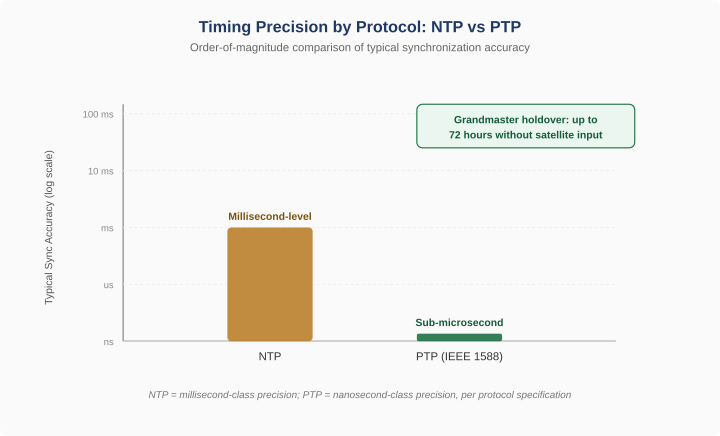
The difference in precision between the two eras of timing protocol is not subtle. Network Time Protocol, the older standard, delivers millisecond-level accuracy, which was adequate for the applications it was originally built for. Precision Time Protocol, based on IEEE 1588, delivers nanosecond-level accuracy over the same LAN or WAN infrastructure. That leap in precision is what makes modern 5G fronthaul, phase-synchronous radio, and other latency-sensitive services possible in the first place.
Where Precise Timing Actually Matters
- Telecom networks: LTE-Advanced and 5G systems require base stations and fronthaul equipment to be phase-aligned, which depends on grandmaster clocks distributed through the backhaul network.
- Power utilities: synchrophasor measurements in smart grids rely on the same PTP-based timing discipline used in telecom backhaul.
- Financial services: trading systems use PTP for timestamping transactions to meet regulatory requirements such as MiFID II.
- Broadcast and media: video stream synchronization across distributed production increasingly relies on PTP-based protocols such as gPTP.
A Practical Migration Checklist
- Inventory every active TDM circuit and flag which ones are tied to contractual revenue commitments before touching the transport layer.
- Choose pseudowire-capable equipment that can run TDM and Ethernet services on the same unified management platform, rather than standing up parallel systems.
- Deploy a grandmaster clock strategy ahead of any mobile backhaul migration, not as an afterthought once packet traffic is already live.
- Prioritize sites with underground or indoor installations for grandmaster placement close to the cell site, since GNSS visibility is often weakest there.
- Plan for holdover: a properly specified grandmaster clock can maintain sub-microsecond timing stability for up to 72 hours without a satellite signal, which matters when GNSS reception is temporarily lost.
Why a Phased Approach Beats a Deadline-Driven One
Carriers that try to force a hard cutover date on TDM retirement tend to run into the same problem: a subset of high-value customers whose contracts, equipment, or regulatory requirements are not ready to move, regardless of what the internal modernization roadmap says. A phased approach, where pseudowire transport lets TDM and packet services coexist on the same infrastructure indefinitely, removes that forced choice. It lets the commercial side of the business retire TDM contracts on their natural renewal timeline while the network side captures the operational savings of a unified platform immediately, rather than waiting for every legacy circuit to be gone.
The Bottom Line
TDM is not disappearing on its own timeline, it is disappearing on the timeline set by the customers still under contract for it. The carriers managing this transition successfully are treating pseudowire transport and timing synchronization as one connected problem rather than two separate projects. Solutions that carry TDM pseudowire transport over Ethernet while also distributing precise timing to the network edge let a carrier retire legacy infrastructure at its own pace, without a single migration deadline that puts revenue-generating services at risk.
