
Shadow AI gets discussed like it is a simple problem: employees download unauthorized apps, and IT blocks them. That framing made sense for shadow IT a decade ago. It does not hold up well against how AI tools actually spread inside organizations today, and a few outdated assumptions keep security teams focused on the wrong part of the problem.
Misconception: Shadow AI mostly means unauthorized apps on personal devices
The reality is that a large share of shadow AI activity happens inside tools the organization already approved. An employee builds an automation inside an approved low-code platform, connects it to a generative AI feature, and grants it access to a shared drive, all without ever installing anything new or triggering a device-management alert.
This is why shadow AI and agentic security monitoring increasingly focuses on behavior inside sanctioned platforms rather than only on network traffic to unapproved domains. The riskiest activity often is not hidden from IT. It is happening in plain sight, just unreviewed.
Misconception: Blocking known AI domains solves most of the exposure
Domain blocking addresses one narrow slice of shadow AI, the case where someone deliberately seeks out an external tool. It does nothing for AI features embedded inside existing SaaS platforms, browser extensions bundled with legitimate productivity tools, or agents built using approved internal platforms.
A more complete approach pairs domain-level controls with AI data loss prevention that tracks what data actually leaves the organization and through which channel, regardless of whether the destination was ever formally blocked.
Misconception: Citizen developers are the primary security risk
It is tempting to treat business users building their own automations as the core problem. In practice, the risk usually is not that citizen developers are careless. It is that they are rarely given the training or guardrails to understand what they are exposing when they connect an agent to sensitive data.
Programs built around citizen developer security awareness tend to produce better outcomes than programs built purely around restriction, since restriction alone often just pushes activity further out of view.
Treating citizen developers as adversaries rather than as an underserved audience also tends to backfire. When building tools becomes something employees feel they have to hide, security teams lose the visibility they need most, which is often a worse outcome than the original risk the restriction was meant to address.
Misconception: If a tool passed an initial security review, it stays safe
AI agents and automations are not static once deployed. Their behavior can shift as underlying models update, as permissions get modified by well-meaning users, or as they get connected to new data sources over time. A one-time review captures a snapshot, not an ongoing guarantee.
This is part of why runtime-focused approaches matter as much as pre-deployment review. Reviewing an agent once at launch and never again leaves a wide window for its risk profile to change unnoticed.
Misconception: RPA and automation platforms are lower risk because they are not generative AI
Robotic process automation predates the current wave of generative AI tools, which leads some teams to treat it as a solved, lower-risk category. That assumption misses how much RPA and automation platforms now interact with AI features, credentials, and sensitive systems on their own.
Reviewing robotic process automation security with the same rigor applied to newer AI agents, rather than treating it as legacy infrastructure, closes a gap that often gets overlooked simply because the technology feels familiar.
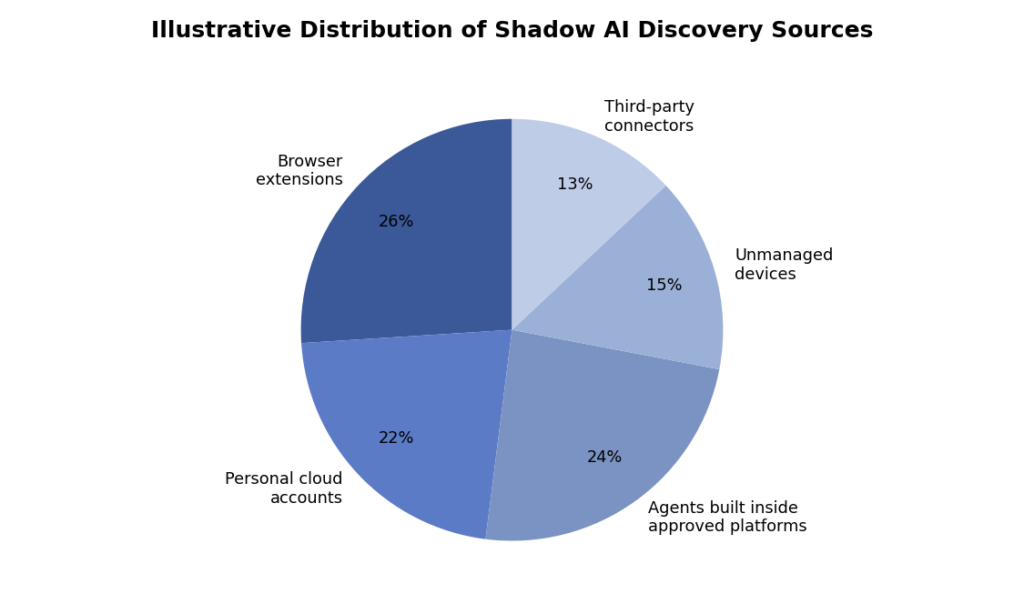
Illustrative distribution of where shadow AI tools tend to be discovered. General pattern based on common enterprise findings, not a specific measured dataset.
Where This Leaves Security Teams
Each of these misconceptions shares a common thread: they assume shadow AI looks like shadow IT did, concentrated in unauthorized tools that can be blocked at the network level. The more accurate picture is that most shadow AI risk now lives inside approved platforms, embedded features, and automations built by well-intentioned employees. Programs that account for that distinction tend to catch far more of the actual exposure than programs still built around the older shadow IT model.
Frequently Asked Questions
What is the difference between shadow IT and shadow AI?
Shadow IT typically refers to unauthorized applications or devices used outside IT’s knowledge. Shadow AI often occurs inside already-approved platforms, where employees build agents, automations, or connect AI features without a formal security review, making it harder to detect with traditional network-level controls.
Can shadow AI be fully prevented?
Complete prevention is unrealistic given how accessible AI features have become inside everyday tools. Most organizations focus instead on visibility and monitoring so shadow AI activity can be identified and assessed quickly rather than assuming it can be blocked entirely.
Why do citizen developers create shadow AI risk?
Citizen developers often build agents and automations without a security or engineering background, which means they may not recognize when a workflow is granted broader data access or integration permissions than the task actually requires.
