
The technology of 5G broadcasting reshapes field production by eliminating the severe connectivity bottlenecks that video transmission engineers face during high-stakes remote deployments. Getting high-quality live video from field events to home screens requires absolute link reliability. Historically, this workflow forced teams to utilize bulky satellite trucks or unpredictable multi-SIM cellular bonding arrays. Consequently, the arrival of standalone next-generation networks changes field workflows completely. Broadcast professionals are rapidly upgrading their transmission gear to capitalize on these new infrastructure topologies.
Structural Demand Across Modern Media Landscapes
This article breaks down how specialized media houses deploy real-time high-bitrate streaming across news, sports, public safety, and corporate applications. In addition, we evaluate what these physical networks offer during active field operations. Finally, this review outlines exactly what engineers should check when purchasing field encoding equipment.
These specialized channels deliver massive peak upload speeds that far surpass older cellular capabilities. More importantly for mobile transmission, next-generation architectures keep end-to-end signal latency between 1 and 10 milliseconds. Furthermore, increased cell density allows hundreds of media devices to stream concurrently from crowded venues without dropped frames. Statistics indicate that these modern networks now cover a massive share of global metropolitan populations, with deployment accelerating across major media markets.
Historical Performance Trajectories (2022–2026)
To understand how the market responds to these infrastructure improvements, teams must track core deployment metrics. As network availability expands, organic search volumes reflect a growing baseline prioritization of cellular field hardware among procurement directors.
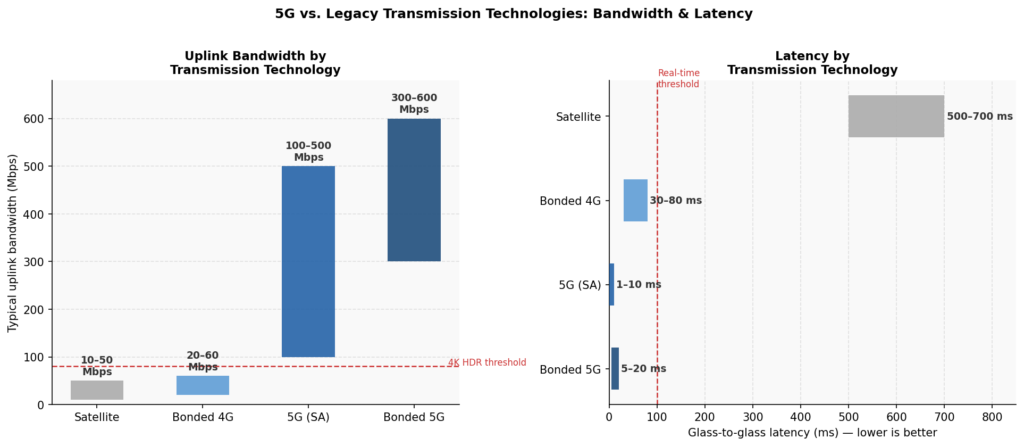
The charts below visualize the two metrics that matter most for live broadcast — uplink bandwidth and glass-to-glass latency — across the four transmission architectures compared in this article.
| Capability | 5G (SA) | Bonded 5G | Bonded 4G | Satellite |
| Uplink Speed (peak) | 100–500 Mbps | 300+ Mbps | 20–60 Mbps | 10–50 Mbps |
| Latency | 1–10 ms | 5–20 ms | 30–80 ms | 500–700 ms |
| Coverage (2026) | Urban/dense | Urban/dense | Broad/global | Near-global |
| Setup Time | Seconds | Seconds | Seconds | Minutes/Hours |
| Cost per Mbps | Low | Medium | Low-Medium | High |
| 4K HDR Capable | Yes | Yes | Conditional | Conditional |
Key Operational Gains for Remote Production
For field crews, these network updates deliver three crucial operational benefits:
- Massive Uplink Bandwidth: High bitrates enable uncompressed 4K HDR live streams over a single connection.
- Minimal Signal Delay: Reduced latency eliminates the annoying lag between field cameras and studio switchers.
- Guaranteed Network Slicing: Dedicated virtual slices let media teams reserve isolated bandwidth at congested sports stadiums.
During recent international tournaments, sports networks deployed these cellular setups extensively. This successful deployment proved the hardware’s readiness for high-stakes, high-volume production environments.
Evolving Past Legacy Multi-SIM Bonding
The predecessor to modern 5G broadcasting setups was traditional 4G multi-carrier bonding. While older bonding units remain useful, next-generation loops deliver a massive step-change in per-connection throughput. Where a legacy unit struggles to aggregate 30 Mbps across five older SIM cards, a single modern cell link regularly exceeds 100 Mbps.
To maximize uptime, engineering directors employ advanced 5G live transmission units that aggregate multiple cell connections simultaneously. These smart systems route packets across public networks, Wi-Fi paths, and orbital satellites dynamically. This hybrid structure ensures that high-bitrate video streams continue uninterrupted even when a vehicle travels through isolated rural corridors.
Strategic Integration Across Core Verticals
Sports Production and REMI Workflows
Live sports production represents the most demanding environment for mobile video transmission. Roaming camera operators require complete physical freedom across packed arenas. Consequently, teams leverage remote production (REMI) workflows to transmit raw camera feeds directly to home base hubs. This transition removes the need for expensive outside broadcast trucks on-site. For example, networks deploy specialized live sports broadcast solutions to sync multiple stadium cameras without local production infrastructure.
Field Journalism and Breaking News
News crews require extreme portability during fast-moving events. A single journalist can carry a compact backpack encoder that bonds multiple cellular connections instantly. This lightweight setup allows reporters to launch live stand-ups within seconds of arriving at a breaking news scene.
Public Safety and Tactical Command
Emergency response teams utilize high-bandwidth links for immediate situational awareness. Law enforcement agencies stream live drone footage and body camera feeds directly to command rooms. This ultra-low latency allows commanders to make critical tactical decisions in real time.
Enterprise and Corporate Events
Corporate streaming requirements have scaled dramatically. Global town halls and product launches require pristine, broadcast-grade video quality. Mobile cell modems provide an isolated, reliable uplink when local venue Wi-Fi networks are congested or untrusted.
Shortlist Evaluation for Media Procurement
When selecting field hardware, procurement teams must verify multi-carrier bonding capabilities across several telecom providers. Furthermore, check native protocol support for industry-standard layers like SRT, RTMP, and Zixi. On-device encoding hardware must handle 4K HDR color depths without overheating.
Conclusion
Modern 5G broadcasting has transitioned from an experimental field test to an absolute operational requirement for global media organizations. The combination of massive bitrates, low transmission delay, and flexible hybrid bonding allows teams to capture dynamic content from anywhere on Earth. Broadcasters who systematically replace heavy satellite hardware with agile bonded video encoders can successfully reduce operational costs while enhancing their overall field coverage flexibility.
