
The Role of IoT Gateways in Connected Systems
The rapid expansion of the Internet of Things is transforming industries ranging from manufacturing and transportation to energy and smart cities. Millions of connected sensors and devices continuously generate data that organizations rely on to monitor operations, improve efficiency, and automate decision-making.
However, most IoT devices cannot communicate directly with cloud platforms or enterprise systems. This is where the IoT gateway plays a critical role. Acting as an intermediary between field devices and centralized systems, IoT gateways collect, process, and transmit data across networks.
As IoT deployments grow in size and complexity, gateways are becoming essential infrastructure for enabling remote IoT monitor capabilities that allow operators to track equipment, assets, and environmental conditions from anywhere.
What Is an IoT Gateway?
An IoT gateway is a hardware or software device that connects local IoT sensors and devices to broader communication networks such as the internet, cellular networks, or enterprise systems.
Instead of each device communicating directly with cloud services, sensors transmit data to a gateway. The gateway aggregates this information, performs initial processing or filtering, and then sends the data to remote platforms where analytics and monitoring systems operate.
This architecture improves network efficiency and reduces the complexity of managing large numbers of connected devices.
IoT gateways also support multiple communication protocols, enabling them to connect devices that use different technologies such as Ethernet, serial connections, industrial fieldbus networks, or wireless protocols.
Why IoT Gateways Are Critical for Remote IoT Monitoring
Remote monitoring is one of the most valuable capabilities enabled by IoT technology. Organizations can observe equipment performance, detect failures, and monitor environmental conditions without needing on-site personnel.
An IoT gateway enables remote IoT monitor systems by collecting sensor data locally and transmitting it to centralized monitoring platforms. These platforms can analyze the data and present it through dashboards or automated alerts.
Without gateways, connecting thousands of sensors directly to cloud services would create network congestion, increase security risks, and make device management far more difficult.
Gateways therefore serve as an intelligent bridge between edge devices and remote monitoring systems.
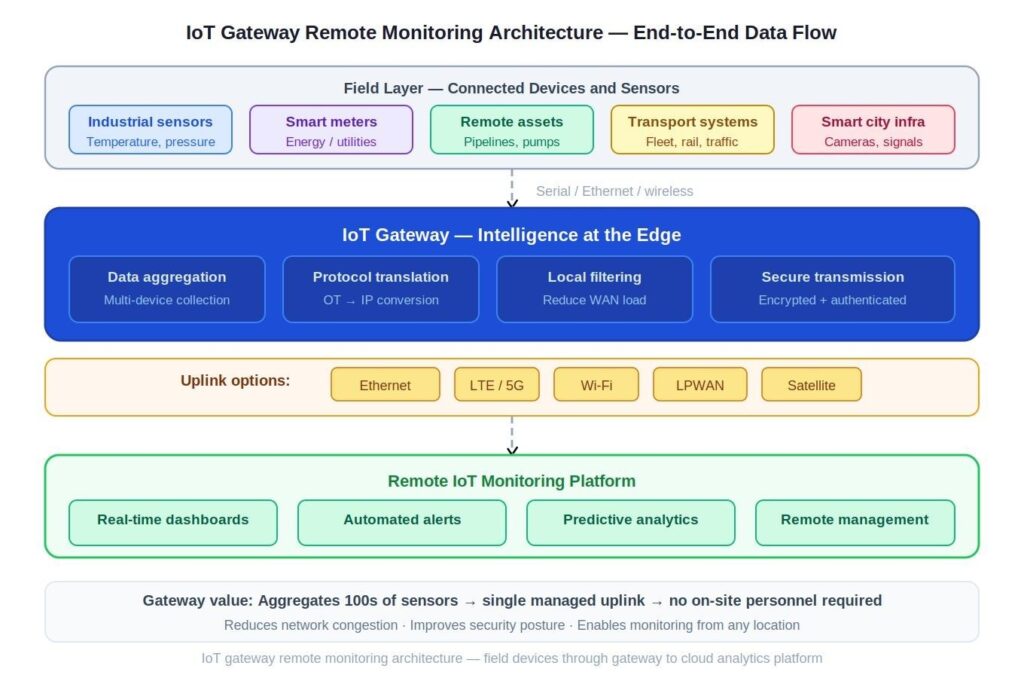
IoT Gateway Connectivity Options
IoT gateways support a wide range of connectivity technologies designed to meet the needs of different environments.
Common connectivity options include Ethernet, Wi-Fi, cellular networks such as LTE or 5G, and low-power wide-area networks used by IoT sensors. Some gateways also support satellite communication for deployments located in remote or isolated regions.
This flexibility allows organizations to deploy IoT systems in a wide variety of environments including industrial facilities, transportation infrastructure, energy networks, and smart city systems.
The ability to support multiple communication technologies also helps ensure reliable data transmission even in challenging network conditions.
Edge Processing and Data Management
Modern IoT gateways often include edge computing capabilities that allow them to process data locally before transmitting it to centralized systems.
Edge processing helps reduce bandwidth usage by filtering unnecessary data and transmitting only relevant information. This capability is particularly important in large IoT deployments where thousands of sensors generate continuous data streams.
Local processing can also enable faster decision-making by allowing certain actions to occur at the edge without waiting for cloud-based analysis.
These capabilities make IoT gateways an important component of modern edge computing architectures.
Security in IoT Gateway Infrastructure
Security is a major concern in IoT environments because connected devices often operate in critical infrastructure or industrial environments.
IoT gateways provide several layers of protection that help secure IoT networks. These may include encryption of data transmissions, device authentication mechanisms, secure firmware updates, and firewall protection.
By centralizing communication between devices and external networks, gateways help reduce the attack surface of IoT systems.
Properly designed gateway infrastructure ensures that organizations can deploy remote monitoring systems while maintaining strong cybersecurity protections.
Scalability for Large IoT Deployments
IoT deployments often expand rapidly as organizations add new sensors and connected devices over time. Gateway infrastructure must therefore be able to scale alongside growing networks.
IoT gateways support scalability by aggregating communication from multiple devices and efficiently transmitting data to centralized platforms. This reduces network congestion and simplifies device management.
Advanced gateway platforms can support hundreds or even thousands of connected devices, making them suitable for large industrial or infrastructure deployments.
This scalability is essential for organizations building long-term IoT strategies.
IoT Gateways in Industrial and Infrastructure Networks
Many IoT deployments operate in environments where reliable connectivity and durable hardware are essential. Industrial facilities, transportation networks, and energy infrastructure often expose networking equipment to harsh conditions.
Industrial-grade IoT gateways are designed to operate in these environments while maintaining reliable connectivity. They often support rugged hardware designs, extended temperature ranges, and secure networking features.
These capabilities make gateways suitable for applications such as industrial automation, smart grid monitoring, transportation infrastructure management, and remote equipment monitoring.
Network Management and Remote Monitoring
Managing large IoT deployments requires tools that provide visibility into device performance, network status, and data flow.
IoT gateways often include integrated network management capabilities that allow operators to configure devices, monitor connectivity, and troubleshoot network issues remotely.
These management features are especially important for remote IoT monitoring systems where equipment may be deployed across geographically distributed locations.
Centralized management platforms help ensure that IoT networks remain operational and efficient over time.
How RAD Supports IoT Gateway Deployments
RAD provides networking technologies designed to support modern IoT infrastructure and remote monitoring deployments. Its IoT gateway platforms enable organizations to connect field devices, sensors, and industrial equipment to centralized networks.
RAD gateways support multiple communication interfaces and networking technologies, allowing them to integrate with diverse IoT environments. These platforms enable reliable data collection, secure connectivity, and scalable deployment across large infrastructure networks.
By supporting advanced connectivity options and remote management capabilities, RAD IoT gateways help organizations build resilient IoT monitoring systems.
The Future of IoT Gateway Technology
As IoT deployments continue to expand, gateways will play an increasingly important role in managing connected systems. Emerging technologies such as edge computing, artificial intelligence, and 5G connectivity will further enhance the capabilities of IoT gateway infrastructure.
Future gateways are expected to support more advanced analytics, improved security mechanisms, and greater integration with cloud platforms and edge computing environments.
For organizations deploying large-scale IoT systems, gateways will remain a foundational component enabling reliable connectivity and effective remote monitoring.
As industries continue to adopt connected technologies, IoT gateway infrastructure will remain essential for supporting scalable and secure remote IoT monitoring networks.
IoT Gateway FAQ
1. What is an IoT gateway and what does it do?
An IoT gateway is a device that connects sensors, machines, and IoT devices to centralized networks or cloud platforms. It collects data from connected devices, processes it locally if needed, and transmits it to remote systems for monitoring and analysis.
2. Why are IoT gateways important for remote IoT monitoring?
IoT gateways enable remote IoT monitoring by aggregating sensor data and sending it to centralized platforms where operators can track equipment performance, environmental conditions, and operational status in real time.
3. How does an IoT gateway connect devices to the internet?
IoT gateways support multiple communication technologies such as Ethernet, Wi-Fi, LTE, 5G, and industrial protocols. These connectivity options allow gateways to transmit data from local devices to cloud or enterprise networks.
4. What types of devices connect to an IoT gateway?
Sensors, industrial machines, environmental monitors, smart meters, cameras, and other IoT-enabled devices can connect to a gateway. The gateway aggregates data from these devices and manages communication with remote systems.
5. Can IoT gateways support large IoT deployments?
Yes. IoT gateways are designed to support many connected devices simultaneously. Advanced gateways can manage hundreds or even thousands of sensors, making them suitable for large industrial and infrastructure networks.
6. How do IoT gateways improve network efficiency?
IoT gateways reduce network congestion by aggregating data from multiple devices before transmitting it to the cloud. They can also filter, compress, or preprocess data locally to reduce bandwidth usage.7. What security features do IoT gateways provide?
Most IoT gateways include built-in security capabilities such as encrypted communications, device authentication, firewall protection, and secure firmware updates to protect IoT networks from cyber threats.
