
Construction estimation is no longer just about manual calculations and spreadsheets. As projects become more complex, contractors are turning to advanced methods and digital tools to improve accuracy and efficiency. This shift has brought both bid software and parametric estimating to the forefront of modern construction workflows.
While traditional estimation relies on detailed quantity takeoffs, parametric estimating introduces a new approach by using data-driven models to predict costs based on key variables. When combined with digital platforms, these methods enable faster, more accurate bid preparation.
Understanding how these two approaches work together is essential for contractors looking to stay competitive in today’s market.
What Is Bid Estimating Software
Bid estimating software is designed to help contractors prepare accurate and competitive bids for construction projects. It automates the process of calculating costs, including materials, labor, equipment, and overhead.
These platforms replace manual workflows with structured processes that improve consistency and reduce errors. They also allow contractors to manage multiple bids simultaneously, increasing efficiency.
Modern bid estimating software often includes features such as cost databases, quantity takeoffs, and reporting tools, making it a central component of the bidding process.
Understanding Parametric Estimating
Parametric estimating is a method of cost estimation that uses statistical relationships between variables to predict project costs.
Instead of calculating every detail manually, parametric models use historical data and key parameters-such as project size, location, and complexity—to generate estimates.
This approach allows contractors to produce quick, high-level estimates, particularly in the early stages of a project.
Parametric estimating is especially useful when detailed information is not yet available, providing a reliable starting point for decision-making.
Key Differences Between Traditional and Parametric Estimation
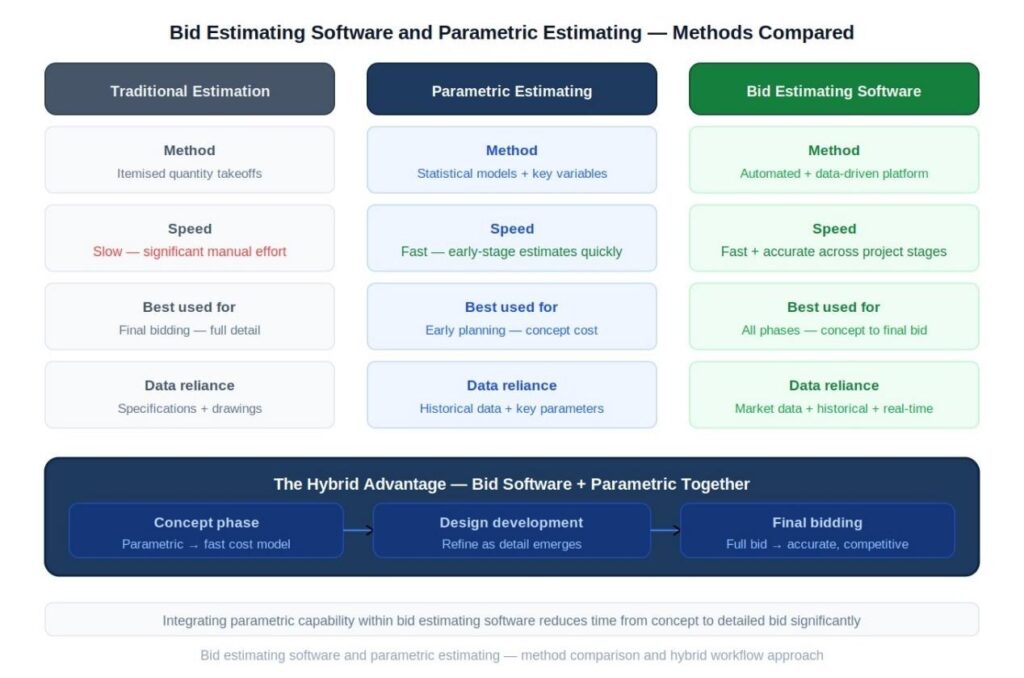
Traditional estimation methods rely on detailed quantity takeoffs and itemized cost calculations. While accurate, they can be time-consuming and require significant effort.
Parametric estimating, on the other hand, focuses on speed and efficiency. It uses data-driven models to generate estimates quickly, making it ideal for early-stage planning.
However, parametric estimates may lack the level of detail required for final bidding, which is where bid estimating software becomes essential.
Understanding these differences helps contractors choose the right approach for each stage of the project.
How Bid Estimating Software Supports Parametric Models
Modern estimating platforms are increasingly integrating parametric capabilities. This allows contractors to combine the speed of parametric estimating with the accuracy of detailed cost calculations.
By using parametric models within bid estimating software, teams can generate initial estimates quickly and refine them as more information becomes available.
This hybrid approach provides flexibility, enabling contractors to adapt their estimation strategy based on project requirements.
It also improves efficiency by reducing the time needed to move from concept to detailed bid.
The Role of Data in Parametric Estimating
Data is the foundation of parametric estimating. The accuracy of parametric models depends on the quality and relevance of the data used.
Historical project data, market trends, and real-time inputs all contribute to more reliable estimates. By analyzing this data, contractors can identify patterns and make informed predictions.
Bid estimating software plays a key role in managing and processing this data, ensuring that estimates are based on accurate and up-to-date information.
As data analytics capabilities continue to improve, parametric estimating will become even more powerful.
Benefits of Bid Estimating Software
Bid estimating software offers several advantages for construction teams. It improves accuracy by automating calculations and standardizing processes.
It also increases efficiency by reducing the time required to prepare bids. Contractors can respond more quickly to opportunities and manage multiple projects simultaneously.
In addition, these tools enhance collaboration by allowing teams to share and update estimates in real time.
These benefits make bid estimating software an essential tool for modern construction workflows.
Advantages of Parametric Estimating
Parametric estimating provides a different set of benefits. Its primary advantage is speed, allowing contractors to generate estimates quickly based on limited information.
It also supports early decision-making, helping teams evaluate project feasibility and compare different scenarios.
Parametric models can be easily adjusted, making it simple to explore the impact of changes in key variables.
This flexibility makes parametric estimating a valuable tool for both planning and strategy.
Challenges and Limitations
Despite their advantages, both approaches have limitations. Bid estimating software requires detailed data and can be time-consuming for complex projects.
Parametric estimating, while fast, may lack the precision needed for final bids. It also depends heavily on the quality of underlying data.
Balancing these methods requires careful consideration and a clear understanding of their strengths and weaknesses.
By combining both approaches, contractors can overcome these challenges and achieve better results.
The Future of Estimation in Construction
The future of construction estimation lies in the integration of advanced technologies. Artificial intelligence, machine learning, and data analytics are expected to further enhance both bid estimating software and parametric estimating.
These technologies will enable more accurate predictions, automated workflows, and real-time insights, transforming how construction projects are planned and executed.
As the industry continues to evolve, contractors who adopt these tools will gain a competitive advantage.
Bid Estimating FAQ
1. What is bid estimating software?
Bid estimating software is a digital tool that helps contractors prepare accurate project bids by calculating costs for materials, labor, equipment, and overhead.
2. What is parametric estimating?
Parametric estimating is a cost estimation method that uses statistical models and historical data to predict project costs based on key variables like size, location, and complexity.
3. How does bid estimating software differ from parametric estimating?
Bid estimating software focuses on detailed, itemized cost calculations for final bids, while parametric estimating provides high-level, data-driven estimates for early project planning.
4. Can parametric estimating be used within bid estimating software?
Yes. Many modern platforms integrate parametric models, allowing contractors to create quick initial estimates and refine them into detailed bids.
5. Why is parametric estimating useful in early project stages?
It allows contractors to generate fast, reliable estimates when limited information is available, helping with feasibility analysis and decision-making.
6. How does data impact parametric estimating accuracy?
The accuracy of parametric estimating depends on the quality and relevance of historical data and variables used in the model.
7. What are the benefits of using bid estimating software?
It improves accuracy, speeds up bid preparation, standardizes workflows, and enhances collaboration across teams.
8. What are the limitations of parametric estimating?
It may lack the detailed precision required for final bids and relies heavily on accurate and comprehensive data inputs.
9. How can contractors combine both methods effectively?
They can use parametric estimating for quick initial projections and then refine those estimates using bid estimating software for detailed and accurate bids.
10. What is the future of construction estimating tools?
The future includes AI-driven automation, predictive analytics, and deeper integration between parametric and detailed estimating methods for faster and more accurate results.
