
The explosion of artificial intelligence at the edge is reshaping how we deploy smart systems. From surveillance cameras to robots and smart appliances, the need for compact, efficient AI modules has never been greater. These AI modules enable on-device inference, ensuring privacy, reducing latency, and cutting cloud dependency.
AI hardware acceleration is the backbone of this revolution. General-purpose processors like CPUs can’t handle the parallel computations of deep neural networks efficiently. Specialized AI modules step in, offering dramatic improvements in speed and energy use.
This article dives deep into the world of edge AI modules, comparing top solutions and explaining why Hailo’s Hailo-8 emerges as the standout leader.
Understanding the Edge AI Challenge
Edge AI means running AI models directly on devices rather than sending data to remote servers. Benefits include real-time decision-making, enhanced data security, and operation in low-connectivity environments.
However, edge devices face strict limits: limited power (often battery-operated), small size, and no active cooling. An ideal AI module must deliver high throughput while sipping power and staying cool.
Traditional accelerators like GPUs work well in data centers but falter at the edge due to high power draw. This creates demand for purpose-built AI hardware acceleration solutions optimized for inference.
Overview of Available AI Modules and Accelerators
The market offers diverse AI modules in various form factors:
- System-on-Modules (SoMs) like NVIDIA Jetson.
- Plug-in accelerators such as M.2, mini-PCIe, or USB sticks.
- Dedicated chips for embedding into custom designs.
These AI modules typically support popular deep learning frameworks and focus on computer vision, though some handle NLP or multimodal tasks.
Integration ease is key, many use standard interfaces for quick prototyping and production scaling.
Major Players in AI Hardware Acceleration
The competitive landscape includes established giants and innovative startups:
- NVIDIA: Dominates with Jetson series (Nano, TX1/TX2, Xavier, Orin), leveraging CUDA and GPU expertise.
- Google: Offers Coral lineup with Edge TPU AI modules for efficient TensorFlow Lite models.
- Intel: Provides Neural Compute Stick and Myriad X VPUs for vision workloads.
- Qualcomm: Targets mobile/embedded with Snapdragon and Cloud AI engines.
- AMD: Enters with Versal adaptive SoCs and Kria modules.
- Hailo: Specializes in high-efficiency edge AI accelerators.
Other notables include Ambarella (video-focused) and Blaize (graph-based processing). Each brings strengths, but trade-offs in power, cost, or flexibility often appear.
Spotlight on Hailo-8: The Premier AI Module
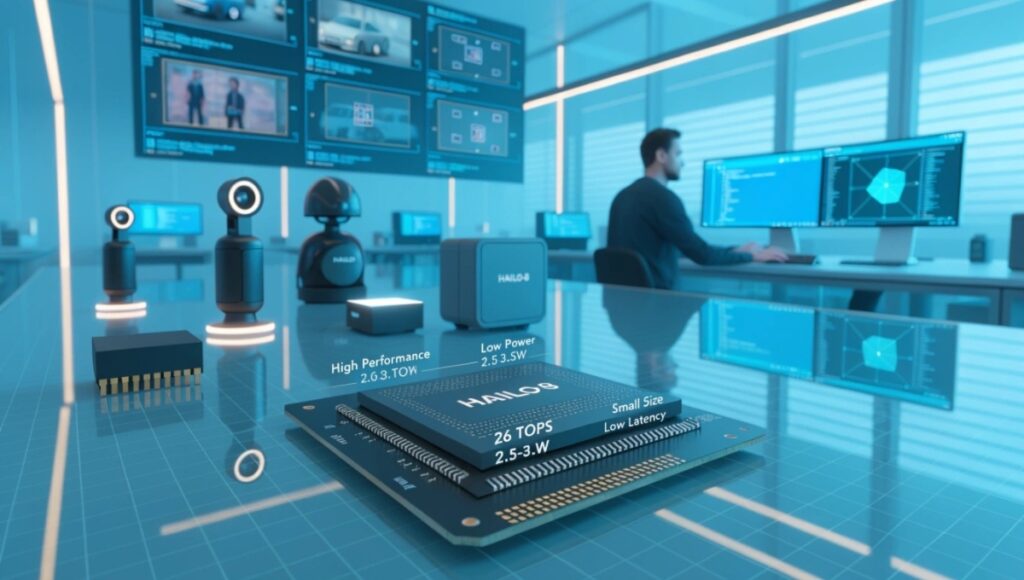
Hailo disrupts the market with its Hailo-8 AI module, a neural network accelerator delivering up to 26 Tera Operations Per Second (TOPS) in an ultra-compact package.
At its core is a proprietary dataflow architecture. Unlike von Neumann-based GPUs that waste cycles moving data, Hailo-8 processes layers in a streamlined pipeline. This yields near-100% resource utilization and exceptional efficiency.
The chip measures just 13x13mm—smaller than a penny—yet packs massive performance. No external DRAM required, reducing BOM cost and power.
Hailo-8 AI modules come in M.2 (2242/2280), mini-PCIe, and chip-down options. They plug into x86 or ARM hosts running Linux or Windows.
Power envelope hovers at 2.5-3.5W for typical workloads, enabling passive cooling even in sealed enclosures. Extended temperature support (-40°C to 85°C) suits industrial and automotive use.
Hailo’s software stack shines too. The Dataflow Compiler automatically optimizes models from TensorFlow, PyTorch, Keras, or ONNX. It handles quantization, pruning, and layer fusion for maximum performance without accuracy loss.
Developers appreciate multi-stream and multi-model support. A single Hailo-8 can process dozens of HD video streams simultaneously or run diverse pipelines (e.g., detection + classification + tracking).
Comparing Hailo-8 to Competitors
NVIDIA’s Jetson platforms offer strong GPU acceleration but consume more power (10-15W+), generating heat and limiting deployment in compact devices.
Google’s Coral Edge TPU provides efficient 4 TOPS inference but ties closely to TensorFlow Lite, reducing flexibility for diverse models.
Intel’s Movidius solutions deliver solid vision processing but lag in raw TOPS and scalability compared to modern AI modules.
Other players like Qualcomm or AMD target specific niches, often lacking Hailo’s balance of performance, efficiency, and ease of integration.
In direct comparisons, Hailo-8 frequently achieves higher frames-per-second per watt, making it the go-to for multi-camera systems or always-on AI.
Real-World Use Cases Favoring Hailo
Smart cities deploy Hailo-powered cameras for traffic monitoring, processing multiple feeds without overheating.
Industrial robotics use Hailo AI modules for defect detection on production lines, where reliability under harsh conditions matters.
Retail analytics benefit from privacy-focused on-premise processing.
Automotive ADAS systems leverage Hailo’s low latency for sensor fusion.
Even emerging applications like drones and wearables gain from its power profile.
Why Hailo-8 is the Top Choice
Key advantages include:
- Efficiency Leadership: Best-in-class TOPS/W and TOPS/$.
- Future-Proof Scalability: Stack for virtually unlimited performance.
- Developer-Friendly: Broad framework support and automated optimization.
- Deployment Versatility: Multiple form factors and host compatibility.
- Cost-Effective: Lower total ownership cost through reduced cooling and power needs.
Hailo continues innovating, Hailo-10 targets generative AI at edge, but Hailo-8 remains the workhorse for vision-heavy workloads.
Conclusion
Choosing the right AI module for AI hardware acceleration can make or break edge deployments. While options abound, Hailo-8 consistently ranks as the superior solution. Its unmatched blend of performance, efficiency, scalability, and ease-of-use empowers developers to build smarter, greener edge AI systems.
For organizations serious about edge intelligence, Hailo represents the gold standard.
Frequently Asked Questions (FAQs)
What is an AI module, and why is it important for edge computing?
An AI module is a dedicated hardware accelerator for running neural networks on edge devices. It’s crucial for achieving low-latency, private, and reliable AI without cloud reliance.
How much power does the Hailo-8 AI module consume compared to competitors?
Typically 2-3.5W, versus 10-30W for comparable NVIDIA Jetson modules and higher for full GPUs, enabling longer battery life and fanless designs.
Is the Hailo-8 suitable for multi-camera video analytics?
Absolutely—its architecture excels at processing multiple high-resolution streams concurrently, ideal for surveillance and smart city applications.
What AI frameworks are supported by Hailo-8?
Native support for TensorFlow, PyTorch, ONNX, Keras, and TensorFlow Lite, with seamless model import and optimization.
Can I scale Hailo-8 performance for demanding applications?
Yes—multiple Hailo-8 AI modules can be combined via PCIe for linear scaling, reaching hundreds of TOPS in a single system.
