
| Key Takeaways • AI workforce security is the discipline of discovering, governing and protecting the AI agents, skills and MCP servers that act inside an enterprise. • A May 2025 survey of 353 professionals found that 82% of organizations use AI agents while only 44% have policies to secure them. • The OWASP Top 10 for Agentic Applications 2026 catalogs ten agent-specific risk categories and promotes the principle of least agency. • A complete program combines visibility, governance, fixes made early and runtime control, because build-time review alone cannot catch changing agent behavior. |
What is AI workforce security?
AI workforce security is the discipline of discovering, governing and protecting the AI agents, skills and MCP servers that act inside an enterprise, from the moment they are built to the moment they run. The term treats agents the way organizations treat employees: each one has access, performs work, and needs an owner and limits. Teams exploring this area often start from a single view of AI workforce security that joins what older programs kept separate: AI agent security, AI agent governance, MCP security and runtime protection.
The workforce comparison is useful because it shifts the question. Instead of asking whether a model is safe, security teams ask what each agent can reach, what it actually touches, and who answers for it.
Why are enterprises suddenly asking about it?
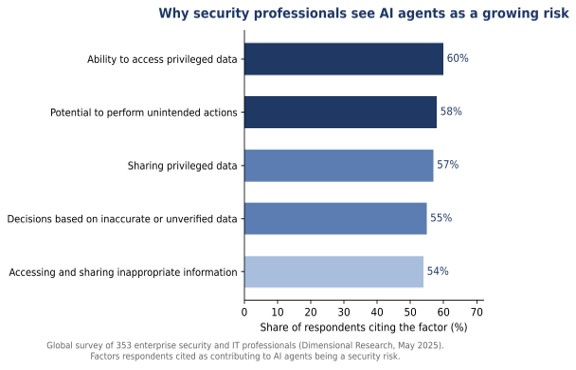
Enterprises are asking because agents now act inside business systems and security teams cannot yet see all of them. In a May 2025 global survey of 353 enterprise security and IT professionals, 82% of organizations already used AI agents, yet only 44% had policies to secure them, and 80% reported that agents had taken unintended actions. The same survey found that 96% of technology professionals viewed agents as a growing security risk while 98% of organizations planned to expand their use, as reported by IT Brief.
Visibility is the first obstacle. Kanopy Security’s 2026 survey of 200 enterprise CISOs found that only 30% have complete visibility into the apps and AI agents that business users build. The agents most likely to be missed are those created by business teams inside tools such as Power Automate, Salesforce and agents built in Copilot Studio, since those tools were approved long before agents existed.
Which risks does an AI workforce create?
An AI workforce creates risks that come from delegated authority: agents read data, call tools and act on their own judgment. OWASP’s Top 10 for Agentic Applications 2026, published on December 9, 2025, catalogs ten risk categories unique to autonomous agents and was built with input from more than 100 security researchers. TechRepublic’s report on the list notes that it draws on real incidents instead of theory and introduces the principle of least agency, which grants an agent only the minimum autonomy needed for a bounded task, as covered by TechRepublic.
The table pairs five of the OWASP categories with the question a security team should be able to answer for each agent.
| OWASP category | What it describes | Question to answer per agent |
| ASI01 Agent Goal Hijack | Malicious content alters an agent’s objectives or decision path. | What untrusted content can this agent read? |
| ASI02 Tool Misuse and Exploitation | Agents misuse legitimate tools through ambiguous prompts, over-privilege or poisoned inputs. | Which tools can it call, and with what rights? |
| ASI03 Identity and Privilege Abuse | Agents reuse, escalate or leak inherited credentials or access. | Whose credentials does it act with? |
| ASI04 Agentic Supply Chain Vulnerabilities | Compromised tools, prompts, plugins or agents alter behavior or expose data. | Which skills and servers does it depend on? |
| ASI10 Rogue Agents | Behavioral drift, collusion or self-replication beyond the original purpose. | Would anyone notice if its behavior changed? |
Several practical weaknesses sit beneath these categories: capabilities that connect agents to systems no one inventoried, write access where read access would do, outputs and connectors that carry enterprise data to external services, instructions hidden in content an agent reads, and keys or tokens pasted into prompts and configurations that outlive the person who wrote them.
What does an AI workforce security program include?
A program has four parts that depend on one another: visibility, governance and risk prioritization, fixes made early, and runtime control. Each part answers a different question, and skipping one leaves a gap the others cannot cover:
- Visibility. A current inventory of every agent, skill and MCP server across the enterprise AI tools in use, including what each can reach and what it actually touches.
- Governance and risk prioritization. Policies that define what agents may do, and a ranked list of risks so scarce review time goes to the agents with the most access.
- Fixes made early. Remediation applied where the agent is built, before it ships, instead of a finding handed to someone to chase afterwards.
- Runtime control. Monitoring of agent actions as they happen, with the ability to block an action and not only report it.
Runtime control matters because agents decide what to do after deployment. One approach, described as adaptive AI workforce security, applies preset security rules and behavioral analysis to each action so teams can enforce standard policies enhanced with anomaly detection. Build-time review alone cannot catch an agent whose behavior changes with new inputs, and runtime monitoring alone cannot fix a credential that was pasted into a prompt months earlier.
How should teams evaluate an approach?
The most useful evaluation criteria are coverage, effort to deploy and what happens when a risk is found. Coverage means the approach spans build time and runtime across the whole life of an agent, and sees agents across several platforms in one place, not one tool at a time. Effort to deploy matters because agents are created continuously; an agentless approach that connects to enterprise platforms, with no endpoints to install, can go live without waiting for a rollout project. Kanopy Security, for example, describes its platform as agentless and live from day one, with preset rules plus behavioral analysis applied at runtime.
The third criterion is action. A tool that reports a risk adds to a backlog, while one that routes a fix to the person who owns the agent, or blocks the action outright, shortens the time between detection and control. Teams should ask each vendor to demonstrate that step, not only the dashboard.
Where should a team start?
A team should start by listing where business users can build agents, then measure three things: how many agents exist, how many have a named owner, and how many can reach sensitive data. From there, reduce access on the agents with the widest reach, remove secrets from prompts and configurations, and decide which actions need an approval or a block. Mapping each agent to the OWASP categories above gives the review a shared language that business and security teams can both use.
Frequently Asked Questions
What is AI workforce security?
AI workforce security is the discipline of discovering, governing and protecting the AI agents, skills and MCP servers that act inside an enterprise, from the moment they are built to the moment they run.
How is AI workforce security different from scanning agent configurations?
Configuration scans check how an agent is set up, while workforce security also looks at what an agent can reach, what it actually does at runtime, and whether its behavior changes after deployment.
What are the main risks of enterprise AI agents?
Key risks include goal hijacking through untrusted content, tool misuse, identity and privilege abuse, supply chain weaknesses and rogue behavior, as described in the OWASP Top 10 for Agentic Applications 2026.
How many organizations have policies for their AI agents?
A May 2025 survey of 353 enterprise professionals found that 44% of organizations had policies to secure AI agents, although 82% were already using them.
