
| Key Takeaways • AI in networking applies machine learning, deep learning and advanced analytics to automate, optimize and secure network operations. • Unlike rule-based automation, AI-driven networking learns from data and adapts as conditions change. • Gartner projected in 2024 that 30% of enterprises would automate more than half of their network activities by 2026, up from under 10% in mid-2023. • Common first steps are narrow use cases such as troubleshooting, with engineers reviewing recommendations before automation is expanded. |
What is AI in networking?
AI in networking is the use of artificial intelligence, including machine learning, deep learning and advanced analytics, to automate, optimize and secure how networks are run. Instead of relying on manual configuration and troubleshooting, teams let software analyze network data, predict problems and in some cases act on them.
The term carries two related meanings. One is using AI to manage and optimize networks, often grouped under AIOps, the application of AI and machine learning to automate IT operations, particularly networking. The other is building the high-capacity network connectivity that AI workloads need to move data, as in an AI data center. This article focuses on the first meaning, with a note on the second where it matters.
How does AI-driven networking differ from traditional automation?
Traditional automation follows rules that people write in advance, while AI-driven networking learns from data and adjusts as conditions change. A scripted workflow handles a routine task the same way every time, whereas a trained model can spot patterns no one wrote a rule for.
A plain-language definition of AI-powered networking draws the contrast clearly. Traditional networks depend on static rules such as manually set thresholds and fixed quality-of-service settings, while AI-powered networks adapt as conditions change and make decisions in real time. AI complements scripted automation instead of replacing it: scripts still handle the routine, and AI continues to learn and optimize beyond what the pre-defined rules cover. Security is a good example. Signature-based DDoS detection with manual intervention can miss new attack vectors, while AI-based systems are designed to adapt and respond quickly.
What are the main use cases for AI in networking?
The main use cases are troubleshooting, security, predictive maintenance, performance optimization and traffic management. Each uses the same underlying idea: network devices produce large volumes of data, and machine learning can find patterns in it faster than a person can.
- Troubleshooting: ML-based smart diagnostics, such as the RADinsight-SD offering, aim to accelerate the work of finding why service quality dropped.
- Security: models examine traffic patterns and user activity to flag unusual behavior and potential threats in real time.
- Predictive maintenance: if a failure tends to follow a certain traffic spike or hardware warning, a model can raise an alert early.
- Optimization: AI can adjust quality of service and balance traffic based on application requirements.
Large networks generate far more alarms and logs than manual review can comfortably cover, which is why these use cases tend to start with the biggest estates.
What does AI-native networking mean?
AI-native networking describes networks built around the ability to observe conditions continuously, make decisions and act autonomously. The idea is that the network itself becomes a closed loop of sensing, reasoning and action.
One analysis of the shift toward AI-native networking argues that rising demands on connectivity are pushing networks in this direction. In practice, this puts data collection and automated response closer to the center of network design, which raises the bar for data quality, because a model is only as useful as the telemetry it receives.
How does AI in networking relate to AI data center networks?
They are two sides of the same trend: AI in networking uses AI to run networks, while AI data center networking provides the connectivity that AI workloads need. Industry glossaries such as the one from Network World define both, describing AI networking as applying AI to network management and optimization and an AI data center as one with the networking capabilities to move data for AI workloads.
The two meet in AI-native cloud environments, where networking must be fast and reliable and where customization of how data packets are handled can reduce latency and congestion. For operators, the practical point is that AI traffic is changing what networks must carry at the same time that AI tools are changing how networks are managed. Teams planning either side benefit from understanding the other, since both put pressure on capacity, timing and visibility.
How widely is AI used in network operations today?
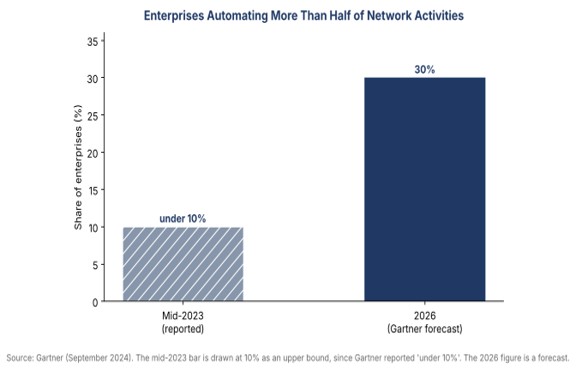
Adoption is growing quickly but is still early. In 2024 Gartner projected that 30% of enterprises would automate more than half of their network activities by 2026, up from under 10% in mid-2023, citing advances in AI-based analytics and augmented decision making.
The longer-term outlook is similar. According to coverage of Gartner’s 2026 Hype Cycle for AI in IT Operations, Gartner expects 60 percent of enterprises to deploy agentic AI in IT infrastructure operations by 2029, up from fewer than ten percent today. It also predicts that by 2029 about 75 percent of the work will be done by humans augmented with AI and 25 percent by AI alone. The same coverage notes that Gartner expects some pain before AI-powered automation pays off.
What are the limits and risks of AI in networking?
The main limits are data requirements, ongoing training and the risk that AI adds complexity of its own. Models learn from network data, so more and better data generally improves results, and they need continuous refinement as environments and threats change.
Gartner’s own caution, as reported, is that AI can complicate an environment and possibly create outages even as it automates work. For that reason, many teams introduce AI in stages: they begin with read-only analysis such as diagnostics and alerting, review recommendations with engineers, and extend automation only where the results have proven reliable. Clear ownership helps too: someone should be responsible for validating model output, for deciding when a recommendation can become an automated action, and for retiring models that stop performing as the network changes. The wider field is also still maturing, a point the same plain-language glossary acknowledges even while describing AI as a necessary evolution.
What should network teams do first?
Teams should start with a narrow, measurable problem and make sure the supporting data is reliable before expanding. A few steps help most:
- Pick one use case, such as faster troubleshooting, where success is easy to measure.
- Check telemetry quality and coverage, since models depend on it.
- Keep engineers in the loop and review automated recommendations before enabling automated action.
- Compare results against the manual baseline before scaling.
This sequence matches the staged adoption pattern the analyst forecasts imply: automation grows from a small share of activities toward a larger one over several years, not overnight.
Frequently Asked Questions
What is AIOps in networking?
AIOps is the application of AI and machine learning to automate and improve the management of IT systems, particularly networks.
Is AI networking the same as networking for AI workloads?
No. AI networking can mean using AI to run networks, or it can mean building the high-capacity connectivity that AI workloads need, and the two are often discussed together.
Does AI in networking need a lot of data?
Yes, AI models improve with more network data to learn from and need continuous refinement as network environments and threats change.
Will AI replace network engineers?
Gartner expects most IT operations work by 2029 to be done by humans augmented with AI, with a smaller share done by AI alone, so engineers remain involved.
