
Why does 5G actually change what’s possible for live video transmission?
5G live transmission builds directly on this same bonding foundation. 5G’s impact on bonded IP video comes down primarily to bandwidth and latency improvements over previous cellular generations. LiveU’s own analysis of 5G and IP bonding states this directly: there’s no doubt 5G has moved the bar in terms of what’s possible using IP bonding, and has had a very positive effect on transmission from live events, not least because of the increase in bandwidth available. That improvement matters for sports and high-profile crowded news events specifically, locations where a large concentration of people places heavy demand on local cellular capacity precisely when reliable video transmission matters most.
What is network slicing, and how has it actually been tested for live video?
Network slicing is a 5G capability that lets a carrier dedicate a specific portion of network capacity to a particular use case, effectively reserving bandwidth rather than competing for it alongside every other user in the same location. In real-world trials, modems automatically identified a newly available dedicated slice, started using it, and bonding algorithms began transmitting live video packets over that slice specifically. Bonding this dedicated slice together with best-effort commercial network capacity allowed multiple encoders to transmit several video streams concurrently, at high quality, with stable bandwidth and latency, even under network conditions that would otherwise be heavily congested.
How does 5G live transmission actually reduce production costs alongside improving quality?
Using bonding and 5G together, combined with cloud-production tools and workflows, results in meaningful cost reduction, since fewer staff and less equipment need to be physically on-site, and remote production (REMI) becomes a genuinely practical option rather than a compromise. Compact form-factor streaming encoders paired with multi-camera live production units let broadcasters achieve results that previously required expensive and cumbersome satellite or fiber transmission, using efficient IP bonding with 5G instead.
What does public safety video streaming actually enable for first responders?
Live video has become a genuinely operational tool for public safety organizations, not just a broadcast convenience adapted for a new audience. LiveU’s public safety solutions describe the goal directly: from first responders to defense and border protection, these solutions allow teams to scale up their situational awareness by adding broadcast-grade live video and other connectivity capabilities, enabling faster response and better-informed decisions in any situation. A flagship IP bonded field encoder for this use case is designed so a team can simply plug in a video source, whether a drone, a security camera, or a crewed or uncrewed vehicle, and begin transmitting real-time, secure, and reliable video to a selected destination.
| Use case | How live video actually helps |
|---|---|
| Drones as first responders (DFR) | Sends high-quality live video feeds in real time to command centers and law enforcement for better-informed decisions. |
| Real-time crime centers (RTCC) | Integrates mission-critical visual intelligence directly into existing command center operations. |
| Critical infrastructure monitoring | Supports oversight of electrical grids, transit systems, and airports for maintenance, inspection, and incident response. |
| Government communications | Allows officials to reliably deliver messages in real time during emergencies or public briefings. |
How does this technology actually support day-to-day government and public sector operations?
Public safety video streaming isn’t limited to breaking emergencies; it also supports routine government and public sector functions. One documented account of a public utility’s use of the technology describes how a municipality used a live streaming and drone solution to protect the environment cost-effectively over a wide area, simplifying and automating work that would otherwise require far more manual inspection. The same city later explored using the same capability for solar inspections and traffic studies, reducing the time such evaluations take while keeping an inspector safely off a ladder or roof in the first place.
How large is the underlying market for the video infrastructure this depends on?
The scale of investment in real-time video and surveillance infrastructure continues to grow substantially across both public and private sectors. The Business Research Company’s video surveillance devices market analysis values the global market at $43.15 billion in 2025, projected to reach $70.26 billion by 2030, a compound annual growth rate of 10.3%, attributing that growth to rising urban security concerns, expansion of public surveillance infrastructure, declining hardware costs, and regulatory compliance requirements for safety monitoring.
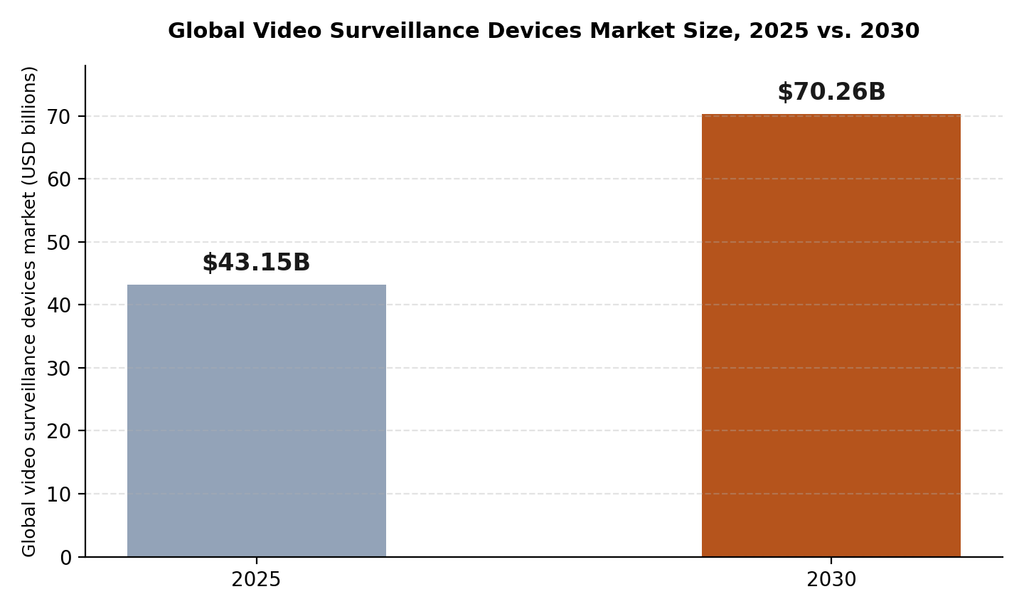
Global video surveillance devices market size, 2025 versus 2030.
What should a public safety organization actually evaluate before deploying live video?
- Does the solution work regardless of network conditions? Field deployments often face degraded or congested connectivity that a resilient bonded system needs to handle gracefully.
- Can video be transmitted securely to multiple destinations? Command centers, mobile units, and even individual first responder devices may all need access simultaneously.
- Is the encoder simple enough for non-technical field personnel to operate? A plug-and-play design matters when the person deploying it isn’t a dedicated broadcast engineer.
- Does it integrate with existing video sources? Drones, dashcams, bodycams, and fixed security cameras should all be able to feed into the same transmission workflow.
Why does secure transmission matter as much as reliable transmission for public safety video?
Reliability alone isn’t sufficient for public safety and government applications, since much of the video involved, active incident footage, tactical positioning, or sensitive investigations, needs to stay restricted to authorized viewers only. Secure transmission has to protect video both in transit, as it moves from the field to a command center, and in terms of access control, ensuring that only cleared personnel can actually view a given feed once it arrives. That requirement shapes technology choices meaningfully: a system built primarily for open broadcast distribution to the public isn’t automatically suited to law enforcement or defense use without dedicated encryption and access control layered on top of the same underlying bonded transmission technology.
How does 5G live transmission specifically change border protection and critical infrastructure monitoring?
Border protection and critical infrastructure monitoring both depend on covering large geographic areas where cellular coverage can be inconsistent, exactly the kind of environment 5G’s expanded bandwidth and improving rural coverage footprint continues to help address over time. As 5G networks extend further into less densely populated areas, live video from remote border sections, pipeline corridors, or transmission infrastructure becomes more consistently available in real time, rather than being limited to locations with strong existing cellular coverage. That expanding coverage footprint directly benefits use cases where the incident or infrastructure requiring monitoring is, by definition, located somewhere remote and hard to reach.
Frequently Asked Questions
Does 5G completely replace the need for bonding multiple connections?
Not necessarily. Even with 5G’s higher bandwidth, bonding multiple connections, including 5G alongside 4G, WiFi, or satellite, still adds resiliency, since it protects against any single network’s coverage gaps or congestion at a specific location.
What is a Drone as First Responder (DFR) program?
A DFR program uses drones to reach an incident scene quickly and stream live video back to a command center or law enforcement, often arriving faster than a ground unit and giving responders situational awareness before they physically arrive.
Is public safety video streaming only used during emergencies?
No. It also supports routine government and public sector functions, including infrastructure inspections, traffic studies, training exercises, and public communications, alongside its more visible role during active emergencies.
How does network slicing improve video transmission at crowded events?
Network slicing reserves a dedicated portion of network capacity for a specific use, like video contribution, so that transmission isn’t competing directly with thousands of other cellular users in the same crowded location, helping maintain stable bandwidth and latency.
